


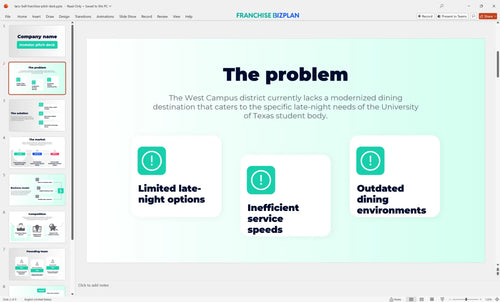
Problem
Defines market pain



This comprehensive template includes 13 essential building blocks covering everything from capital expenditure to five-year financial projections for a high-volume quick service operation.
Defines market pain
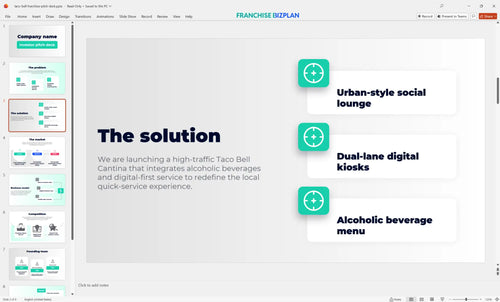
Explains your fix
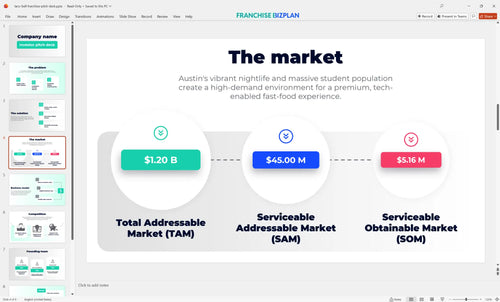
Quantifies opportunity size
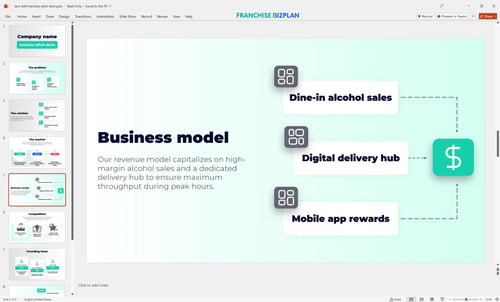
Shows revenue engine
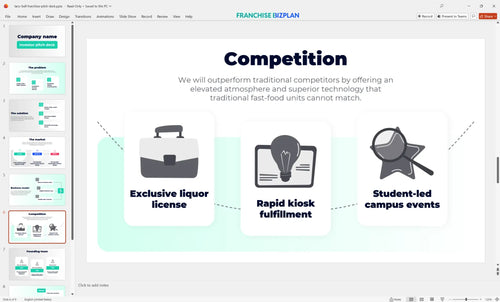
Highlights competitive edge
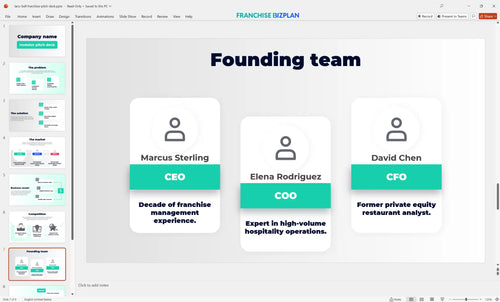
Proves operator credibility
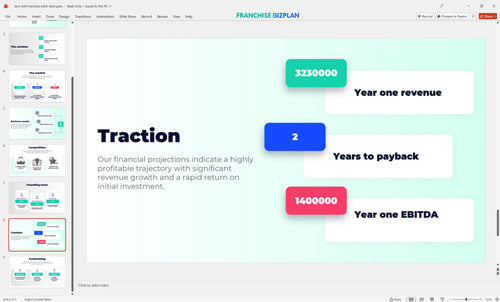
Demonstrates market momentum
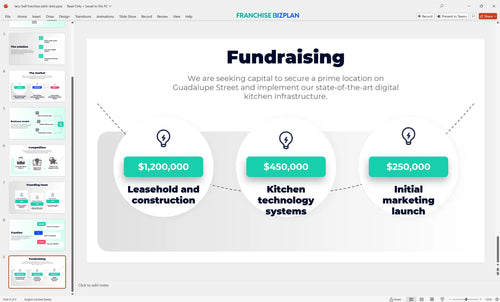
Details capital use
We developed this franchise unit financial model and pitch deck using deep-dive research into high-volume urban QSR operations. Every slide is pre-populated with specific data, such as the $1.42 million initial investment and the projected 8% internal rate of return, so you can present a credible case to partners immediately. This sample investor presentation for quick service restaurant is fully editable in Microsoft PowerPoint, allowing you to tailor the $20,000 monthly rent or staffing plans to your specific site.
Local customers in high-density areas need a social dining hub that offers both speed and an elevated experience with alcohol. This unit fills the gap between slow sit-down bars and basic fast food by providing a modernized lounge atmosphere that fits the student lifestyle.
This unit offers a unique format that combines traditional menu favorites with alcoholic beverages and an open-kitchen design. It defintely beats local competitors by using dual-lane digital kiosks to maximize throughput while maintaining a social hub vibe that builds long-term loyalty.
The primary target is the local university population and urban residents seeking affordable, late-night dining and social spaces. With a year-one revenue target of $3.23 million, the high volume fast food restaurant business model is designed to capture significant market share in dense urban corridors.
Revenue comes from four main streams, led by $1.4 million in food sales and $440,000 in alcohol in the first year. This fast food franchise business plan maintains a strong store-level margin by keeping food ingredients at 13% and packaging at 1.8% of total sales, even after paying a 5.5% royalty.
Main competitors include local bars and traditional fast-food chains, but this unit wins through its specialized delivery hub and liquor license. This combination creates a defensible edge in quick service restaurant operations by serving two distinct customer needs-speed and social experience-under one roof.
Total funding must cover the $45,000 franchise fee and $750,000 in leasehold improvements to reach the March 2026 breakeven. Key milestones in the fast food franchise operational plan template include completing the $220,000 kitchen equipment install and hitting the 2-year payback target through the capital expenditure budget.
Finance: update unit break-even and payback model by Friday.
This franchise pitch deck template is a pre-structured tool designed to help you secure funding without starting from scratch. It comes pre-populated with researched data for a high-volume quick service restaurant, allowing you to swap in your specific location details or local market case in minutes. Since it is PowerPoint-ready, you can easily adjust the $1.42 million capital expenditure budget or the 2-year payback timeline to fit your specific territory needs. How to write a pitch deck for a franchise unit becomes a simple task of refining these existing slides to match your local vision.

Showing investors exactly how the unit generates cash is critical for any restaurant investment presentation. This template breaks down four distinct streams: food sales, alcohol, drinks, and delivery, which combine for a projected $3.23 million in year one. It simplifies the unit economics analysis by mapping out how a 13% food cost and 5.5% royalty fee impact the bottom line, making the path to a March 2026 breakeven date clear. This financial projection template for restaurant franchise ensures your numbers are grounded in operational reality.

Success in a modern urban restaurant franchise business plan depends on dominating a specific trade area, like a high-density campus district. The deck provides structured slides to analyze local demand from students and nightlife participants who want both speed and a social atmosphere. By defining your competitive landscape and positioning logic, you can explain why your dual-lane kiosks and specialized delivery hub will outperform traditional local alternatives. Use this franchise development plan to prove your site selection is based on real demand density.

A clean restaurant startup pitch deck template for investors needs to look as professional as the brand you are representing. We have organized these slides to follow a logical story flow, moving from the $45,000 franchise fee to the projected $1.4 million year-one EBITDA. You don't need design skills to present a high-quality franchise expansion pitch deck for lenders that highlights your $750,000 leasehold improvement plan with precision. This restaurant franchise deck template ensures your visual presentation matches the quality of your financial data.

This slide helps you articulate why this QSR franchise investment presentation slides stand out, focusing on a format that blends alcohol service with rapid food prep. It highlights the customer value angle of a social hub environment and the local differentiation provided by a liquor license and specialized staff. This section is vital for showing how the unit captures both the late-night crowd and high-volume delivery orders simultaneously. Learning how to present a restaurant franchise opportunity to investors starts with a clear, defensible value proposition.


Get instant access to your pitch deck by downloading the template in PowerPoint or Google Slides. Open it in your preferred software and start customizing immediately.

Easily personalize each slide by replacing the placeholder text with your business information, market insights, and key financial details, ensuring the deck aligns perfectly with your vision.

Review and adjust the financial slides to align with your revenue model, cost breakdown, and funding needs, ensuring investors receive a clear and professional financial overview.

Refine your presentation for clarity and impact, ensuring it tells a compelling story about your business, highlights your competitive edge, and makes a strong case for investment.