


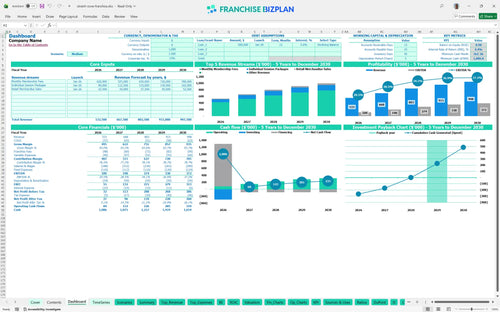
All-in-one Dashboard
Core inputs and core outputs



This franchise financial projection tool provides a complete 5-year outlook including startup costs, membership revenue streams, and detailed practitioner payroll for a wellness service unit.
Core inputs and core outputs
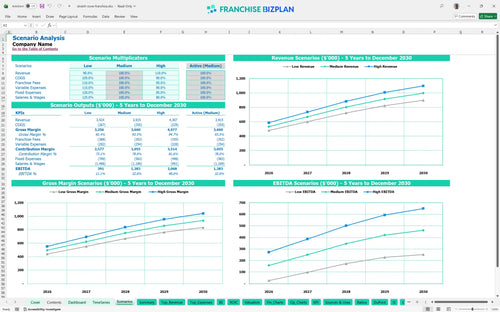
Three scenario analysis
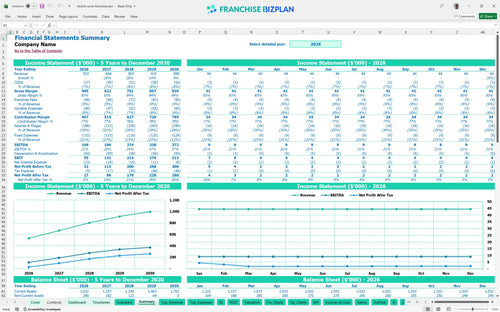
Presentation ready
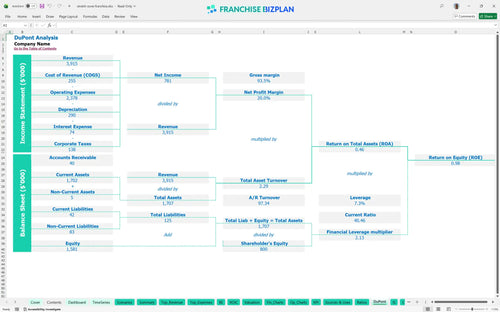
DuPont analysis
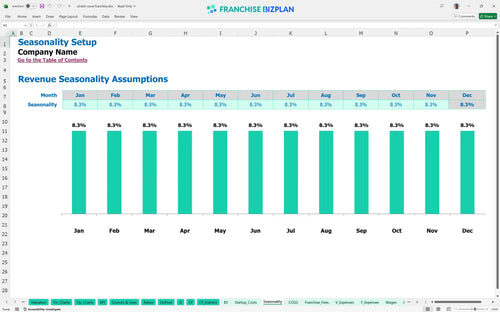
Researched revenue assumptions
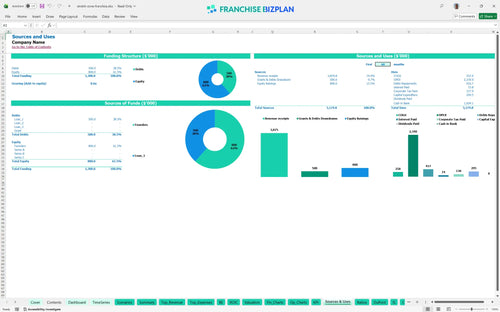
Lender-friendly financial outputs
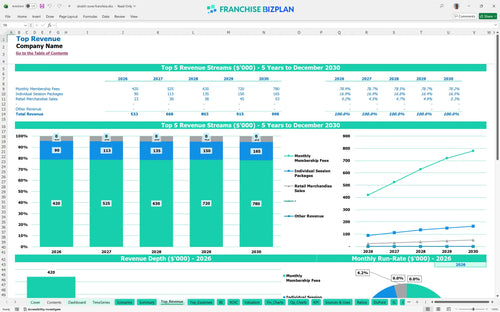
Revenue stream detailed view
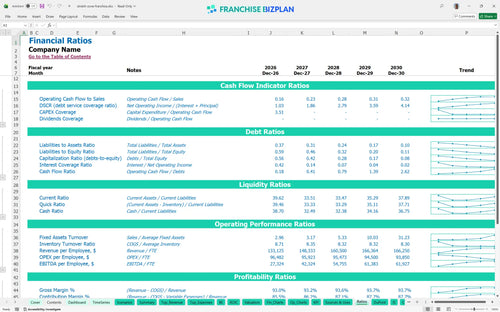
Performance metrics benchmark
We built this franchise unit financial model using our own research into the assisted-stretching market. Key assumptions, including the $59,500 franchise fee and the $7,500 monthly studio lease, are pre-populated and fully editable to match your specific territory. With Year 1 revenue starting at $533,000 and scaling to $998,000 by Year 5, this model helps you visualize the path from launch to a mature, high-volume studio.
Determining profitability for practitioner-assisted service businesses depends on membership conversion, and this unit shows positive EBITDA of $109,000 in its first year. After accounting for the 7% royalty and 2% marketing fees, the model projects net profit will continue to climb as revenue nearly doubles by Year 5. Efficiency in practitioner scheduling is the primary driver for bottom-line growth.
To launch this wellness unit in the US, you need approximately $294,500 in initial capital expenditure. This includes the $59,500 franchise fee and $120,000 for leasehold improvements to get the studio up to brand standards. The model also accounts for $80,000 in specialized equipment and tables, plus a $20,000 marketing launch to drive initial traffic.
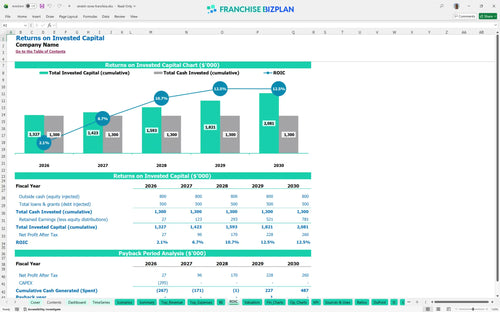
Based on our franchise investment feasibility study template, you can expect an Internal Rate of Return (IRR) of 4.41% and a Return on Equity (ROE) of 0.98. The payback period is estimated at 4 years, which is typical for a service-based model with significant upfront build-out costs. Steady growth in membership fees is the key to shortening this window.
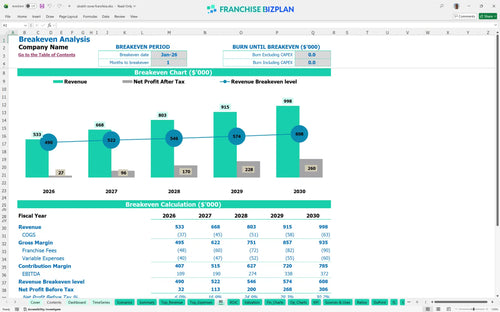
The model indicates a break-even date in January 2026, which is remarkably fast if you hit your Year 1 revenue target of $533,000. Break-even analysis shows that with $7,500 in monthly rent and a $55,000 manager salary, your primary lever is the volume of recurring monthly memberships. High fixed costs mean you defintely need to focus on local density and member retention from day one.
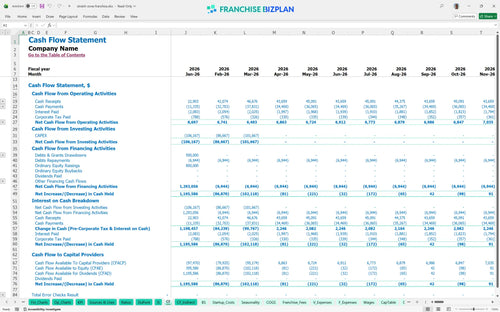
Using this franchise unit cash flow projection spreadsheet, the lowest cash point is identified in October 2026 at $1,006,000. This suggests a significant cash buffer is maintained, but you must still watch the timing of your $20,000 initial marketing spend. Estimating monthly recurring revenue for franchise models is critical to ensure your runway stays intact during the first 12 months of operation.
This financial model for fitness and recovery franchises allows you to test how a 10% drop in membership affects your 4-year payback. In the high-growth scenario, reaching $998,000 in Year 5 revenue significantly improves the IRR by leveraging the fixed studio lease. Financial planning for health and wellness studio franchises requires looking at these swings to ensure the unit remains viable during seasonal dips.
This franchise financial model template is built in Excel with open formulas, allowing you to adjust every variable from membership pricing to practitioner wages. You can easily swap out operating expenses or modify growth assumptions to see how local market shifts impact your bottom line. It is a flexible tool designed to handle the messy reality of unit-level planning without the rigid constraints of locked software.

Using this Excel template for franchise unit financial forecasting, you can map out your trajectory from a single-studio launch to a mature operation. The model generates pro forma financial statements that track your climb from $533,000 in Year 1 revenue to nearly $1 million by Year 5. It provides the long-term clarity needed to manage expectations with lenders or equity partners.

Preparing a financial plan for a new franchise location requires accounting for every percentage point that leaves the studio. This tool simplifies analyzing royalty fees and overhead in franchise units by automating the 7% royalty and 2% marketing fund calculations against your gross sales. It ensures you see the true net cash flow after the franchisor takes their cut.

Our franchise startup cost calculator aggregates your initial $59,500 franchise fee with leasehold improvements and equipment to show your total entry price. The break-even analysis then identifies the exact volume of stretching sessions required to cover your $7,500 monthly rent and fixed overhead. Knowing your floor helps you manage the risk of a slow ramp-up.

This model includes built-in logic for a franchise unit profitability analysis, comparing your projected labor and rent against wellness industry standards. With a Year 1 EBITDA of $109,000, you can see how your margins stack up against other boutique fitness concepts. It is a reality check for your operating assumptions before you sign a lease.


Simply purchase and download the financial model template, then access it instantly using Microsoft Excel or Google Sheets. No installation or technical expertise required-just open and start working.

Enter your business-specific numbers, including revenue projections, costs, and investment details. The pre-built formulas will automatically calculate financial insights, saving you time and effort.

Leverage the investor-ready format to confidently showcase your financial projections to banks, franchise representatives, or investors. Impress stakeholders with clear, data-driven insights and professional reports.

Leverage the investor-ready format to confidently present your projections to banks, franchise representatives, or investors.