


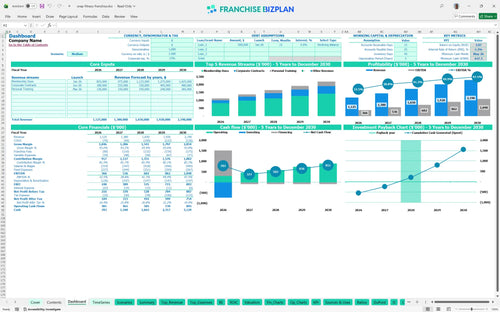
All-in-one Dashboard
Core inputs and core outputs



This small business financial projection for gym franchise includes detailed modules for CAPEX, payroll, and recurring revenue streams to ensure complete financial visibility.
Core inputs and core outputs
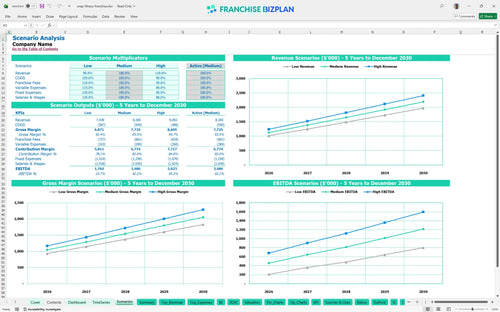
Three scenario analysis
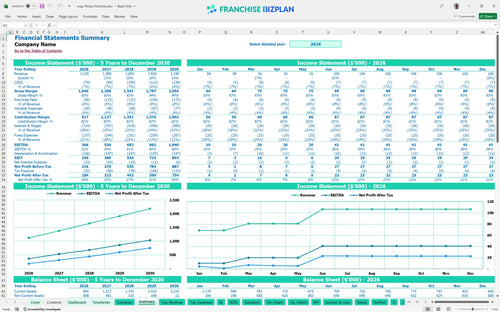
Presentation ready
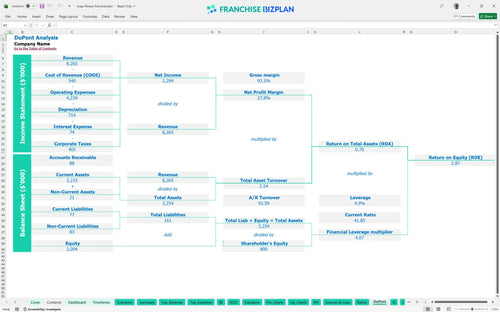
DuPont analysis
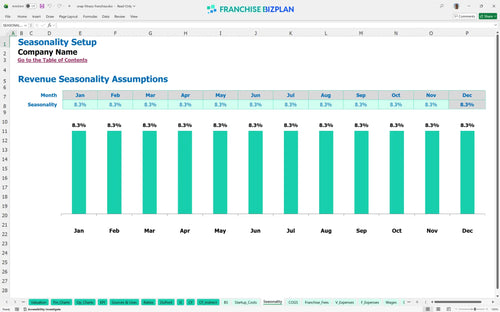
Researched revenue assumptions
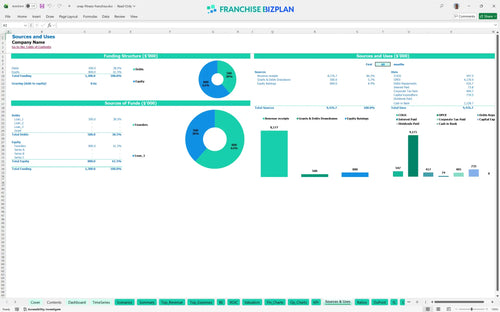
Lender-friendly financial outputs
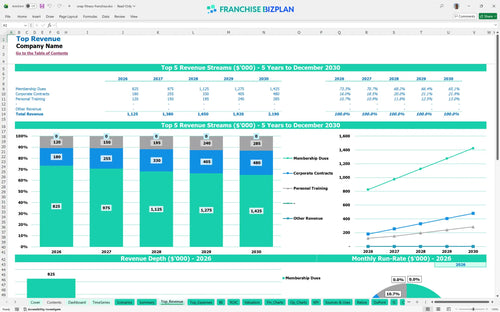
Revenue stream detailed view
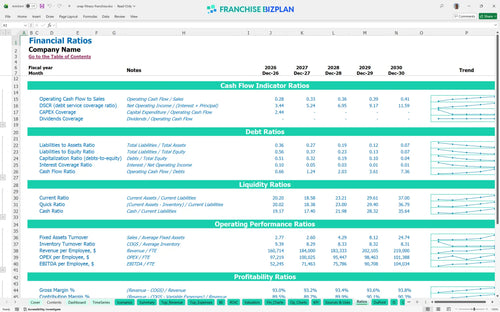
Performance metrics benchmark
We built this fitness franchise financial model using detailed research into boutique gym economics and franchise disclosure documents. Key assumptions, including the $39,500 franchise fee, $14,000 monthly rent, and Y1 EBITDA of $366,000, are pre-populated and fully editable to match your specific location. This model provides a credible, data-driven framework for any owner looking to forecast profitability for a new franchise location.
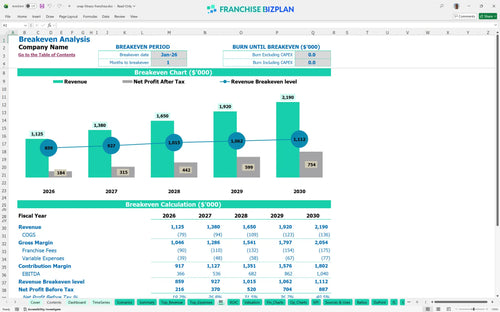
The unit is projected to reach its monthly break-even point in January 2026, just one month after launch. By year three, the fitness center profit and loss statement shows an EBITDA of $682,000 after accounting for all royalties and fixed costs. This rapid climb assumes you hit your membership targets and manage your $17,000+ monthly payroll efficiently.
You need a total initial investment that covers the $39,500 franchise fee and significant capital expenditure planning for equipment. The model suggests a minimum cash requirement of $627,000 to handle the build-out and the initial ramp-up phase. Here's the quick math: with $250,000 in leasehold improvements alone, your liquidity needs are highest in the first six months.
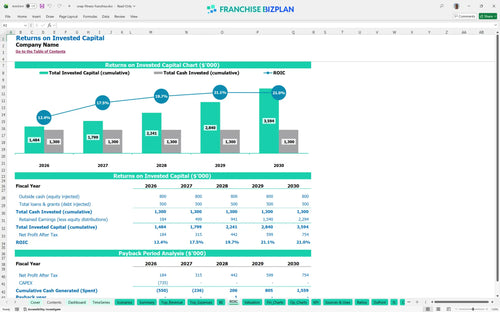
A franchisee can expect a 3-year payback period, which is a strong performance metric for a high-CAPEX fitness unit. The ROI analysis shows an internal rate of return (IRR) of 5.32% and a return on equity (ROE) of 2.87. While the initial returns are steady, the real value is in the year-5 EBITDA, which is projected to surpass $1M.
The monthly break-even point is achieved when revenue covers the $14,000 rent and the 8% total franchise and marketing fees. Your primary driver for reaching this point is membership volume, as fixed costs remain high regardless of foot traffic. Still, the high-margin personal training revenue helps bridge the gap during the early months of operation.
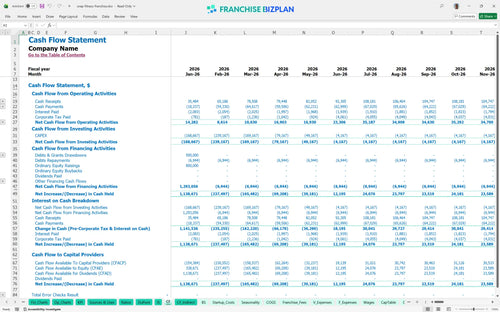
The lowest cash point occurs in May 2026, leaving you with a $627,000 buffer if you start with the recommended capital. You need at least six months of runway to account for the time it takes to finalize corporate contracts and ramp up personal training. If the build-out takes longer than planned, the working capital pressure will defintely increase quickly.
In a high-growth scenario, year-1 revenue of $1.125M can scale much faster, significantly improving your ROI analysis. However, in a low-growth case, the $14,000 monthly rent and fixed insurance costs can quickly erode your margins. Estimating monthly operating expenses for a boutique gym accurately across these scenarios is vital for risk management. To be fair, your success depends on local marketing execution more than any other variable.
Finance: update unit break-even and payback model by Friday.
This fitness franchise financial model is fully customizable in Excel, featuring pre-filled formulas and editable assumptions that allow you to adapt the numbers to your specific territory. You can easily adjust membership pricing, trainer commissions, and local rent to see how they impact your bottom line in real-time. It is a flexible Excel template for franchise investment analysis that takes the guesswork out of your financial planning.

Planning for long-term success requires a detailed franchise unit financial projection that looks beyond the first year of operations. This model provides a 5-year outlook, showing revenue growing from $1.125M to over $2.1M as you scale your membership base and corporate contracts. It helps you visualize the transition from a new gym to a mature, high-performing asset with stable cash flows.

Managing ongoing franchise royalty fees is essential for maintaining a healthy fitness center profit and loss statement. This model automatically calculates the 6% royalty and 2% marketing fund contributions based on your gross sales, so you always know your true net margin. It ensures you account for every dollar owed to the franchisor before you calculate your take-home pay.

Knowing how to calculate startup costs for a gym franchise is the first step to securing funding and managing your initial capital. This tool breaks down your $250,000 leasehold improvements and $220,000 equipment package to give you a clear break-even point calculation. You will see exactly how many memberships you need to sell to cover your $14,000 monthly rent and fixed overhead.

This model includes built-in benchmarks to help you sanity-check your operational expenses against industry standards for boutique fitness studios. If your fitness supplies or laundry costs exceed the typical 4-7% range, the model highlights the variance so you can adjust your strategy. It acts as a financial feasibility study for boutique fitness studios, ensuring your projections remain grounded in reality.


Simply purchase and download the financial model template, then access it instantly using Microsoft Excel or Google Sheets. No installation or technical expertise required-just open and start working.

Enter your business-specific numbers, including revenue projections, costs, and investment details. The pre-built formulas will automatically calculate financial insights, saving you time and effort.

Leverage the investor-ready format to confidently showcase your financial projections to banks, franchise representatives, or investors. Impress stakeholders with clear, data-driven insights and professional reports.

Leverage the investor-ready format to confidently present your projections to banks, franchise representatives, or investors.