


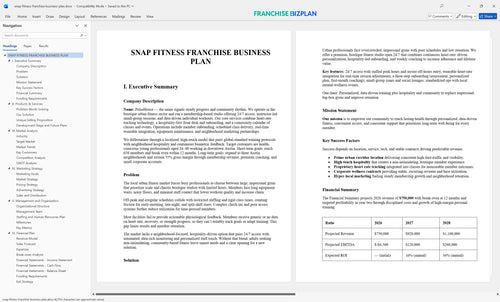
Executive Summary
Your concept at a glance



This product includes a fully editable Microsoft Word business plan and an Excel-based gym franchise financial projection spreadsheet to support your planning.
Your concept at a glance
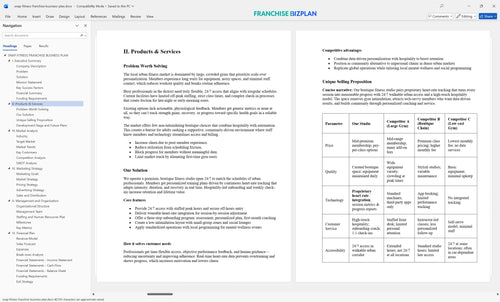
What you sell and why
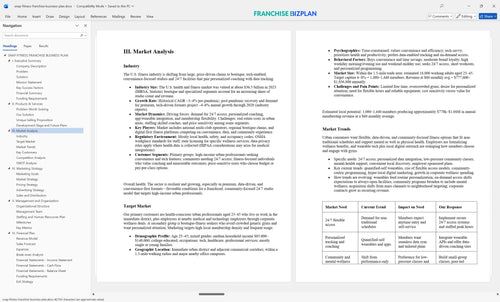
Market size and rivals
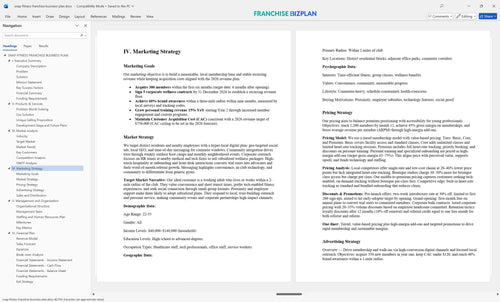
Channels, promotions, conversions
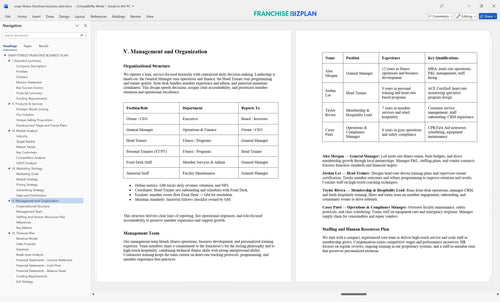
Team roles and org chart
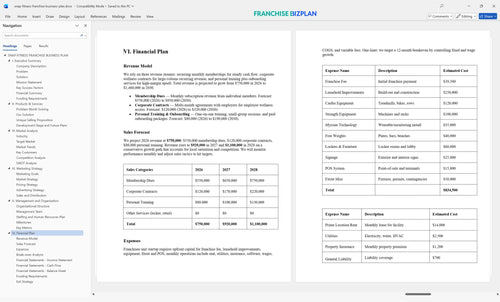
P&L cash flow break-even

Edit fast on any device

All core chapters included
We built this franchise unit business plan for new owners in Microsoft Word using our own independent research. All six chapters are pre-populated with data specific to opening and operating a franchise unit, including a detailed fitness industry market analysis, but are fully editable to match your local assumptions. For example, the financial model projects first-year revenue of $1,125,000 and a 3-year payback period, providing a solid, data-driven foundation for your planning.
The opportunity is to launch a boutique, 24/7 fitness center in the high-growth Mueller urban district, targeting health-conscious professionals underserved by traditional big-box gyms. The business case is built on a proven franchise model, strong local demand, and a clear path to profitability, with projected first-year EBITDA of $366,000.
The unit will sell 24/7 gym access through recurring memberships, corporate wellness contracts, and premium personal training services. Revenue streams are diversified, with Year 1 projections of $550,000 from membership dues, $120,000 from corporate contracts, and $80,000 from personal training. The offering is enhanced with Myzone heart-rate tracking technology to provide a data-driven fitness experience.
The primary target market consists of health-conscious young professionals, corporate employees from nearby medical and tech companies, and residents seeking a boutique fitness experience in the Mueller district. The competitive landscape is dominated by larger, impersonal 'big-box' gyms, creating a clear opening for a community-focused, non-intimidating alternative. This is a core part of how to write a business plan for a gym franchise.
Customer acquisition will be driven by a hyper-local marketing strategy focused on digital campaigns, community events like boot camps at Mueller Lake Park, and B2B partnerships with local employers. This effort is supported by a 2% contribution to the national marketing fund. Retention will be achieved through a high-touch hospitality model and personalized member onboarding to foster long-term loyalty.
The unit will be run by the franchisee-owner with support from a full-time General Manager responsible for daily operations. The initial staffing plan includes a Head Trainer, one Personal Trainer, 2.5 front desk staff, and 1.5 janitorial staff. This team will be trained to deliver the brand's high-touch, hospitality-focused service model, which is defintely a key part of the best practices for gym franchise operations.
The venture requires a minimum cash injection of $627,000 to fund startup costs, including the $39,500 franchise fee, equipment, and leasehold improvements. The financial plan projects a 3-year payback period and breakeven within the first month of operation (January 2026). Key metrics to monitor include membership growth, average revenue per member, and store-level EBITDA, while managing ongoing franchise royalty fees of 6%.
This fitness franchise business plan is a comprehensive, pre-written template designed to save you dozens of hours. It arrives fully populated with franchise-specific data and strategic analysis, but remains 100% editable in Microsoft Word. This unique combination allows you to quickly align the plan with the franchisor's expectations, your local market conditions, and your specific ownership strategy without starting from a blank page.

The included Word template contains a complete set of franchise unit financial projections, including a detailed breakdown of startup costs, operating expenses, and revenue assumptions. These figures are essential for creating a gym franchise investment guide for your specific opportunity. The projections help you evaluate profitability, determine funding requirements, and confirm the financial feasibility of opening a new location, making it a critical tool for any discussion with lenders or investors.

Using this franchise startup template is a highly cost-effective business planning solution for any prospective franchisee. It significantly reduces the need to hire expensive consultants, saving you both time and money. Those saved resources can be reallocated directly into the business, covering essential expenses like the initial franchise fee, commercial gym equipment costs, build-out, and critical working capital for the first few months of operation.

This franchise business plan for fitness centers is designed to make a strong, professional impression on lenders, investors, and the franchisor's approval committee. The professional structure, clear financial logic, and organized presentation of your local opportunity enhance your credibility. It provides a solid foundation for funding discussions, showing that you have a well-researched and viable plan for success, which is a key part of the gym ownership requirements.

The template provides a complete business overview, covering your franchise unit's mission, vision, target market, and local competitive positioning. It includes sections for operations, staffing, and your specific value proposition. This gives you a clear and well-structured narrative for presenting the business, ensuring that every key aspect is addressed within the framework of the franchise brand, from day-to-day tasks to long-term strategy.


Purchase the template and download it immediately. Open and edit it seamlessly using Microsoft Word or Google Docs, making it easy to start working on your business plan right away.

Modify each section to align with your business concept, industry, and financial goals. Personalize the content to reflect your target market, unique value proposition, and key financial details.

Leverage the provided example financial projections or seamlessly incorporate your specific figures, utilizing an optional financial model available for purchase.

Conduct a thorough review of your business plan, refining the content to ensure it's investor-ready and serves as an effective operational guide.