


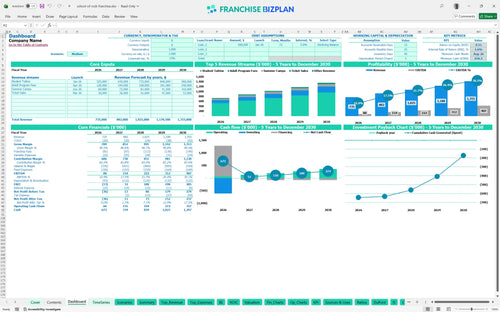
All-in-one Dashboard
Core inputs and core outputs



This retail franchise unit financial projection template provides a complete roadmap for managing your music school's franchise unit profit and loss, cash flow, and capital requirements using professional financial planning tools for new franchisees. Everything you need in one file.
Core inputs and core outputs
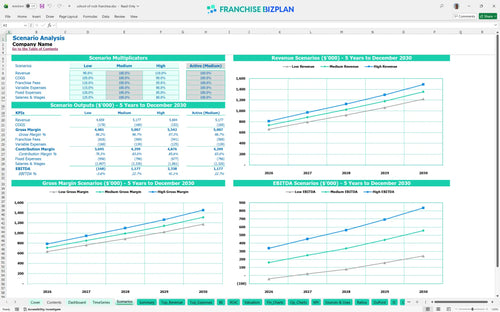
Three scenario analysis
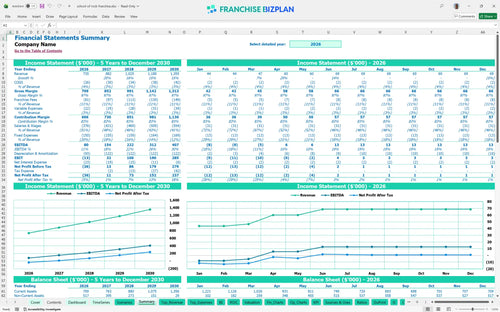
Presentation ready
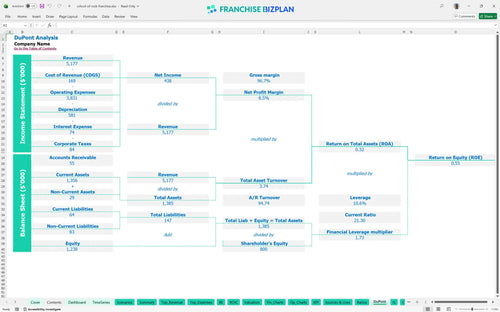
DuPont analysis
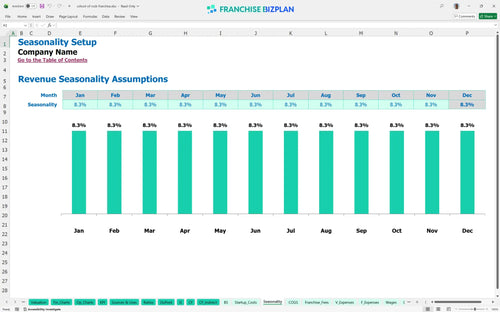
Researched revenue assumptions
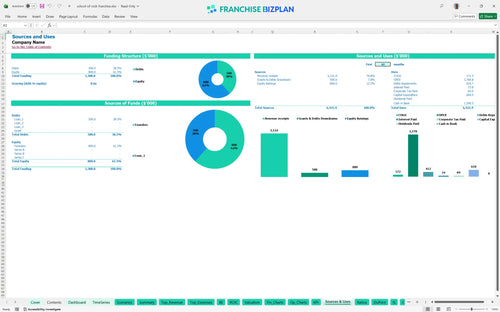
Lender-friendly financial outputs
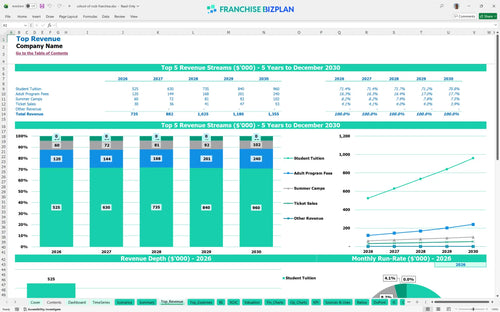
Revenue stream detailed view
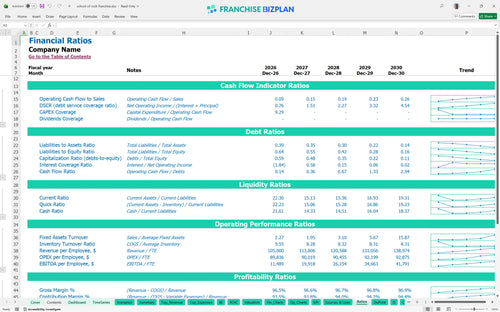
Performance metrics benchmark
We built this franchise unit financial model using our own research to help you navigate the music education space. Key assumptions like the $59,900 franchise fee and $8,000 monthly rent are pre-populated and fully editable to match your specific territory. With year-one EBITDA projected at $80,000, the model provides a realistic look at store-level performance from day one.
The unit shows positive EBITDA of $80,000 in the first year, meaning it reaches operational profitability quickly. By year five, net profit after expenses like the 8% royalty and 3% marketing fund contributions reaches $407,000. Profit starts when the music does.
Launching this music school franchise investment requires a total initial outlay of approximately $609,900 plus a significant cash buffer. This startup budget template for local music centers includes the $59,900 franchise fee, $250,000 for leasehold improvements, and $120,000 for essential musical instruments. Real stages require real capital.
When calculating ROI for a performance-based music school, the model shows an internal rate of return (IRR) of 1.55% and a return on equity (ROE) of 0.55. While the payback period extends after year 5, the EBITDA grows steadily to $407,000 by the fifth year of operation. Patience pays in the long run.
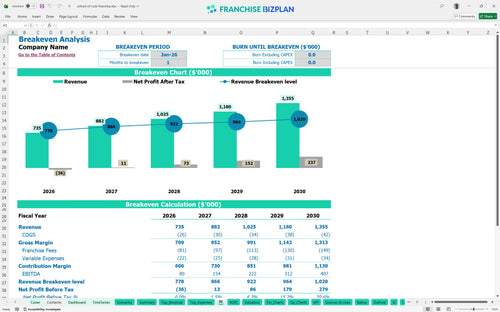
The unit hits its monthly break-even point in January 2026, just one month after launch, assuming you hit your initial enrollment targets. The primary driver for this is the $8,000 monthly rent and the fixed payroll for a studio manager and lead instructor. Volume is the key to coverage.
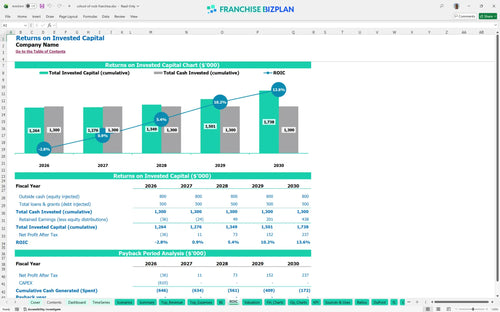
Your lowest cash point is $656,000 in August 2026, so you need enough runway to cover the eight-month build-out period. If construction or permitting stalls, the pressure on your working capital will rise, so having a contingency fund is defintely a smart move. Cash is king during the build.
Using the franchise business plan template to compare scenarios shows how a 10% shift in tuition affects your peak cash needs. High-performing units focus on maximizing the $160,000 adult program revenue and keeping event production costs at 1.3% to boost year-one margins. Plan for the worst, lead for the best.
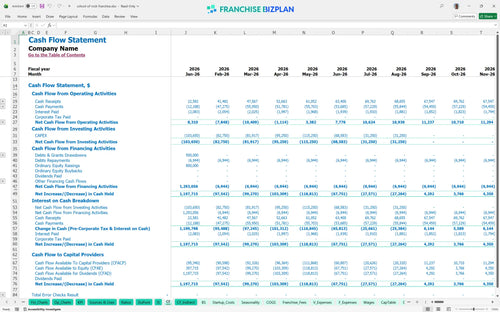
Use this franchise business model financial feasibility tool to stress-test your assumptions against your specific rent and labor market. Understanding these financial performance metrics for education franchises is the first step toward a successful launch. Data drives the best decisions.
This franchise financial model is an editable Excel tool designed to map out your music school's specific trajectory. You can adjust pre-filled formulas for local rent, specific instructor wages, and student enrollment numbers to see how different operating scenarios impact your bottom line. It is a franchise financial model excel template that adapts to your market. Your spreadsheet, your rules.

Plan for the long haul with detailed 5-year projections covering revenue, costs, and cash flow for your music studio. The model tracks how scaling from $735,000 in year one to $1,355,000 in year five changes your unit economic analysis and overall store-level margin. Retail business financial forecasting has never been this straightforward. Growth is a five-year game.

This tool captures the heavy lifting of franchise royalty fees and brand fund contributions so you know exactly what stays in the unit. With an 8% royalty and 3% marketing fee, the model calculates these ongoing franchise operational expenses against your monthly recurring revenue model for franchises to ensure the math still works. Know your fees before you sign.

Use this franchise startup cost calculator to estimate the total initial investment, from the $59,900 franchise fee to the $250,000 in leasehold improvements. It helps you find the exact sales volume needed to cover your $8,000 monthly rent and other fixed costs. How to calculate startup costs for a music franchise shouldn't be a guessing game. Know your number to stay afloat.

The model includes benchmarks for education franchise opportunities to help you sanity-check your music studio franchise profitability analysis. Comparing your projected labor costs or gross margins against industry standards helps you spot potential margin leaks before they happen. Don't fly blind without benchmarks.


Simply purchase and download the financial model template, then access it instantly using Microsoft Excel or Google Sheets. No installation or technical expertise required-just open and start working.

Enter your business-specific numbers, including revenue projections, costs, and investment details. The pre-built formulas will automatically calculate financial insights, saving you time and effort.

Leverage the investor-ready format to confidently showcase your financial projections to banks, franchise representatives, or investors. Impress stakeholders with clear, data-driven insights and professional reports.

Leverage the investor-ready format to confidently present your projections to banks, franchise representatives, or investors.