


Executive Summary
Your concept at a glance



You receive a complete, editable Microsoft Word business plan and a pre-built Excel financial model tailored to a music education franchise, ready for immediate download and customization.
Your concept at a glance
What you sell and why
Market size and rivals
Channels, promotions, conversions
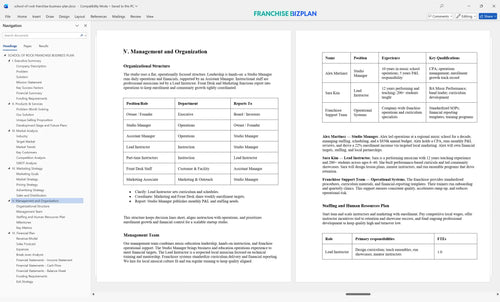
Team roles and org chart
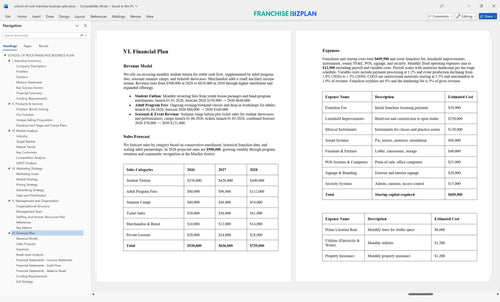
P&L cash flow break-even

Edit fast on any device

All core chapters included
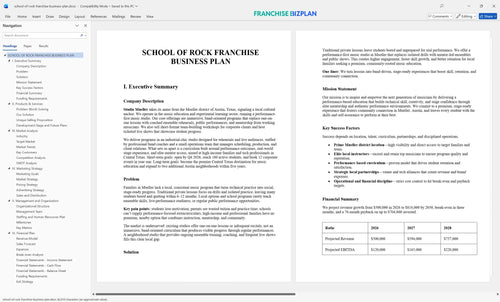
We developed this music school franchise business plan based on our own research into the performance-based education model. The template, delivered in Microsoft Word, comes with all six chapters pre-written with data specific to opening and operating a single franchise unit. With projected first-year revenue of $735,000, the plan provides a solid, data-driven foundation that you can easily edit to match your local market and financial needs.
The business case is to establish a premium, performance-based music school in a high-income area, leveraging a proven franchise model to capture demand from education-focused families and corporate clients. The unit is projected to reach profitability quickly, with an EBITDA of $80,000 in year one and scaling to $407,000 by year five, demonstrating a strong and sustainable financial opportunity.
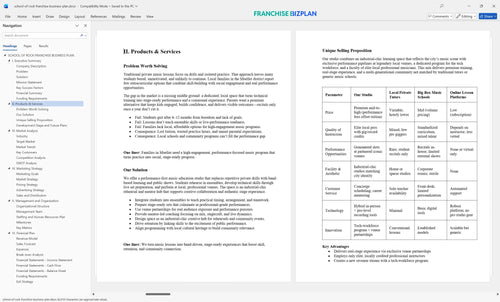
The franchise unit will primarily offer performance-based music education through recurring monthly tuition programs for children and teens. It will also generate revenue from adult program fees, seasonal summer camps, and ticket sales from student showcases. This diversified revenue model, led by student tuition projected at $350,000 in the first year, creates a stable financial base.
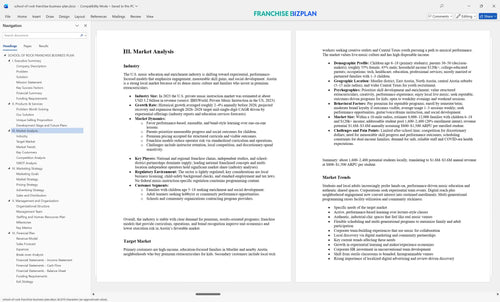
The primary target market consists of high-income families in the local area seeking engaging, premium extracurricular activities for their children. A secondary segment is the local corporate workforce, targeted for adult music programs and team-building events. The strategy is to become the go-to cultural hub in a high-visibility location, serving both youth education and adult recreational needs.
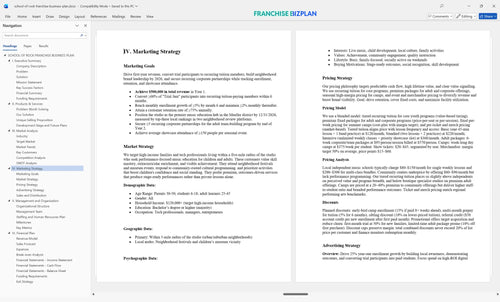
Customer acquisition will be driven by a hyper-local marketing strategy combining targeted digital campaigns with community-based events like 'Trial Jam' pop-ups. The unit will also partner with iconic local music venues for student showcases, creating powerful social proof. Retention will be achieved through a mentorship-based teaching model that builds strong relationships between students and instructors, making the experience defintely more than just a lesson.
The unit will be led by a full-time Studio Manager with an annual salary of $75,000, supported by an Assistant Manager and a Lead Instructor. The initial staffing plan includes two full-time equivalent (FTE) Part-time Instructors and 1.5 FTE Front Desk Staff. This structure ensures strong leadership for daily operations, sales, and instructional quality, aligning with the franchise's standards for a premium customer experience.
The initial startup requires significant capital, with major costs including a $59,900 franchise fee and $250,000 for leasehold improvements. The financial model indicates a minimum cash requirement of $656,000. Key performance metrics include achieving breakeven by January 2026, just one month after launch, and growing annual revenue from $735,000 in year one to over $1.3 million by year five. While the payback period extends beyond five years, the unit's growing profitability is clear.
This music school franchise business plan template is a complete, pre-written document designed to save you dozens of hours. It's delivered as a Microsoft Word file, making it fully editable so you can tailor the content to your specific location, financial assumptions, and operational strategy. This approach ensures your plan aligns with franchisor expectations while reflecting the unique realities of your target market.

The included franchise unit business plan provides detailed financial projections, including startup costs, a five-year profit and loss statement, cash flow analysis, and a balance sheet. We've built the revenue model based on multiple streams like student tuition, adult programs, and summer camps, giving you a clear framework for evaluating profitability. These franchise financial projections are critical for securing loans and proving the viability of your music school franchise opportunity.

Starting a music school franchise requires careful capital allocation, and this template is a highly cost-effective tool. It provides a professional, lender-ready document without the high fees of hiring a consultant, saving you thousands of dollars. That saved capital can be redirected toward what matters most: the franchise fee, leasehold improvements, instrument inventory, and initial marketing.

A well-structured business plan creates a strong first impression with lenders, investors, and the franchisor's approval committee. This template is designed to present your franchise unit opportunity with clarity and professionalism. The organized narrative, logical financial model, and comprehensive market analysis demonstrate that you have a credible and strategic plan for launching a performance-based music school.

This franchise business plan template provides a comprehensive overview of your proposed unit, covering everything from the mission and vision to the specific products and services offered. It includes sections for local market analysis, marketing strategy, management team, and a full operational plan. This complete structure ensures you have a coherent and compelling story for anyone evaluating your proposal.


Purchase the template and download it immediately. Open and edit it seamlessly using Microsoft Word or Google Docs, making it easy to start working on your business plan right away.

Modify each section to align with your business concept, industry, and financial goals. Personalize the content to reflect your target market, unique value proposition, and key financial details.

Leverage the provided example financial projections or seamlessly incorporate your specific figures, utilizing an optional financial model available for purchase.

Conduct a thorough review of your business plan, refining the content to ensure it's investor-ready and serves as an effective operational guide.