


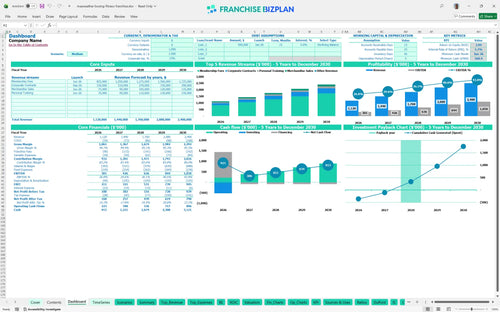
All-in-one Dashboard
Core inputs and core outputs



This franchise unit financial model template provides a complete roadmap from initial build-out to a mature 5-year operating state.
Core inputs and core outputs
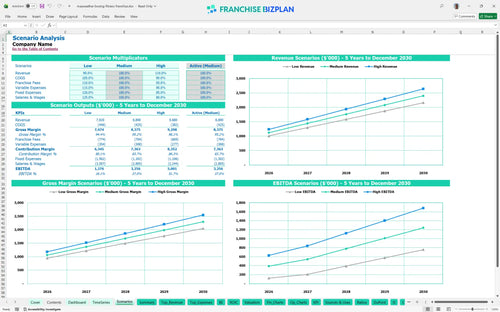
Three scenario analysis
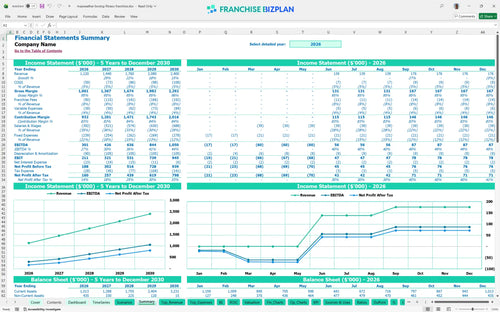
Presentation ready
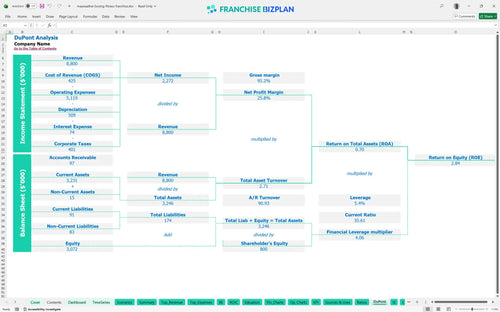
DuPont analysis
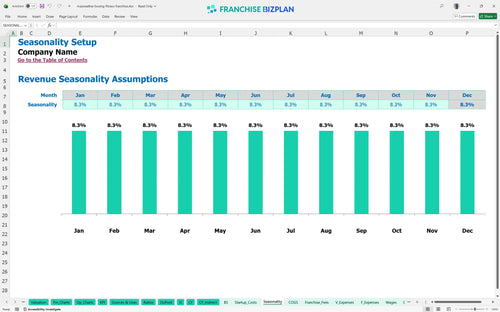
Researched revenue assumptions
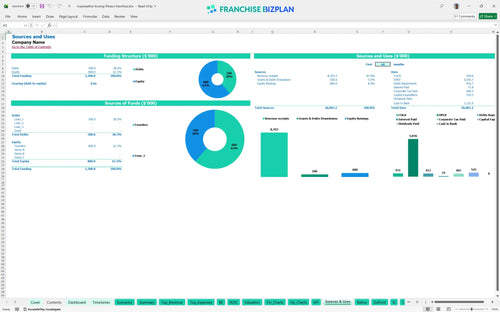
Lender-friendly financial outputs
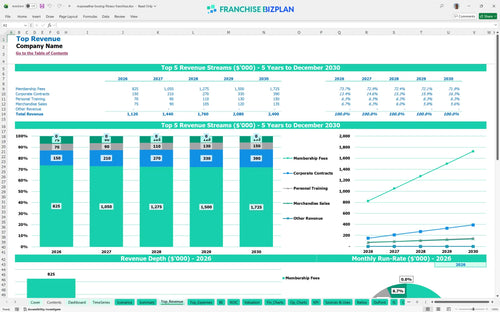
Revenue stream detailed view
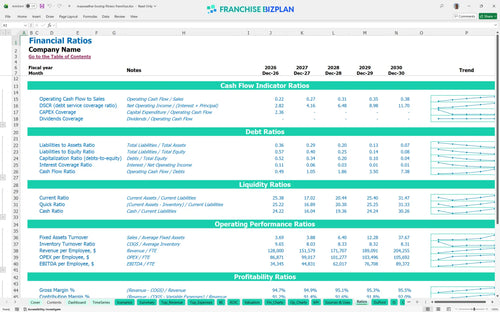
Performance metrics benchmark
We built this franchise unit financial model using our own research into the boutique fitness sector and high-intensity interval training studio economics. Key assumptions, including revenue streams like membership fees and corporate contracts, along with expenses like the $49,500 franchise fee and 7% royalty, are pre-populated and fully editable. This tool helps you move from a business idea to a data-driven execution plan with Year 1 revenue targets of $1.12 million.
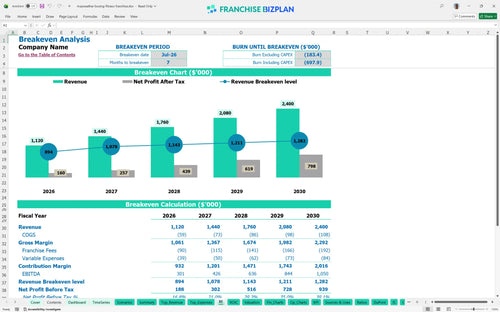
The unit reaches its break-even date in July 2026, just seven months after launching. Year 1 EBITDA starts at $301,000 and grows to $1.05 million by Year 5 as membership and personal training revenue scale. Profitability depends on maintaining a tight grip on the $15,000 monthly rent and the 8% combined royalty and marketing fee.
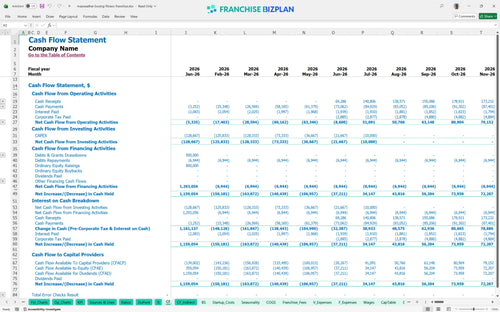
You need a minimum cash position of $560,000 to launch and reach the lowest cash point in June 2026. The capital is primarily used for the $49,500 franchise fee, $200,000 in leasehold improvements, and $140,000 for boxing and cardio equipment. Total pre-opening CAPEX is roughly $524,500 before accounting for initial working capital and marketing.
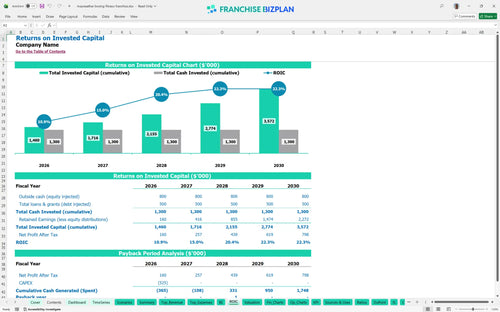
Analyzing ROI for a premium boutique boxing franchise shows an Internal Rate of Return (IRR) of 5.67% with a 3-year payback period. While the Return on Equity (ROE) is 2.84%, the model shows significant cash flow acceleration after the initial debt or capital is recovered. Long-term value is driven by the $2.4 million revenue ceiling in Year 5.
The monthly break-even point is achieved in month 7, requiring enough membership volume to cover $15,000 in rent and over $25,000 in monthly payroll. The biggest lever for hitting this target is the rapid acquisition of the $550,000 in Year 1 membership fees. High-intensity interval training studio revenue must ramp quickly to offset fixed occupancy costs.
The lowest cash point is $560,000 in June 2026, which serves as your critical safety margin. You need roughly six months of runway to cover the gap between the $200,000 build-out and the point where monthly revenue exceeds operating expenses. Still, keeping a buffer for unexpected maintenance or slow summer months is essential for survival.
In a high-performance scenario, reaching $2.4 million in revenue by Year 5 drastically improves the 5.67% IRR and shortens the payback. Conversely, if membership fees lag, the 3-year payback could slip, and the $560,000 cash floor might be tested. Small changes in trainer productivity and member retention change the outcome defintely.
This fitness franchise financial model is fully customizable in Excel, allowing you to swap out pre-filled data for your specific territory. It includes editable assumptions for everything from membership pricing to local utility costs, so you can see how different scenarios impact your boutique gym profit analysis. Here's the quick math: changing your membership price by just $10 can shift your entire year-one trajectory.

Planning for boxing gym startup costs requires looking past the grand opening to understand long-term viability. This model provides a 5-year outlook on revenue, scaling from $1.12 million in year one to $2.4 million by year five. It defintely helps you visualize the transition from a new studio to a mature, high-volume fitness destination.

We mapped out the specific franchise royalty fee structure, including the 7% royalty and 1% marketing fund contributions. These are calculated automatically against your projected revenue so you see the net impact on your store-level margin before you commit. Knowing your ongoing obligations is the only way to protect your bottom line.

Learning how to calculate startup costs for a fitness franchise is the first step to avoiding a cash crunch during ramp-up. This tool identifies your break-even sales level and maps out the $524,500 in primary capital expenditures needed for build-out and equipment. Most operators fail because they underestimate the cash needed to reach daylight.

The model incorporates built-in franchise and industry benchmarks for key operating metrics like labor and occupancy. You can sanity-check your $15,000 monthly rent or your staffing plan against typical boutique fitness market trends to ensure your plan is realistic. If your numbers are too far outside the norm, you need to know why before you sign the lease.


Simply purchase and download the financial model template, then access it instantly using Microsoft Excel or Google Sheets. No installation or technical expertise required-just open and start working.

Enter your business-specific numbers, including revenue projections, costs, and investment details. The pre-built formulas will automatically calculate financial insights, saving you time and effort.

Leverage the investor-ready format to confidently showcase your financial projections to banks, franchise representatives, or investors. Impress stakeholders with clear, data-driven insights and professional reports.

Leverage the investor-ready format to confidently present your projections to banks, franchise representatives, or investors.