


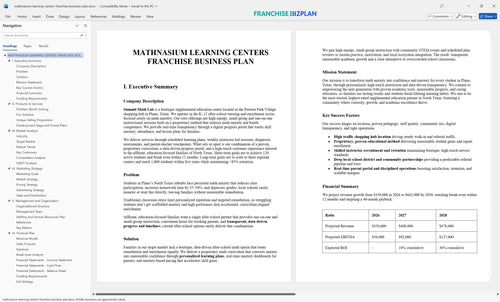
Executive Summary
Your concept at a glance



You will receive a complete, pre-written franchise unit business plan word document template with integrated financial tables that is ready to be customized for your specific location and goals.
Your concept at a glance
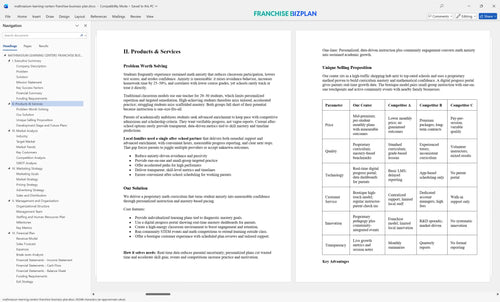
What you sell and why
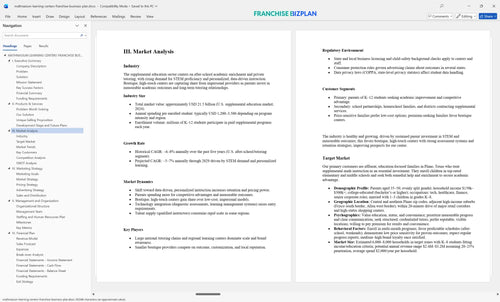
Market size and rivals
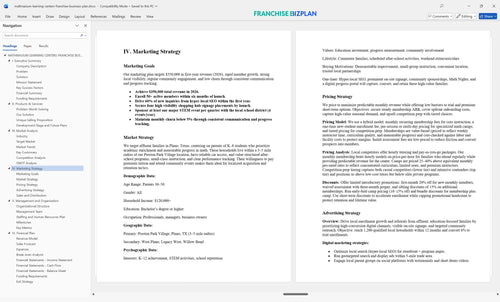
Channels, promotions, conversions
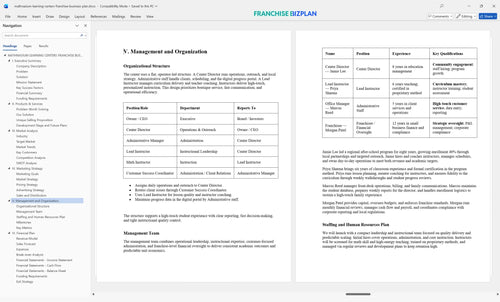
Team roles and org chart
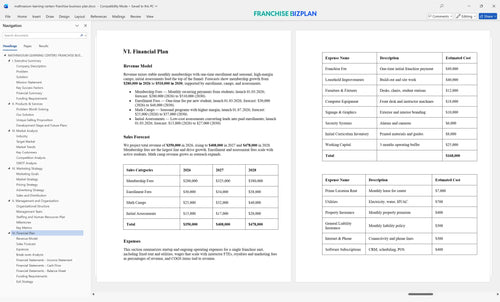
P&L cash flow break-even

Edit fast on any device

All core chapters included
We developed this math tutoring center business plan template for franchisees based on our own analysis of the supplemental education industry. The six-chapter Word document comes pre-populated with researched data specific to opening and operating a math learning center franchise, including a startup budget that accounts for a $49,000 franchise fee and $40,000 in leasehold improvements. All sections are fully editable, allowing you to create a strategic business plan for a private tutoring center startup that projects realistic growth toward the Year 1 revenue target of $518,000.
The opportunity is to launch a proven math learning center franchise in a high-income suburban market with strong demand for supplemental education. By establishing a prime location and executing the franchisor's operating model, the unit is positioned to capture a significant share of the local market, serving families seeking both remedial and enrichment tutoring services.
The center sells personalized math instruction through a subscription-based model, transforming student anxiety into confidence and mastery. The core revenue streams are recurring monthly membership fees, supplemented by one-time enrollment fees for new students. Additional revenue will come from seasonal offerings like math camps, which are projected to generate $25,000 in the first year.
The primary customers are education-focused families in affluent suburban areas with children in elementary and middle school. The target market includes two key segments: students needing remedial support to catch up and high-achieving students seeking advanced enrichment. The business plan for learning centers must address local competitors by highlighting the franchise's proprietary teaching method and superior customer experience.
Customer acquisition will be driven by a hyper-local marketing strategy focused on community engagement and digital outreach. The plan allocates $800 per month for local marketing, including sponsoring school STEM events, building relationships with local educators for referrals, and running targeted digital ads. High-visibility signage at a prime retail location will capture local traffic and build brand awareness.
The center will be led by a full-time Center Director with an annual salary of $65,000, responsible for operations, sales, and ensuring franchise brand standards are met. The initial staffing model includes a Lead Instructor, an Administrative Staff member, and 2.5 full-time equivalent (FTE) Math Instructors. The instructor team is planned to scale to 4.5 FTEs by Year 5 to support projected revenue growth.
The financial plan requires significant initial capital, including a $49,000 franchise fee and $143,000 in other startup expenses, but projects a clear path to profitability. The tutoring center operating model forecasts reaching breakeven within 4 months of opening (by April 2026) and achieving payback in 4 years. Revenue is projected to grow from $518,000 in Year 1 to $950,000 in Year 5, with EBITDA margins expanding from 5% to 26% as the center scales. This is defintely a key part of the franchise investment roadmap.
This comprehensive education franchise business plan template is fully pre-written, saving you dozens of hours in research and writing. It is delivered as a Microsoft Word document, making it 100% customizable. You can easily edit the text, tables, and financial assumptions to align the plan with your specific location, operational strategies for a math learning center franchise, and the franchisor's requirements.

The franchise unit business plan template includes detailed financial projections, covering startup costs, operating expenses, and a complete revenue model. These figures provide a clear financial model for an educational learning center startup, helping you assess profitability, determine funding requirements, and present a viable investment roadmap to lenders and investors.

Using this pre-written business plan for tutoring center owners is a highly cost-effective solution that minimizes the need for expensive consultants. By providing a professional, lender-ready framework, it saves you time and money. These saved resources can be reallocated to critical startup needs like the initial franchise fee, leasehold improvements, and working capital for a successful launch.

This math learning center business plan is designed to make a strong, credible impression on lenders, investors, and the franchisor. The professional structure, clear financial logic, and organized presentation of your franchise investment roadmap demonstrate a thorough understanding of the business. It directly supports your business plan requirements for education franchise financing and enhances your credibility as a prospective franchisee.

The template provides a complete overview of your proposed franchise unit, including its mission, target market, local competitive positioning, and operational plan. It gives you a well-structured narrative to present your supplemental education franchise plan. This ensures all key business components are covered, from your value proposition to your management structure, all within the franchise brand's framework.


Purchase the template and download it immediately. Open and edit it seamlessly using Microsoft Word or Google Docs, making it easy to start working on your business plan right away.

Modify each section to align with your business concept, industry, and financial goals. Personalize the content to reflect your target market, unique value proposition, and key financial details.

Leverage the provided example financial projections or seamlessly incorporate your specific figures, utilizing an optional financial model available for purchase.

Conduct a thorough review of your business plan, refining the content to ensure it's investor-ready and serves as an effective operational guide.