


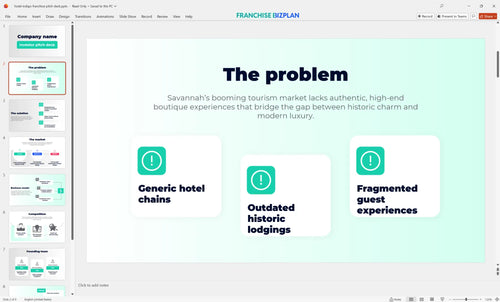
Problem
Defines market pain



This comprehensive template includes 13 essential building blocks covering everything from CapEx requirements to five-year EBITDA projections for a boutique hotel unit.
Defines market pain
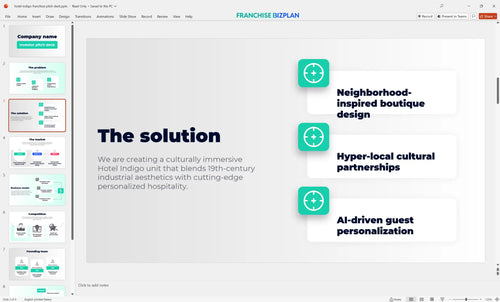
Explains your fix
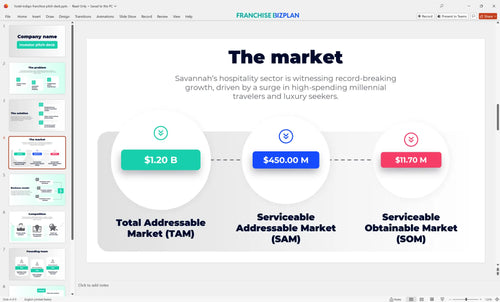
Quantifies opportunity size
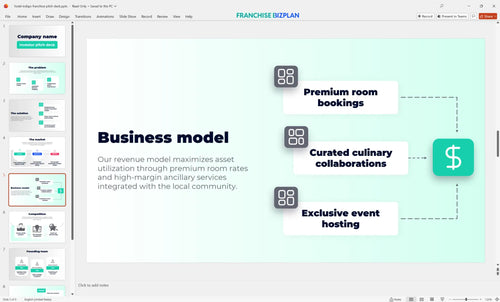
Shows revenue engine
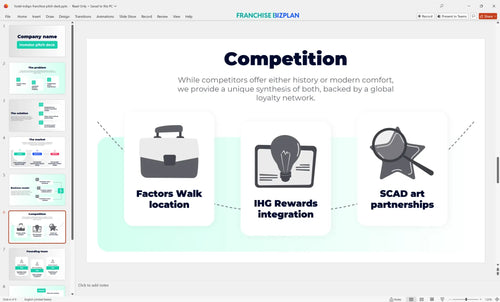
Highlights competitive edge
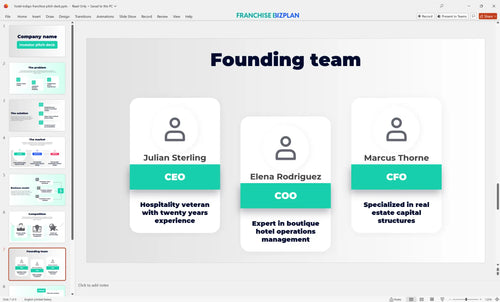
Proves operator credibility
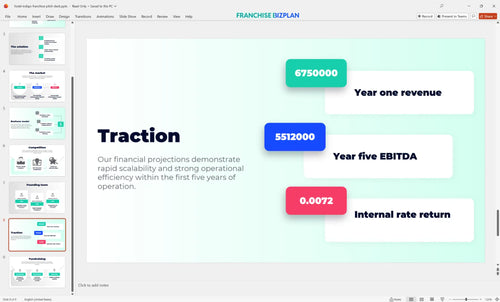
Demonstrates market momentum
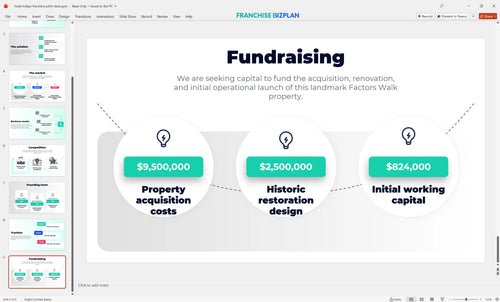
Details capital use
We built this hotel business plan template using deep research into boutique hospitality economics and global brand standards. Every slide comes pre-populated with realistic data, like the $15.7 million initial investment and the 1-month breakeven timeline, but you can easily edit every number to match your specific site. It's a pragmatic tool for any serious operator looking to scale in the upscale segment.
Travelers are tired of cookie-cutter rooms and want a connection to the local neighborhood's history and culture. This unit meets that demand by blending industrial aesthetics with modern luxury in high-traffic historic hubs. Plus, travelers will pay a premium for authenticity that standardized brands just can't match.
Most local options are either dated independent inns or soulless corporate boxes. This project offers a hyper-local experience with rotating art and AI-driven itineraries that personalize every stay. It's a better solution because it combines the soul of a boutique with the massive distribution power of a global loyalty program.
We target high-spending millennials and design-conscious professionals who value unique experiences over low prices. The local opportunity is massive, with our projections showing a ramp-up from $6.75 million in year one to $11.7 million by year five. Honestly, the market for upscale, localized stays in historic hubs remains underserved by current inventory.
Revenue flows from three main streams: premium room rates, food and beverage collaborations, and curated local tours. With a 5% royalty and 3% marketing fee, the model is built for scale, hitting a $5.5 million EBITDA by year five. What this estimate hides is the initial pressure of the $35,000 monthly rent, which makes high occupancy critical from day one.
Main competitors include local independent boutiques and upscale chain hotels in the riverfront area. Our defensible edge is the combination of the historic location and the global brand's proprietary guest data. This moat ensures we capture loyal travelers while providing a localized experience that chains can't easily replicate.
We need funding to cover the $75,000 franchise fee and the $7.5 million in leasehold improvements for the historic building. Key milestones include reaching breakeven by January 2026 and achieving a 6.02% return on equity. Still, the biggest win is hitting that first month of operations to start the ramp toward $3.2 million EBITDA in year two.
Finance: update unit break-even and payback model by Friday
Building a boutique hotel franchise opportunity presentation from scratch is a massive time sink that most operators can't afford. This pre-written deck gives you a professional structure that you can defintely customize in PowerPoint to fit your specific market and funding needs. It's designed to help you move from a blank screen to a finished hospitality franchise proposal in hours instead of weeks, keeping your focus on the deal rather than the design.

Investors need to see exactly how your boutique hotel development generates cash across different departments. This template includes a dedicated revenue model slide that breaks down room rates, food and beverage sales, and ancillary services. It simplifies the unit economics so lenders can see the path to that $11.7 million year-five revenue target without getting lost in the weeds of a complex hotel P&L.

A hotel franchise business plan for potential investors is only as good as its local market data. We've included structured slides to map out local demand, guest profiles, and how you'll beat the standardized chains. Understanding your local density and why design-conscious travelers will choose your historic location is the key to winning the site selection game and securing better terms.

You don't need to be a graphic designer to deliver a high-end franchise investment presentation that commands respect. The layout is clean and professional, focusing on the numbers and the brand story that matters to capital partners. It's built to keep the focus on your store-level margin and growth potential, ensuring your message doesn't get buried in cluttered or amateur slides.

What makes your upscale hospitality business stand out in a crowded historic district? This slide helps you articulate your unique value, from AI-driven personalization to rotating art installations. It's about showing why your specific boutique hotel franchise unit pitch deck template represents a defensible edge in the local market that competitors can't easily replicate.


Get instant access to your pitch deck by downloading the template in PowerPoint or Google Slides. Open it in your preferred software and start customizing immediately.

Easily personalize each slide by replacing the placeholder text with your business information, market insights, and key financial details, ensuring the deck aligns perfectly with your vision.

Review and adjust the financial slides to align with your revenue model, cost breakdown, and funding needs, ensuring investors receive a clear and professional financial overview.

Refine your presentation for clarity and impact, ensuring it tells a compelling story about your business, highlights your competitive edge, and makes a strong case for investment.