


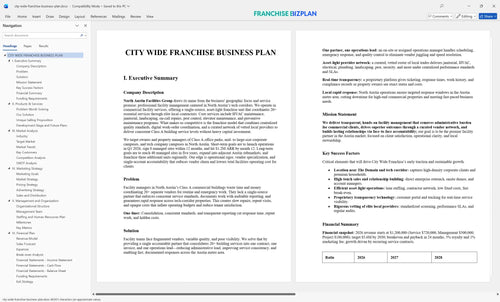
Executive Summary
Your concept at a glance



You get a comprehensive, pre-written, and fully customizable franchise unit business plan in Microsoft Word, complete with 5-year financial projections and a detailed guide to the asset-light facility management business plan template.
Your concept at a glance
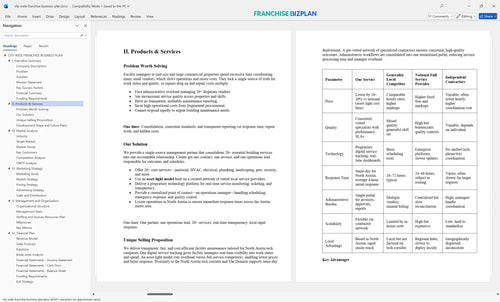
What you sell and why
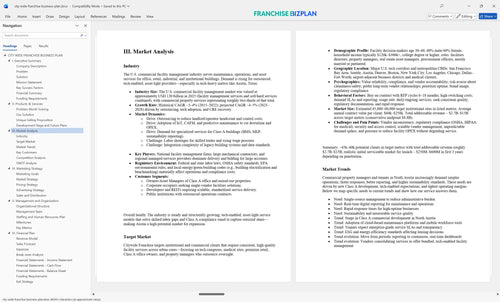
Market size and rivals
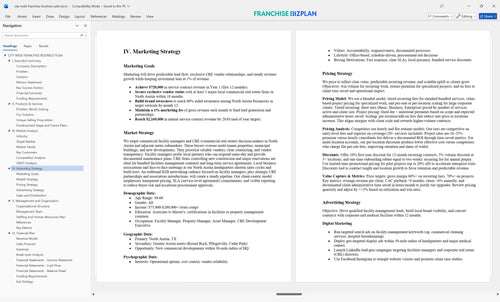
Channels, promotions, conversions
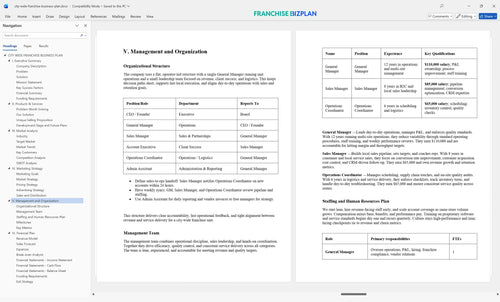
Team roles and org chart
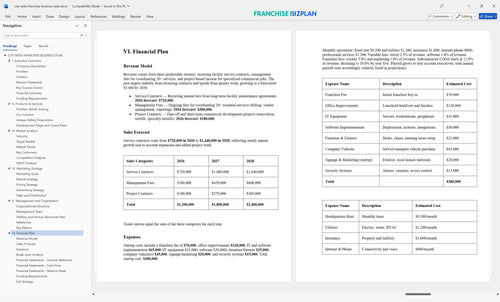
P&L cash flow break-even

Edit fast on any device

All core chapters included
We developed this comprehensive business plan for a commercial maintenance franchise using our own in-depth research into the asset-light business model. All six chapters are pre-populated in a Microsoft Word file with data specific to opening and running this type of B2B service franchise, and it's all fully editable. The financial model projects Year 1 revenue of $1,800,000 and a breakeven date just one month after launch in January 2026, reflecting the model's potential for rapid ramp-up.
The business case is built on an asset-light model that serves high-value commercial clients by managing over 20 building services through a network of vetted subcontractors. This approach minimizes capital expenditure on equipment and direct labor, allowing the franchisee to focus on B2B sales, relationship management, and quality control, driving strong margins and scalability.
The franchise unit doesn't perform the physical work itself; instead, it acts as a single-source manager for commercial property maintenance, coordinating everything from janitorial services to landscaping. Revenue comes from three primary streams: long-term service contracts, management fees for coordinating vendors, and higher-margin project-based work for specialized client needs.
The primary customers are facility managers and property owners of large-scale commercial buildings who are overwhelmed by managing multiple vendors. The opportunity lies in targeting specific, high-value niches where service reliability and quality are paramount. This includes corporate headquarters in tech corridors, medical facilities with specialized needs, and premium Class A commercial properties.
Customer acquisition is driven by a direct, B2B lead generation strategy focused on face-to-face networking and relationship building. The plan relies on a dedicated sales team to connect with facility managers, plus strategic partnerships with commercial real estate firms to gain access to new developments. Retention is achieved through a high-touch, single-point-of-contact model and a proprietary vendor management system that ensures quality and transparency.
The business is led by the franchisee, supported by a lean, professional team focused on sales, operations, and account management. The franchise operations manual provides the playbook, but local execution depends on key hires. The initial team structure is designed for growth, with a General Manager overseeing operations, a Sales Manager driving new business, and Account Executives managing client relationships.
The initial investment is significant, driven by the franchise fee and office setup, with total capital expenditures (CAPEX) around $360,000. However, the financial model projects a rapid path to profitability, with a breakeven point just one month after launch. Key metrics to watch are top-line revenue growth, EBITDA margin, and cash flow, as the business requires substantial working capital, with a minimum cash need of $1,037,000 by February 2026 to fund operations before receivables are collected. This is defintely a key part of the facility services franchise model.
This facility management franchise business plan is a fully pre-written template designed to save you dozens of hours. It arrives ready to use but is also 100% editable in Microsoft Word, allowing you to tailor every detail to your specific location, local market conditions, and personal strategy. This blend of structure and flexibility ensures your plan aligns perfectly with franchisor expectations while reflecting your unique business case.

The business plan template for franchise includes detailed financial projections, covering startup costs, revenue forecasts, and operating expenses. These figures, presented in clear Word tables, help you model the unit's financial performance, determine funding requirements, and assess profitability. It provides a solid financial narrative to support your investment in a commercial cleaning franchise business plan.

Using this template is a highly cost-effective way to develop a professional B2B service franchise business plan. It eliminates the need for expensive consultants, saving you thousands of dollars that can be better invested in your franchise fee, working capital, or local marketing. You get a high-quality, comprehensive document without the high cost, which is critical in the early stages.

This plan is structured to make a strong, credible impression on lenders, investors, and the franchisor's approval committee. The professional formatting, clear financial logic, and comprehensive operational details demonstrate a thorough understanding of the facility services franchise model. It's designed to answer the tough questions before they're even asked, supporting your funding and approval discussions.

The template provides a complete narrative for your franchise unit, covering mission, vision, target market, and local competitive positioning. It details your operational plan, management structure, and the specific value you bring to commercial clients within the franchise system's framework. This gives you a clear, structured story for presenting your business to any stakeholder.


Purchase the template and download it immediately. Open and edit it seamlessly using Microsoft Word or Google Docs, making it easy to start working on your business plan right away.

Modify each section to align with your business concept, industry, and financial goals. Personalize the content to reflect your target market, unique value proposition, and key financial details.

Leverage the provided example financial projections or seamlessly incorporate your specific figures, utilizing an optional financial model available for purchase.

Conduct a thorough review of your business plan, refining the content to ensure it's investor-ready and serves as an effective operational guide.