


Executive Summary
Your concept at a glance



This package includes a fully editable Microsoft Word business plan with pre-populated text and financial tables tailored for your home care franchise unit.
Your concept at a glance
What you sell and why
Market size and rivals
Channels, promotions, conversions
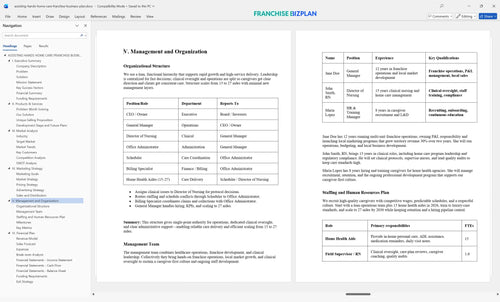
Team roles and org chart
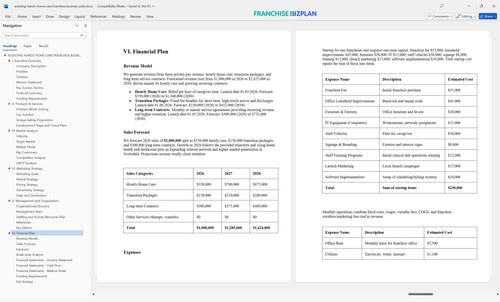
P&L cash flow break-even

Edit fast on any device

All core chapters included
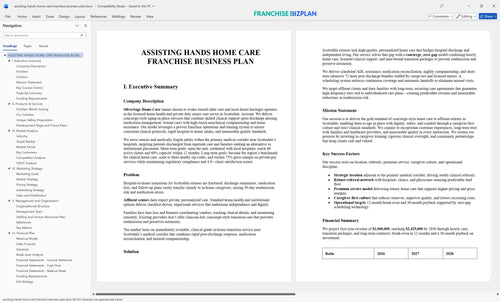
We built this home care franchise business plan in Microsoft Word using our own research into the senior care market. All six chapters are pre-populated with data specific to opening and operating a private duty care franchise unit, including financial projections showing first-year revenue of $1,500,000 and an initial franchise fee of $55,000. The entire document is fully editable, allowing you to adapt the plan to your specific territory and assumptions.
This franchise unit is designed to capture the high-demand, affluent retiree market in Scottsdale, Arizona, with a premium, concierge-style service model. By focusing on private pay clients and building direct referral pipelines from top medical centers, the business is positioned to meet a clear need for high-quality aging in place services in a demographically favorable area.
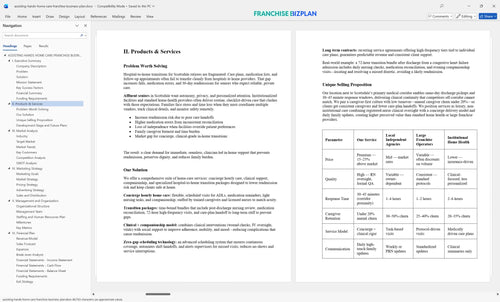
The unit's revenue model is built on three core service lines: premium hourly home care, specialized 'Transition Packages' for post-hospitalization support, and long-term contracts for comprehensive care. This diversified offering allows the business to capture clients with immediate, short-term needs and convert them into stable, long-term relationships for private duty care.
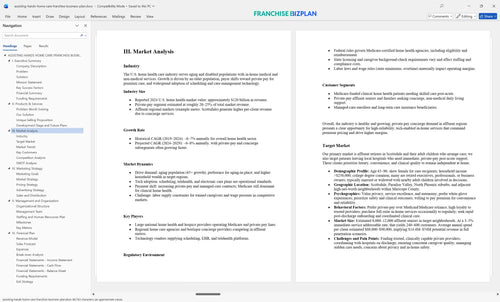
The primary customers are affluent retirees in Scottsdale and their adult children, who are seeking a 'gold standard' of non-medical home care. A key secondary segment includes patients discharging from nearby medical facilities like HonorHealth Scottsdale Shea Medical Center who require immediate, reliable support for a safe transition home. The market analysis shows strong demand for premium, non-institutional care options.
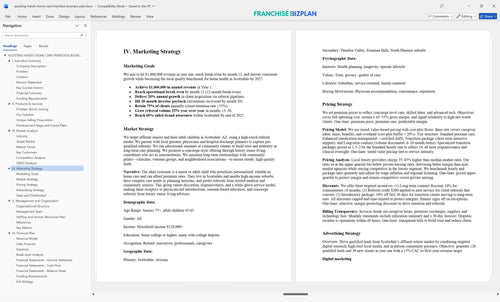
The marketing strategy prioritizes building direct referral relationships with local hospitals, geriatric clinics, and senior living consultants. Instead of relying on broad, costly advertising, the plan focuses on establishing the unit as a trusted local authority through educational seminars and strategic networking. This approach is designed to generate a steady pipeline of qualified, private pay clients.
A General Manager with an annual salary of $90,000 will oversee all healthcare business operations, leading a core office team that includes a Director of Nursing and an Office Administrator. The operational plan calls for an initial team of 15 Home Health Aides, scaling up to 27 by Year 5 to meet projected revenue growth. This structure is defintely designed to ensure high standards of care and efficient management from day one.
The financial plan projects first-year revenue of $1,500,000 and an EBITDA of $433,000. Key assumptions include a 5% royalty fee and a 2% marketing fee paid to the franchisor. The model shows the unit reaching breakeven in just three months, with a projected internal rate of return (IRR) of 16.97%, though the full investment payback period extends beyond the initial five-year forecast.
This home care franchise business plan is a comprehensive, pre-written guide you can immediately use and tailor to your specific location and strategy. It's fully editable in Microsoft Word, which means you can align the text, tables, and financial assumptions with your local market conditions, franchisor requirements, and lender expectations without needing any special software. This approach saves dozens of hours while ensuring a professional, franchise-focused document.

Our franchise business plan template includes detailed financial projections, startup costs, operating expenses, and revenue assumptions specific to a home health care startup. The model projects first-year revenue of $1,500,000, helping you evaluate profitability, cash flow needs, and the overall financial feasibility of the opportunity. It's built to account for key franchise realities like royalty fees and marketing fund contributions, giving you a clear picture of your unit's economic engine.

This template is a smart, cost-effective tool for any prospective franchisee. It reduces the need for expensive consultants, saving you time and money that can be better allocated toward your initial $55,000 franchise fee, office improvements, or critical working capital. By providing a professional, lender-ready structure from the start, you can focus your resources on launching and growing your non-medical home care agency.

The plan is structured to make a strong impression on lenders, investors, and the franchise approval committee. Its professional format, clear financial logic, and organized presentation of your healthcare business operations enhance your credibility. This helps streamline funding discussions and demonstrates you have a solid grasp of the unit economics required to succeed, making it a key part of your senior care franchise opportunities evaluation.

This template provides a complete business overview, covering your unit's mission, target market, operational plan, and value proposition for providing aging in place services. It gives you a well-structured narrative for presenting your local strategy within the framework of the national brand. You get a clear, organized way to explain the opportunity, from your local positioning to your staffing and service delivery model.


Purchase the template and download it immediately. Open and edit it seamlessly using Microsoft Word or Google Docs, making it easy to start working on your business plan right away.

Modify each section to align with your business concept, industry, and financial goals. Personalize the content to reflect your target market, unique value proposition, and key financial details.

Leverage the provided example financial projections or seamlessly incorporate your specific figures, utilizing an optional financial model available for purchase.

Conduct a thorough review of your business plan, refining the content to ensure it's investor-ready and serves as an effective operational guide.