


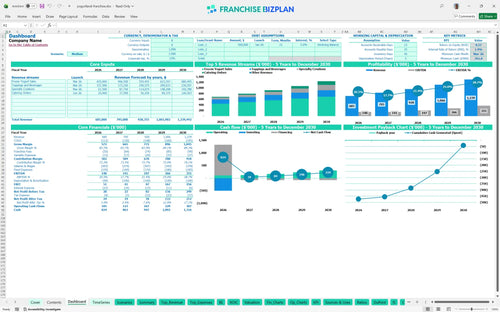
All-in-one Dashboard
Core inputs and core outputs



This package includes a full franchise profit and loss template along with a financial projection template for retail franchises to help you secure funding and manage daily operations.
Core inputs and core outputs
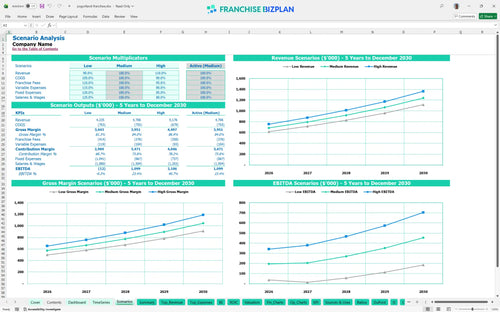
Three scenario analysis
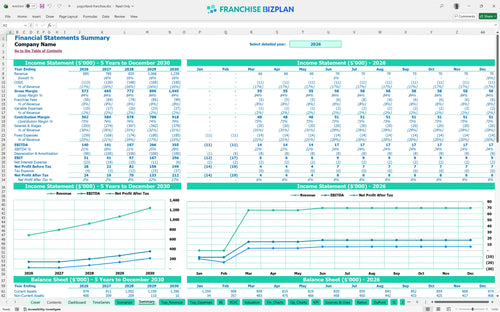
Presentation ready
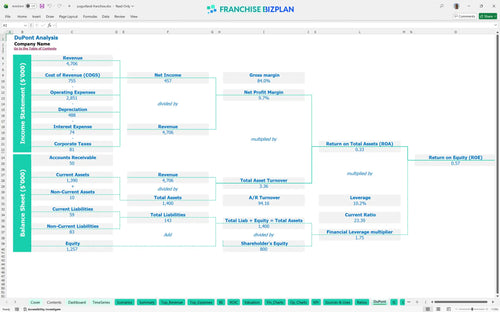
DuPont analysis
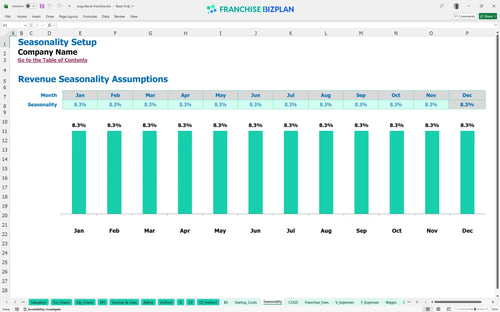
Researched revenue assumptions
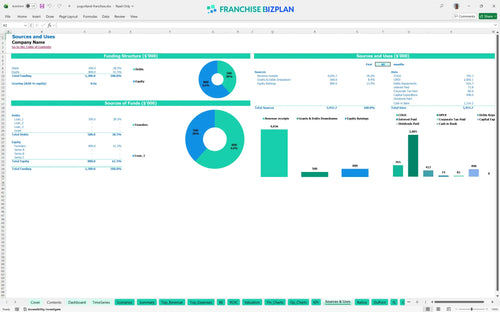
Lender-friendly financial outputs
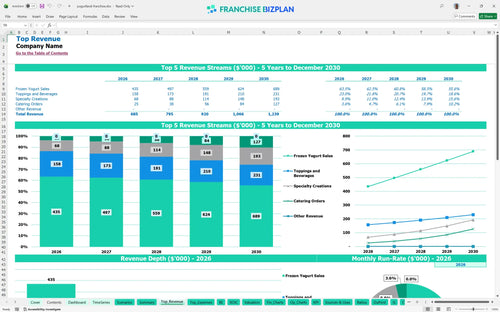
Revenue stream detailed view
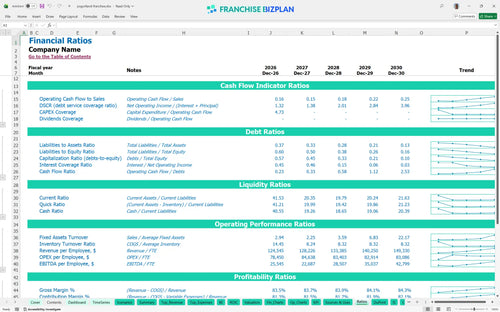
Performance metrics benchmark
We built this franchise unit financial model using our own research to help you master estimating operating costs for food service franchise units. The model is pre-populated with data specific to a Yogurtland Franchise unit, including a $140,000 year-one EBITDA and a four-month break-even target, all of which are fully editable to match your specific territory.
This unit is designed to reach operational profitability quickly, with the break-even date set for April 2026. By calculating net profit after the 15% ingredient cost and 8% total franchise fees, the model shows EBITDA climbing from $140,000 in year one to $355,000 by year five. One bad month of spoilage can wipe out a week's profit, so monitoring these margins is vital. Here is how to calculate frozen yogurt franchise profitability effectively.
Launching this unit in the US requires significant capital expenditure planning, primarily driven by the $220,000 leasehold improvements and $95,000 equipment package. The total initial investment also includes a $35,000 franchise fee and an $18,000 initial inventory push. Build-out costs are your biggest hurdle before the first scoop is ever served.
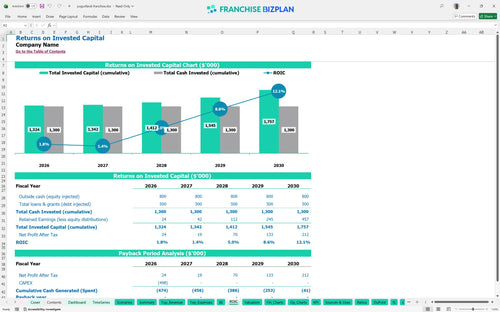
The ROI analysis indicates an Internal Rate of Return (IRR) of 1.93% and a Return on Equity (ROE) of 0.57 over the first five years. Because of the high initial build-out and equipment costs, the model shows the full payback period occurring after year five. This is a marathon for equity in a prime location, not a sprint for quick cash.
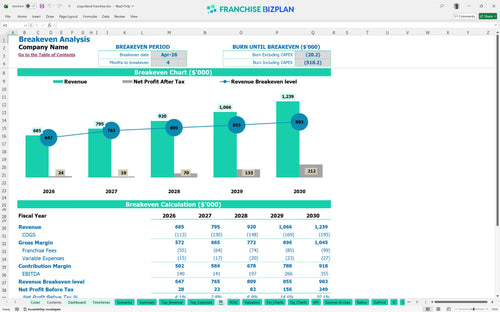
You hit the monthly break-even point in month four, provided you can cover the $9,500 monthly rent and $110,000 in combined management salaries. Volume is the only way to outrun high prime-location rent and the 8% royalty burden. Using best practices for franchise unit financial planning, you can focus on the throughput needed to move from red to black.
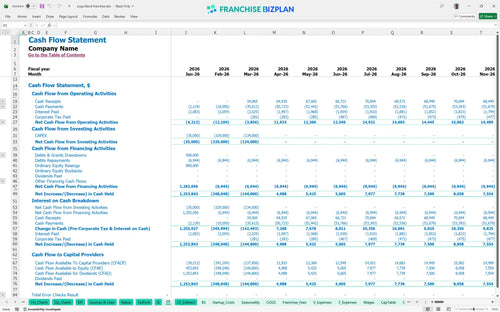
The lowest cash point occurs in March 2026 at $761,000, which represents the peak of your ramp-up spending. You defintely need a monthly operating budget template for yogurt franchise operations to manage the gap between equipment payments and steady revenue. Cash is king, especially when your machines are being installed and the staff is being trained.
The retail franchise investment return calculator shows that small changes in daily traffic significantly impact your year-one margin. In a high scenario, increasing catering and specialty creations can boost your $140,000 EBITDA and shorten the payback timeline. Small wins in daily traffic lead to big jumps in annual ROI, while a low scenario makes the $9,500 rent a heavy burden.
Finance: update unit break-even and payback model by Friday
This franchise financial model is built in Excel, giving you total control over every variable in your shop. It includes pre-filled formulas for frozen yogurt franchise cost and editable assumptions so you can adjust for local labor rates or specific lease terms. It is the easiest way to learn how to build a financial model for a new franchise without starting from a blank sheet.

Success in this industry requires looking past the grand opening to long-term sustainability. This franchise business plan template maps out a five-year path, showing how revenue scales from $685,000 in year one to $1,239,000 by year five. It provides a clear view of retail franchise startup costs and how they impact your long-term cash flow and balance sheet.

Franchise royalty fees and brand fund contributions are fixed realities that can squeeze your margins if not planned correctly. This model specifically tracks the 6% royalty and 2% marketing fund, ensuring you are analyzing franchise royalty and marketing fund costs against your gross sales every month. It simplifies the math so you know exactly how much goes to the franchisor before you pay your own bills.

Knowing your numbers starts with a detailed startup cost breakdown for a self-serve yogurt shop, covering everything from the $35,000 initial fee to the $220,000 build-out. The integrated break-even analysis identifies the exact sales volume needed to cover your $9,500 monthly rent and fixed overhead. This helps you set realistic daily traffic goals from the moment you open your doors.

We integrated industry-standard data into this franchise unit financial forecasting excel model to help you sanity-check your expectations. For example, yogurt ingredients are pegged at 15% of sales, providing a baseline for your operating expenses spreadsheet. These benchmarks allow you to compare your projected performance against established norms for labor, occupancy, and gross margins.


Simply purchase and download the financial model template, then access it instantly using Microsoft Excel or Google Sheets. No installation or technical expertise required-just open and start working.

Enter your business-specific numbers, including revenue projections, costs, and investment details. The pre-built formulas will automatically calculate financial insights, saving you time and effort.

Leverage the investor-ready format to confidently showcase your financial projections to banks, franchise representatives, or investors. Impress stakeholders with clear, data-driven insights and professional reports.

Leverage the investor-ready format to confidently present your projections to banks, franchise representatives, or investors.