


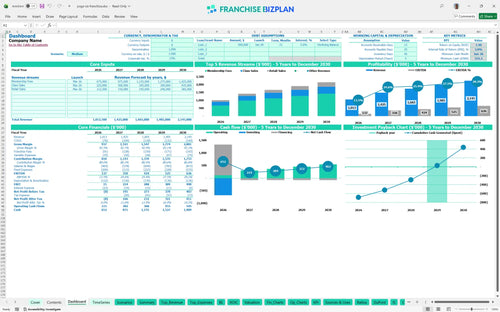
All-in-one Dashboard
Core inputs and core outputs



This franchise unit financial model template includes a full franchise P&L statement, cash flow tracker, and CapEx schedule to manage your fitness studio investment. This is your financial flight manual.
Core inputs and core outputs
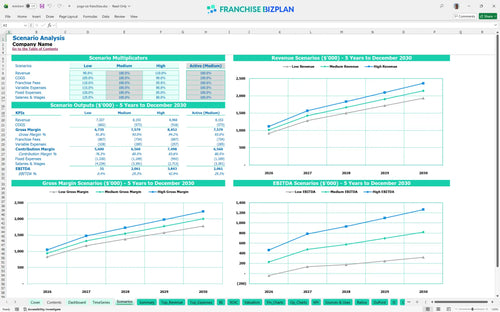
Three scenario analysis
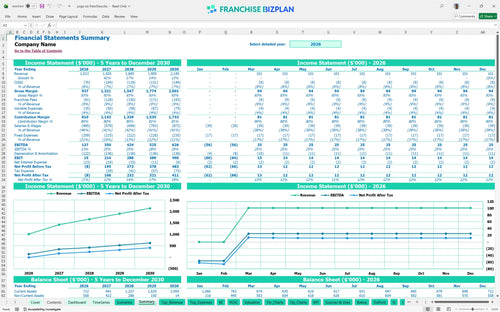
Presentation ready
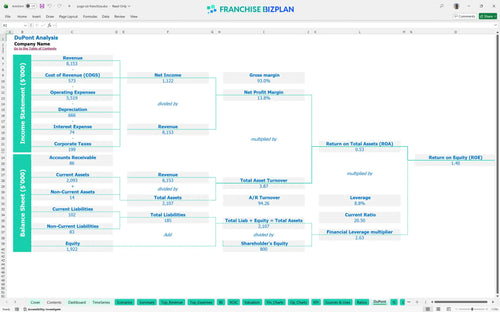
DuPont analysis
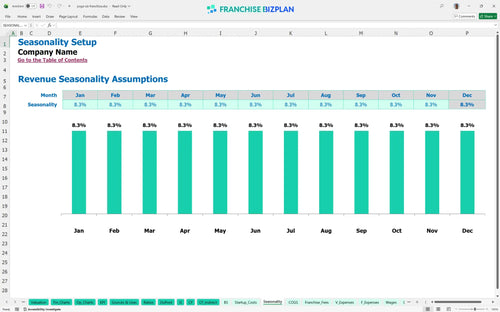
Researched revenue assumptions
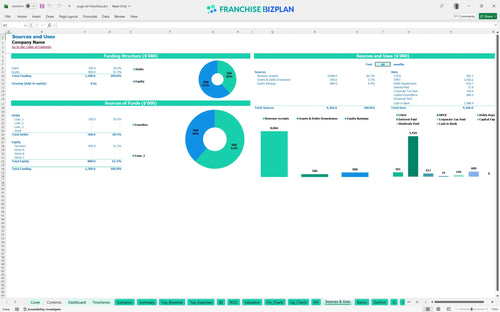
Lender-friendly financial outputs
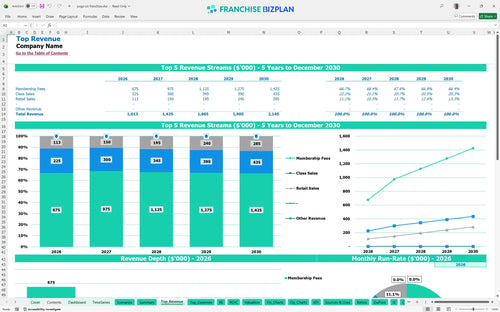
Revenue stream detailed view
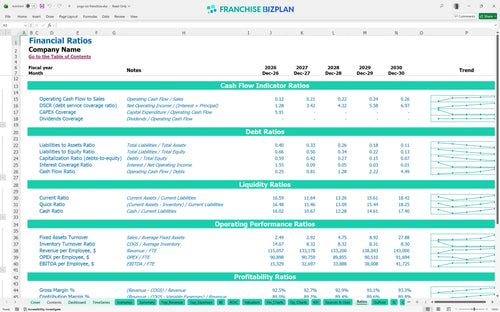
Performance metrics benchmark
We built this yoga studio franchise financial model using deep-dive research into boutique fitness unit economics and sensory-driven studio requirements. Key assumptions, including the $1.01M year-one revenue and the 4-month ramp to break-even, are pre-populated with researched data specific to this boutique yoga franchise. These pre-opening financial projections for fitness franchises are fully editable to match your specific location and local labor market. Research-backed data beats gut feelings every time.
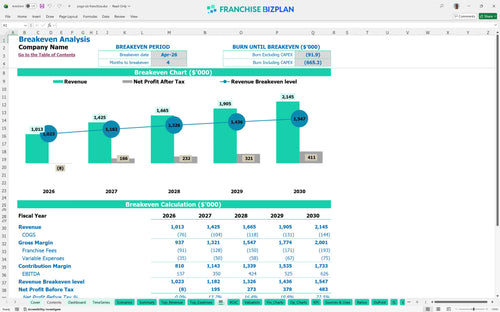
You can expect this franchise unit to become profitable by April 2026, which is just four months after your initial launch. By year five, the model projects a net profit driven by $2.14M in annual revenue and a disciplined 7% royalty structure. Analyzing recurring revenue for yoga studio memberships is the key to maintaining this upward trajectory. Membership retention is the engine of this business.
Launching this unit in the US requires a total initial investment of approximately $700,000, covering everything from the $60,000 franchise fee to specialized studio flooring. Your capital expenditure budget is dominated by leasehold improvements and high-end HVAC systems designed for heated yoga sessions. Build-out is where most budgets go to die.
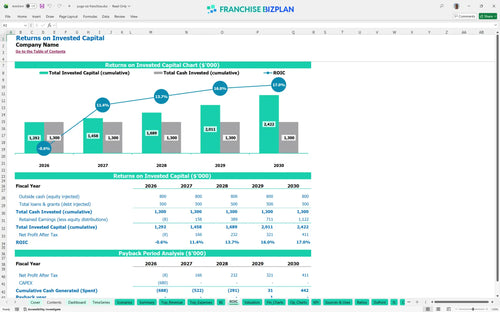
The ROI calculation for gym franchises shows a 4-year payback period with an Internal Rate of Return (IRR) of 3.04%. While the initial cash outlay is high, the 1.4 Return on Equity (ROE) and $626,000 year-five EBITDA reflect the stability of the boutique fitness model. Patience is required when the payback is four years.
You reach the monthly break-even point in April 2026 by generating enough membership and class sales to cover $12,000 in monthly rent and $1,000 in cleaning costs. The yoga studio franchise operational expense breakdown shows that membership volume is the primary driver for covering these fixed costs. Volume solves almost every margin problem.
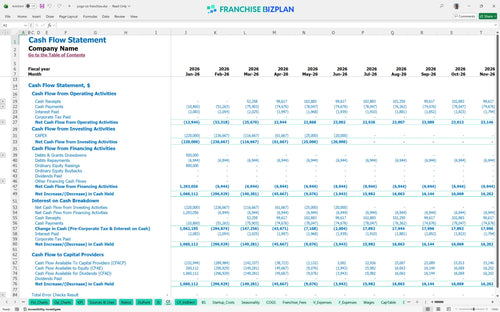
Your lowest cash point occurs in June 2026 at $555,000, meaning you need a significant cash buffer to survive the initial ramp-up phase. Following best practices for fitness franchise financial planning, you should maintain at least six months of operating runway to handle any delays in membership growth. Keep your powder dry for the first six months.
Creating a pro forma for a boutique yoga business requires looking at the downside; a 10% drop in memberships could push your payback period to 6 years. However, the high-growth scenario shows that maximizing studio throughput can significantly increase your $137,000 year-one EBITDA. Plan for the worst so you can manage the best.
This yoga studio franchise financial model is a flexible Excel tool that lets you swap out pre-filled formulas to match your specific territory. You can adjust the $12,000 monthly rent or the 7% royalty rate to see how they impact your bottom line in real-time. It is a financial model template for boutique fitness studios that allows you to test different membership pricing and retail margins without breaking the sheet. It's a plug-and-play tool for serious operators.

Planning for long-term growth is vital for boutique fitness studio profitability, and this model tracks your trajectory from $1.01M in year one to $2.14M by year five. You can forecast how scaling your instructor team from 4 to 8 full-time equivalents (FTEs) affects your store-level margin as the unit matures. Use this franchise business plan template to map out your path to a $626,000 annual EBITDA. Numbers don't lie, but they do scale.

Every dollar matters when you are paying a 7% royalty and a 2% marketing fund contribution back to the franchisor. This yoga franchise investment analysis tool automates these calculations based on your monthly membership and class sales so you aren't surprised by the bill. It ensures you account for the $60,000 initial fee and ongoing brand obligations before you ever sign a lease. Royalties are your biggest fixed-variable headache.

Figuring out how to calculate startup costs for a yoga studio franchise is the first hurdle for any new owner. With $250,000 for leasehold improvements and $100,000 for specialized HVAC heat systems, your initial check is significant, but this model shows you exactly when you stop burning cash. You defintely need to hit the April 2026 break-even date to keep your fitness franchise startup costs from spiraling. Cash is king, especially during build-out.

We have included franchise unit economic performance data so you can sanity-check your operating expense forecasting against industry standards. If your merchandise costs exceed the 6% benchmark or your $1,000 cleaning budget is too low, the model will highlight the variance immediately. It helps you compare your $1.4M year-two revenue target against other high-performing boutique fitness concepts. Use these benchmarks to stay in the green.


Simply purchase and download the financial model template, then access it instantly using Microsoft Excel or Google Sheets. No installation or technical expertise required-just open and start working.

Enter your business-specific numbers, including revenue projections, costs, and investment details. The pre-built formulas will automatically calculate financial insights, saving you time and effort.

Leverage the investor-ready format to confidently showcase your financial projections to banks, franchise representatives, or investors. Impress stakeholders with clear, data-driven insights and professional reports.

Leverage the investor-ready format to confidently present your projections to banks, franchise representatives, or investors.