


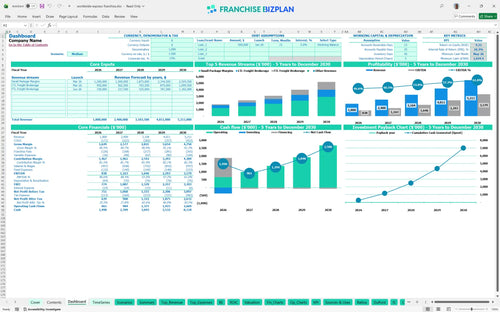
All-in-one Dashboard
Core inputs and core outputs



This franchise unit business plan template delivers a complete 5-year roadmap with integrated revenue streams for small package, LTL, and FTL freight brokerage operations.
Core inputs and core outputs
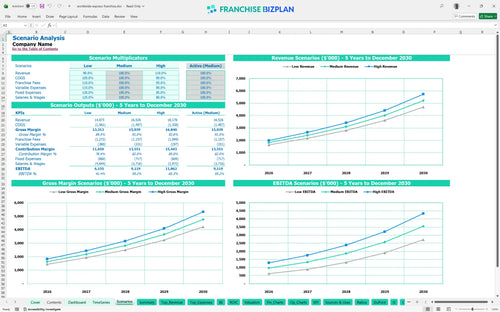
Three scenario analysis
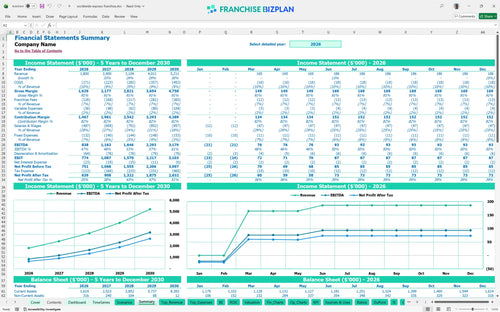
Presentation ready
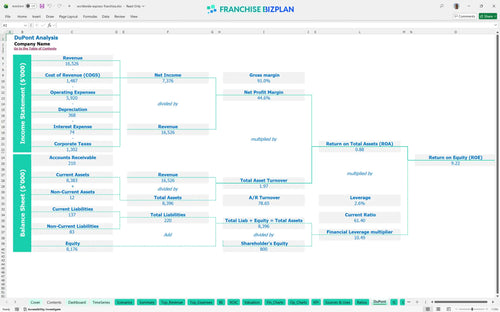
DuPont analysis
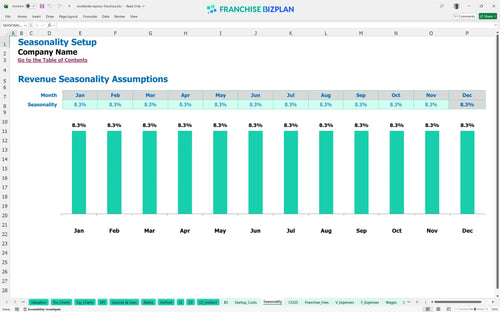
Researched revenue assumptions
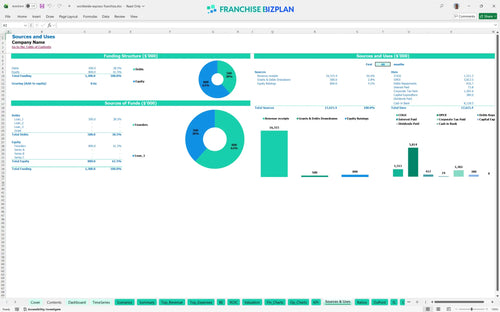
Lender-friendly financial outputs
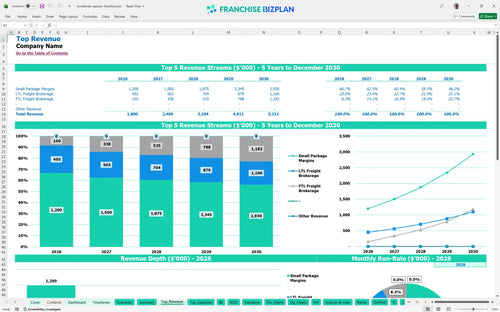
Revenue stream detailed view
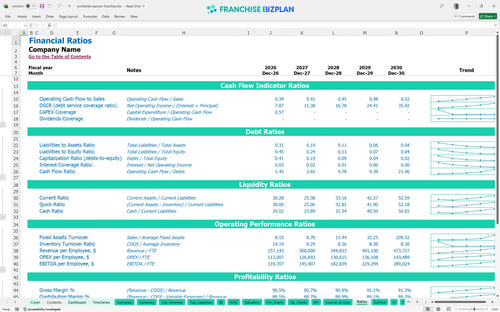
Performance metrics benchmark
We built this logistics franchise financial model using detailed research on freight brokerage startup capital and unit performance. Key assumptions like the $1.8M year-one revenue and 18.17% IRR are pre-populated and fully editable to match your specific market conditions. This ensures you have a credible, data-driven starting point for your financial forecasting for franchise owners.
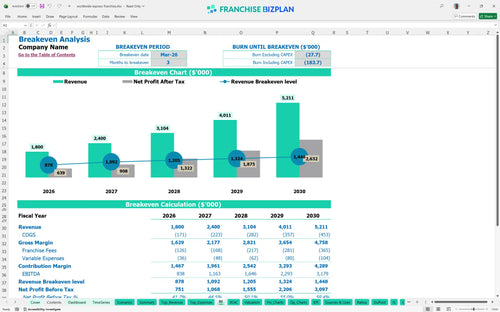
The unit reaches monthly profitability by March 2026, just three months after launch, thanks to strong early demand in the small package segment. With year-one EBITDA projected at $838,000, the model shows a healthy trajectory as you scale toward $3.1 million in annual earnings by year five.
You need approximately $380,000 in total CAPEX to launch this logistics franchise unit in the US market. This covers the $95,000 franchise fee, $120,000 in leasehold improvements for your North Austin office, and $45,000 for IT and server infrastructure.
Investors can expect an Internal Rate of Return (IRR) of 18.17% and a Return on Equity (ROE) of 9.22% for this unit. While the total payback period extends after year five due to the significant initial investment, the annual net margins remain strong as revenue scales past $5 million.
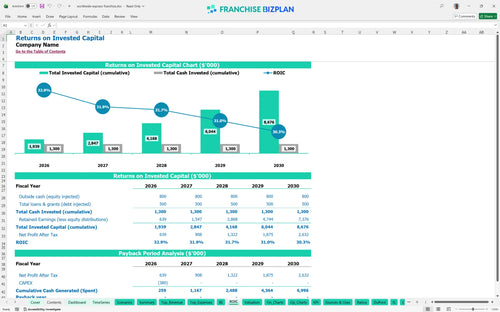
The unit hits break-even in March 2026, requiring about three months of trading to cover the $7,500 monthly rent and high-touch sales payroll. Volume in the small package margin segment is the primary lever, so hitting your year-one $800,000 target there is critical for cash neutrality.
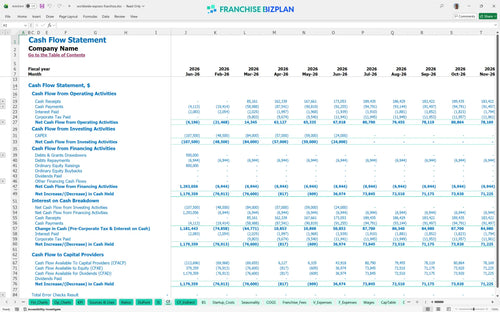
The lowest cash point occurs in May 2026 with a balance of $1,024,000, assuming you have sufficient startup liquidity. You defintely need to watch the timing gap between paying carriers and collecting from B2B clients, as this can squeeze your runway during the initial ramp-up phase.
The model compares scenarios where a 10% drop in revenue can delay your March 2026 break-even date and lower the 18.17% IRR. Conversely, hitting the high case through better FTL brokerage penetration significantly boosts your year-five EBITDA and shortens the overall payback timeline.
Finance: update unit break-even and payback model by Friday.
This logistics franchise financial model is built in Excel with fully editable assumptions, letting you swap out carrier costs or local office rent in seconds. It uses pre-filled formulas to handle the heavy lifting, so you can focus on testing different shipping volumes and freight brokerage margins without starting from scratch.

Map your growth from a $1.8 million start in year one to over $5.2 million by year five with detailed shipping business financial projections. This tool tracks your long-term cash flow and profitability, ensuring your territory scales sustainably as you add more B2B accounts and expand your freight brokerage services.

This model captures the real economics of the unit by calculating the $95,000 initial fee and the ongoing 6% royalty and 1% marketing fund obligations. It helps you see exactly how these brand-standard costs impact your monthly store-level margin before you commit to a territory.

Use the franchise startup cost calculator to plan your $380,000 initial investment, covering everything from leasehold improvements to the SpeedShip tech integration. The model identifies the exact revenue level needed to cover your $7,500 monthly rent and specialized sales team payroll.

Compare your projected performance against logistics profit margins and standard supply chain business model metrics to sanity-check your plan. The model includes benchmarks for labor and occupancy, helping you verify if your 8% direct carrier costs are in line with high-performing freight brokerage units.


Simply purchase and download the financial model template, then access it instantly using Microsoft Excel or Google Sheets. No installation or technical expertise required-just open and start working.

Enter your business-specific numbers, including revenue projections, costs, and investment details. The pre-built formulas will automatically calculate financial insights, saving you time and effort.

Leverage the investor-ready format to confidently showcase your financial projections to banks, franchise representatives, or investors. Impress stakeholders with clear, data-driven insights and professional reports.

Leverage the investor-ready format to confidently present your projections to banks, franchise representatives, or investors.