


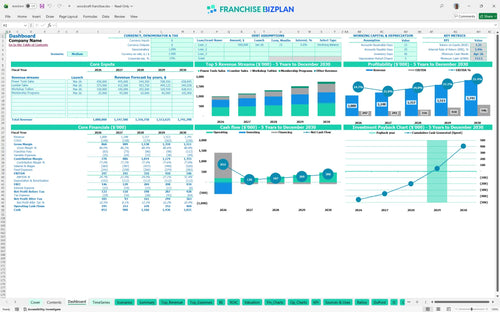
All-in-one Dashboard
Core inputs and core outputs



This Excel template for franchise financial forecasting provides a complete roadmap for your unit, covering everything from initial build-out costs to five-year profit and loss statements.
Core inputs and core outputs
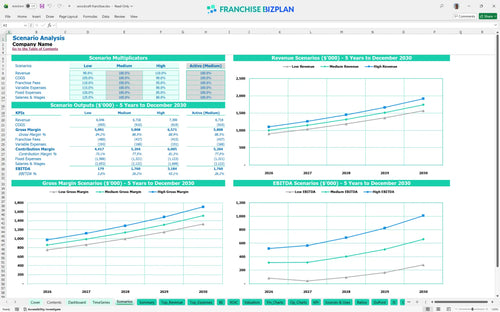
Three scenario analysis
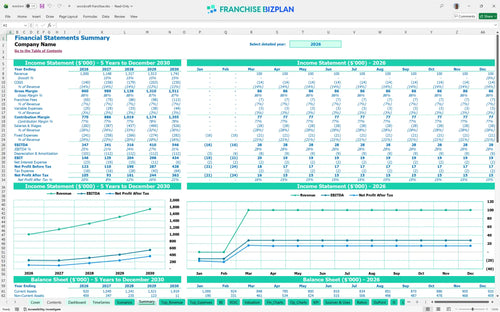
Presentation ready
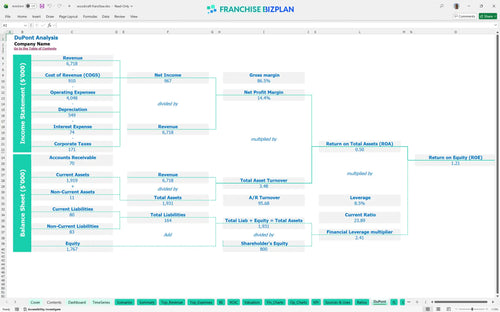
DuPont analysis
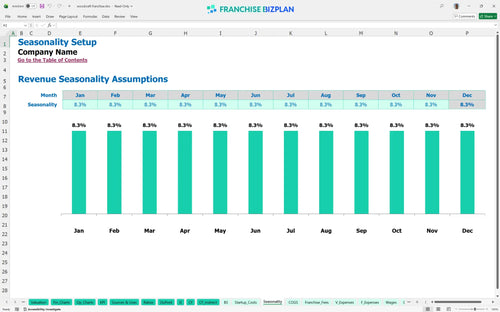
Researched revenue assumptions
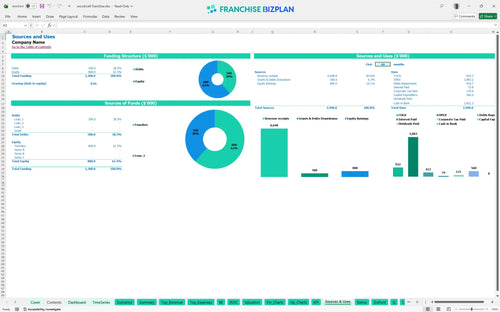
Lender-friendly financial outputs
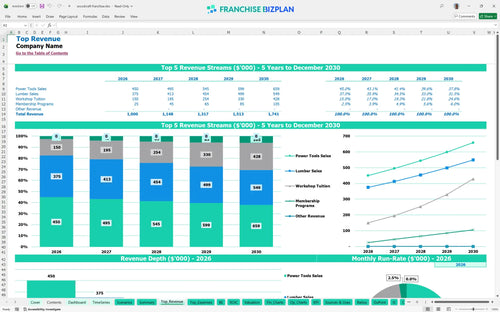
Revenue stream detailed view
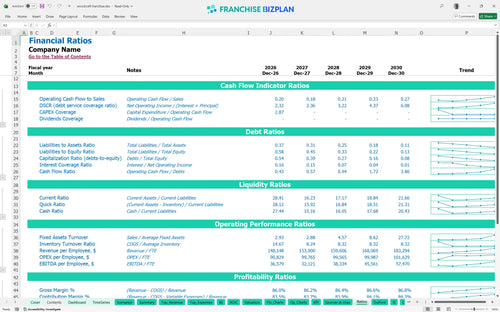
Performance metrics benchmark
We developed this financial model for woodworking retail store operations based on intensive research into the sector. The model comes pre-populated with realistic assumptions for four revenue streams, including power tools and workshop tuition, and accounts for specific costs like the $50,000 franchise fee and 5% royalty. You can defintely edit every line to match your local market reality, from the $14,000 prime location rent to the specific staffing mix required for your store.
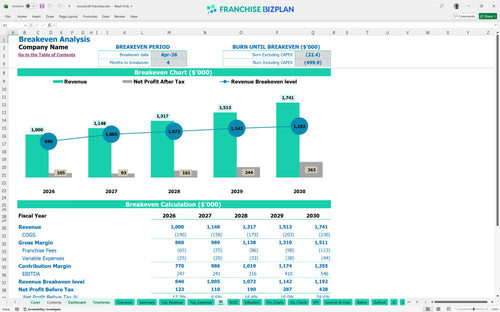
Based on the data, this unit hits its break-even point in April 2026, just four months after the March launch. By Year 1, you are looking at an EBITDA of $247,000, which grows steadily as workshop tuition and membership programs ramp up. High-margin services like classes help offset the lower margins on heavy machinery sales.
You will need a significant startup budget spreadsheet for retail franchise operations, totaling roughly $560,000 in initial CAPEX. This covers the $250,000 leasehold improvements and the $65,000 workshop classroom setup. You need to account for the $50,000 'Try-Before-You-Buy' stations that define this specific retail experience.
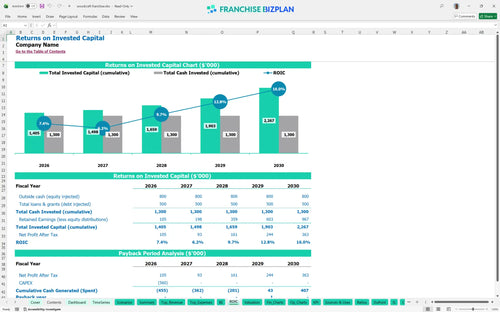
The model shows a 4-year payback period and an Internal Rate of Return (IRR) of 3.4%. While the IRR might look modest, the Return on Equity (ROE) of 1.21 suggests a solid foundation for a long-term operator. Analyzing franchise investment returns requires looking past the first year to see the $546,000 EBITDA potential by Year 5.
The monthly break-even point is reached in April 2026, driven largely by the $14,000 fixed rent and the $15,000+ monthly management payroll. To hit this quickly, you need to maintain a steady flow of power tool sales, which are projected at $300,000 in the first year. If your store-level margin dips due to high inventory costs, the break-even date will slide right.
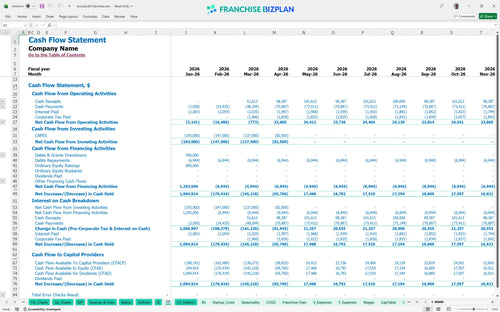
The lowest cash point is $714,000 in April 2026, which coincides with your break-even month. You need to ensure you have enough working capital to cover the gap between the January build-out start and the March opening. A cash buffer is essential because any delay in the $250,000 build-out can drain your reserves faster than expected.
In a high-growth scenario, increasing your workshop tuition and membership revenue can significantly pull forward your payback period. Conversely, a low-revenue case where power tool sales lag by 20% would require much tighter control over the $14,000 monthly rent and payroll. Estimating inventory costs for franchise units is the biggest variable here; a 1-point shift changes everything.
Finance: update unit break-even and payback model by Friday
This franchise financial model lives in Excel, meaning you can tweak every variable to match your specific territory. Whether you are adjusting the $14,000 monthly rent for a different zip code or changing the 5% royalty fee, the pre-filled formulas handle the heavy lifting. It is a flexible tool that lets you stress-test your woodworking business financial projections without starting from scratch.

Planning for the long haul is easier when you can see Year 1 revenue of $1,000,000 scaling to over $1.7 million by Year 5. This tool provides a deep dive into your operating expense forecast and cash flow, ensuring you see how EBITDA grows from $247,000 to $546,000. It is about seeing the big picture of your franchise unit profitability analysis over a half-decade.

We built in specific slots for the $50,000 initial franchise fee and the ongoing 5% royalty and 1.5% marketing fund contributions. These off-the-top costs can eat into margins if you aren't careful, so tracking them alongside local overhead is vital. Understanding these obligations helps you see the real net cash left in your pocket after the franchisor gets their cut.

Launching a retail franchise requires a clear capital expenditure budget, from the $250,000 build-out to the $75,000 in shelving. This model includes a break-even point calculation to show exactly when your monthly sales cover both fixed and variable costs. Knowing you need to hit break-even by April 2026 helps you manage your initial launch runway effectively.

Use our researched data to sanity-check your numbers against typical woodworking store profitability metrics. If your inventory costs are significantly higher than the 13% benchmark we've included, you'll know where to look for margin leaks. It is like having a CFO in your pocket to tell you if your staffing plan is realistic or too lean.


Simply purchase and download the financial model template, then access it instantly using Microsoft Excel or Google Sheets. No installation or technical expertise required-just open and start working.

Enter your business-specific numbers, including revenue projections, costs, and investment details. The pre-built formulas will automatically calculate financial insights, saving you time and effort.

Leverage the investor-ready format to confidently showcase your financial projections to banks, franchise representatives, or investors. Impress stakeholders with clear, data-driven insights and professional reports.

Leverage the investor-ready format to confidently present your projections to banks, franchise representatives, or investors.