


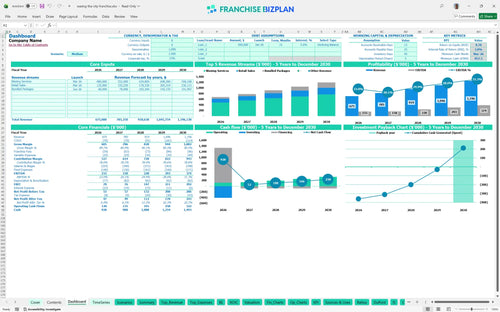
All-in-one Dashboard
Core inputs and core outputs



This franchise financial forecasting spreadsheet includes a comprehensive revenue engine, detailed payroll tracker, and automated financial statements to guide your investment decision.
Core inputs and core outputs
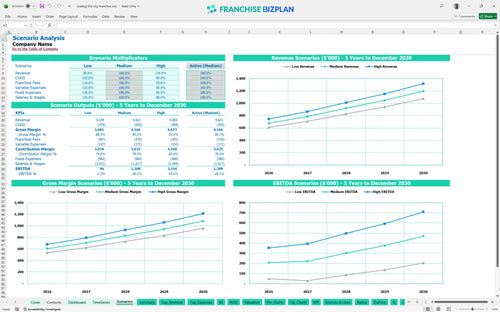
Three scenario analysis
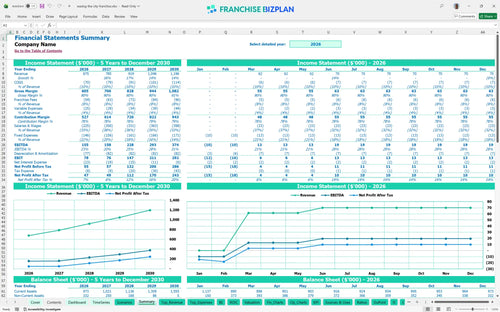
Presentation ready
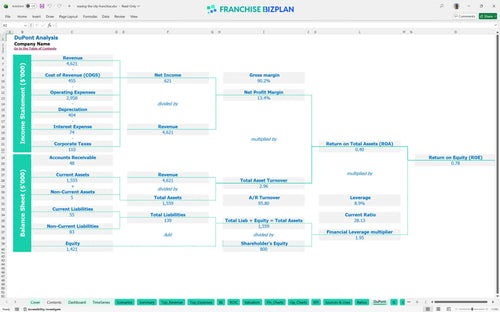
DuPont analysis
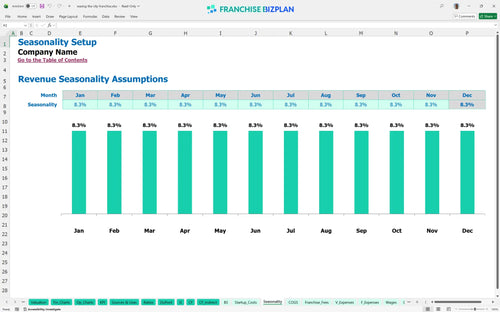
Researched revenue assumptions
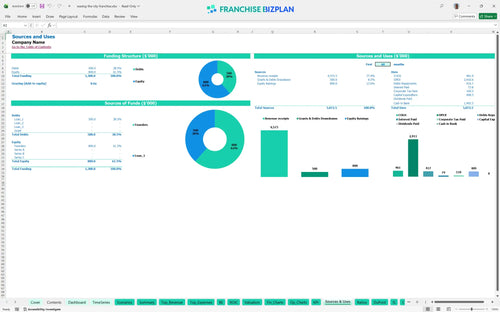
Lender-friendly financial outputs
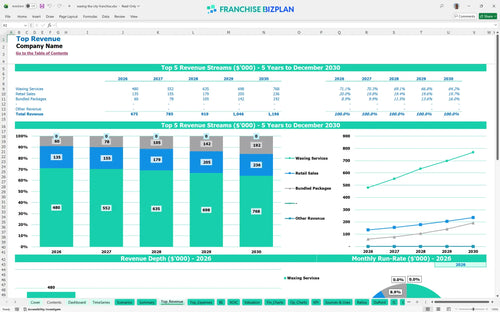
Revenue stream detailed view
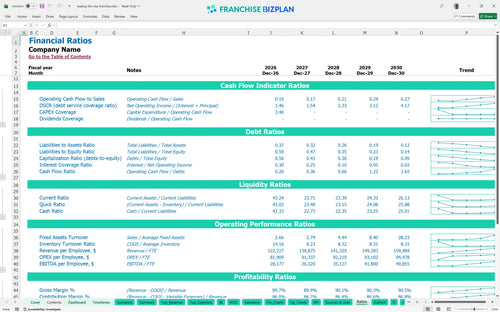
Performance metrics benchmark
We built this franchise unit financial model using our own research into the personal care sector. Key assumptions, including the $675,000 year-one revenue target and the $8,500 monthly rent for prime locations, are pre-populated and fully editable. This tool allows you to stress-test the 5-year EBITDA growth and the $42,500 initial investment to ensure the unit meets your specific return requirements.
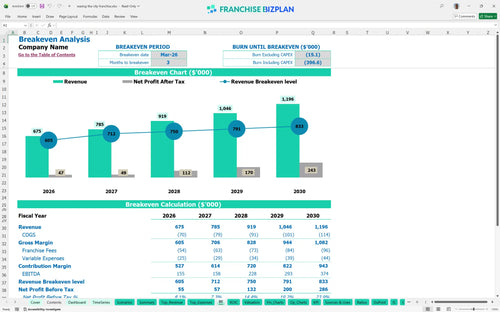
The studio reaches profitability in March 2026, just three months after the initial launch. By year one, the unit generates $155,000 in EBITDA after covering wax supplies, labor, and the 8% combined royalty and marketing fees. Profitability scales significantly as revenue climbs toward the $1.19 million mark in year five.
Launching this unit in the US requires a total initial investment centered on a $220,000 build-out and $65,000 in equipment. You must also account for the $42,500 franchise fee and an initial inventory of $15,000. The model indicates a minimum cash requirement of $857,000 to safely navigate the ramp-up period through early 2026.
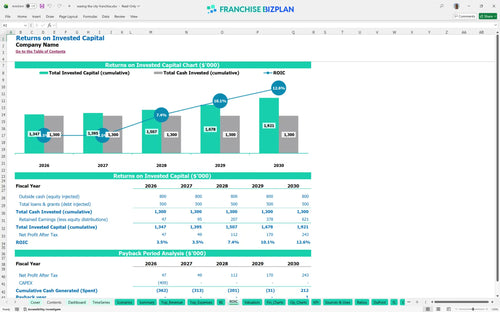
Investors can expect a 5-year payback period with an Internal Rate of Return (IRR) of 2.96%. While the initial years focus on recovering the heavy leasehold investment, the average net margin improves as revenue scales. The model shows a Return on Equity (ROE) of 0.78, reflecting the capital-intensive nature of high-end studio build-outs.
The monthly break-even point is reached in March 2026, driven primarily by the volume of waxing services. With fixed costs like the $8,500 rent and $72,000 manager salary, the studio relies on maintaining high throughput and a strong average ticket. Labor productivity is the most sensitive lever in this salon franchise startup costs analysis.
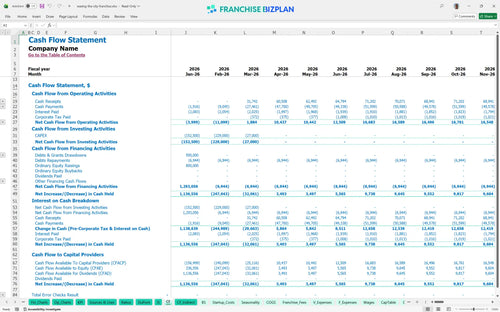
The lowest cash point occurs in March 2026 at $857,000, coinciding with the end of the build-out and the start of full operations. You defintely need a three-to-six-month working capital buffer to handle the timing gap between the $220,000 leasehold payment and the ramp-up of recurring service revenue.
The High scenario assumes a faster ramp-up of the 4.0 Licensed Cerologists and higher retail sales, which can push year-five revenue to $1.19 million. In contrast, a Low scenario with slower client acquisition would delay the 5-year payback and increase the peak cash need. The model shows that even small changes in the 6% royalty burden impact year-one margins.
This franchise financial model template is fully customizable in Excel, providing a dynamic environment where you can adjust every variable. With pre-filled formulas and editable assumptions, you can easily adapt the math to your specific territory, local labor rates, and real estate costs. It is designed to help you move from a generic business plan to a precise, location-specific operating scenario.

Planning for a boutique wax studio requires a multi-year lens to understand how margins evolve as the client base matures. This model provides detailed 5-year revenue, cost, and cash flow projections, showing revenue growth from $675,000 in year one to $1,196,000 by year five. It offers a clear view of long-term profitability for a single unit or a growing multi-unit portfolio.

The model captures the specific royalty fee structure and ongoing obligations that define the franchisor-franchisee relationship. It accounts for the $42,500 initial fee along with the 6% royalty and 2% brand marketing fund contributions. This ensures you see the true store-level margin after all brand-related overhead is paid, leaving no surprises in your recurring revenue modeling.

Estimating profitability for a boutique wax studio starts with a clear view of the total startup investment. This tool helps you calculate startup costs for a waxing franchise, including $220,000 for leasehold improvements and $65,000 for equipment. It maps out the monthly sales level required to cover your $8,500 monthly rent and variable costs, providing a definitive break-even target.

We integrated salon franchise unit economics analysis into the model so you can compare your projections against industry standards. From wax supply costs starting at 7.5% of sales to staffing levels for Cerologists, the model uses built-in benchmarks to sanity-check your budget. This helps you identify if your labor or occupancy costs are out of alignment with successful beauty franchise operations.


Simply purchase and download the financial model template, then access it instantly using Microsoft Excel or Google Sheets. No installation or technical expertise required-just open and start working.

Enter your business-specific numbers, including revenue projections, costs, and investment details. The pre-built formulas will automatically calculate financial insights, saving you time and effort.

Leverage the investor-ready format to confidently showcase your financial projections to banks, franchise representatives, or investors. Impress stakeholders with clear, data-driven insights and professional reports.

Leverage the investor-ready format to confidently present your projections to banks, franchise representatives, or investors.