


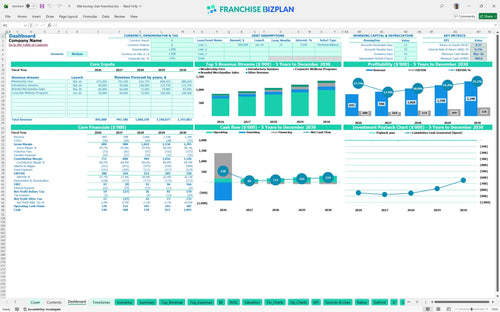
All-in-one Dashboard
Core inputs and core outputs



This fitness franchise business plan tool maps every dollar from the first bag hung to the five-year exit, providing a complete roadmap for cash flow management.
Core inputs and core outputs
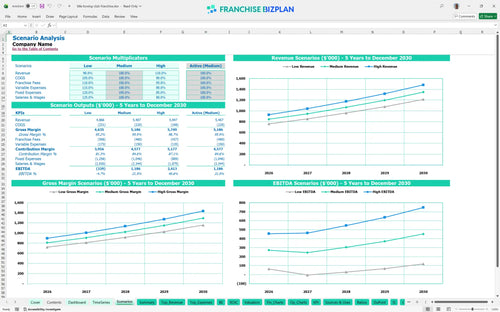
Three scenario analysis
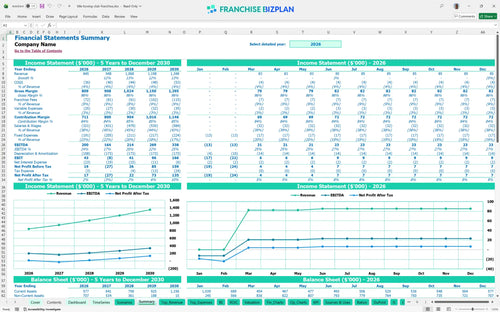
Presentation ready
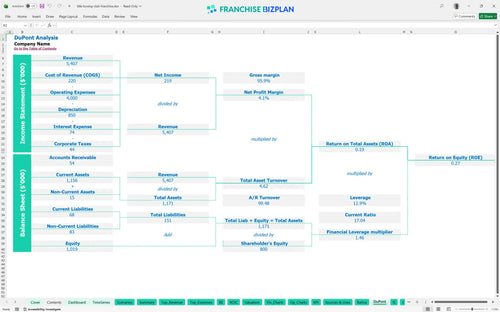
DuPont analysis
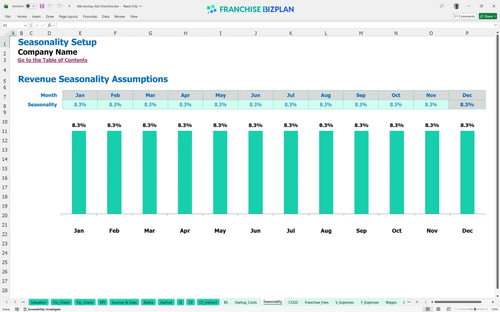
Researched revenue assumptions
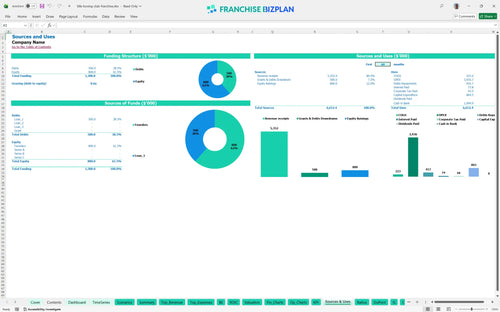
Lender-friendly financial outputs
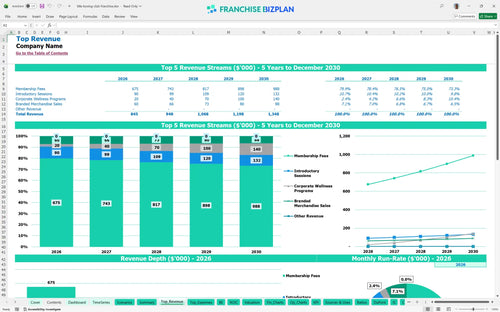
Revenue stream detailed view
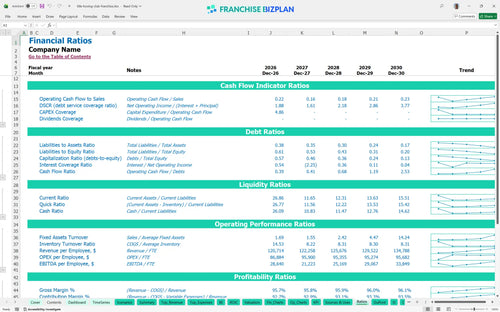
Performance metrics benchmark
We developed this model using intensive research into the boutique fitness sector to provide a realistic financial roadmap. Key assumptions, such as the $49,500 initial fee and $400,000 in leasehold improvements, are pre-populated and fully editable to match your specific location. This researched data ensures you can accurately project how membership fees and merchandise sales impact your store-level margins from day one.
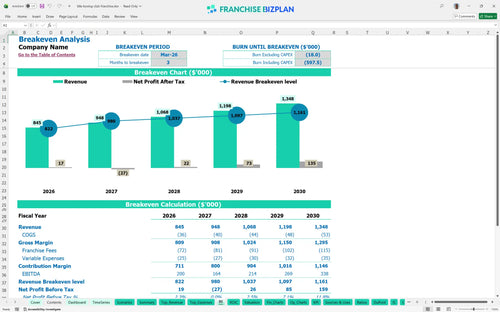
Profitability for this unit is expected very early, with the model showing a break-even date in March 2026, just three months after launch. With a Year 1 EBITDA of $200,000, the unit scales effectively as membership revenue grows from $450,000 to over $650,000 by Year 5. This trajectory is defintely achievable if you maintain high coach productivity and perform a boutique gym franchise profit margin analysis regularly. Speed to profit is the only metric that keeps the lights on early.
Launching this unit requires a total initial investment of approximately $864,500, which includes the franchise fee and all equipment. When estimating startup costs for a health and wellness franchise, you must account for the $400,000 leasehold build-out and $150,000 for heavy bags and fitness gear. Creating a budget for a new boxing fitness studio requires balancing these high upfront costs against your initial membership ramp-up. Your biggest check isn't the fee; it's the floor and the walls.
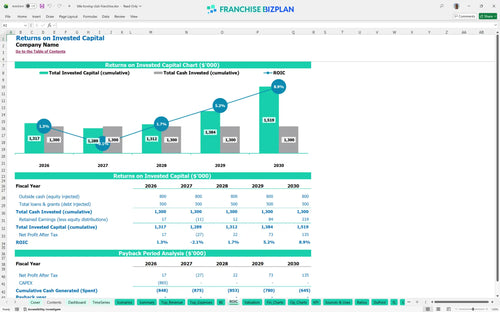
Investors can expect an Internal Rate of Return (IRR) of 69% and a Return on Equity (ROE) of 0.27 based on these researched financial projections for boutique fitness franchises. While the payback period extends beyond Year 5 due to the high initial build-out cost, the steady climb in EBITDA to $338,000 by the fifth year shows strong long-term value. High returns require disciplined margin management over the long haul.
The monthly break-even point occurs when revenue covers approximately $16,550 in fixed operating costs, plus royalties and variable expenses. This Excel template for franchise unit business planning shows that membership volume is the primary driver, as it represents the bulk of the $845,000 in Year 1 sales. Volume is vanity, but break-even is sanity.
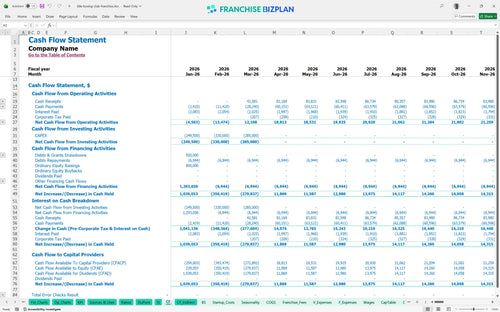
The fitness franchise financial model excel template identifies March 2026 as the lowest cash point, with a minimum cash balance of $409,000 remaining. This suggests you need a significant liquidity cushion to handle the $864,500 startup cost and the initial months of operation. Cash is your oxygen during the first six months of operation.
Switching between scenarios shows how a shift in membership retention can drastically alter your Year 1 $200,000 EBITDA. The High case assumes you successfully learn how to forecast membership revenue for fitness clubs by maximizing corporate wellness programs, which are projected to grow to $140,000 annually. Planning for the worst while aiming for the best is just good business.
Finance: update unit break-even and payback model by Friday
This franchise financial model template is built in Excel with fully editable assumptions, allowing you to adjust every variable from membership pricing to local utility costs. You can modify pre-filled formulas to reflect your specific territory and lease terms, ensuring the revenue forecasting aligns with your local market density. Customization is the difference between a generic guess and a local strategy.

Plan your growth with detailed franchise unit financial projections that span sixty months of operation. The model tracks your journey from a Year 1 revenue of $845,000 to a projected $1.348M by Year 5, providing a clear ROI analysis for stakeholders. Five years of data turns a leap of faith into a calculated move.

Manage your ongoing obligations with dedicated inputs for the 7.5% franchise royalty fees and the 1.0% brand marketing fund contribution. This section ensures your franchise unit operating expenses breakdown accurately reflects the cost of brand affiliation before you calculate your take-home pay. Royalties are a top-line tax that dictates your bottom-line reality.

Calculate your total startup capital requirements by aggregating leasehold improvements, equipment, and initial fees. The model identifies the exact sales volume needed to cover your $16,550 in monthly fixed costs, showing you how to calculate startup costs for a boxing gym with precision. Knowing your zero-day is the first step toward actual wealth.

Use integrated benchmarks to perform a financial feasibility study for fitness franchise operations, comparing your labor and rent to industry standards. This feature helps you refine your operating expense budget by highlighting areas where your costs might deviate from typical boutique fitness norms. Benchmarks act as the guardrails for your financial sanity.


Simply purchase and download the financial model template, then access it instantly using Microsoft Excel or Google Sheets. No installation or technical expertise required-just open and start working.

Enter your business-specific numbers, including revenue projections, costs, and investment details. The pre-built formulas will automatically calculate financial insights, saving you time and effort.

Leverage the investor-ready format to confidently showcase your financial projections to banks, franchise representatives, or investors. Impress stakeholders with clear, data-driven insights and professional reports.

Leverage the investor-ready format to confidently present your projections to banks, franchise representatives, or investors.