


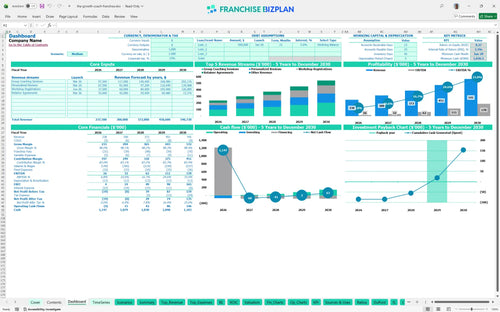
All-in-one Dashboard
Core inputs and core outputs



This excel template for franchise unit financial forecasting provides a complete toolkit to project revenue, expenses, and investor returns over five years.
Core inputs and core outputs
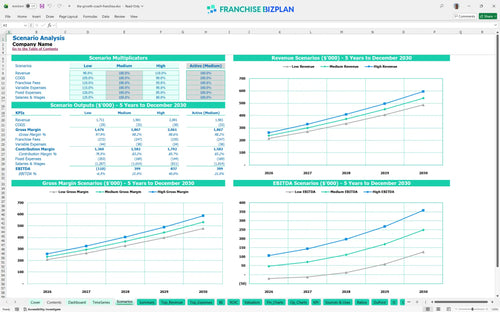
Three scenario analysis
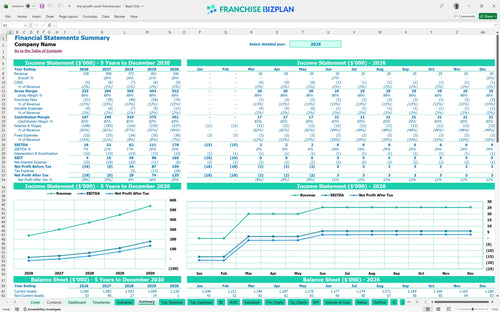
Presentation ready
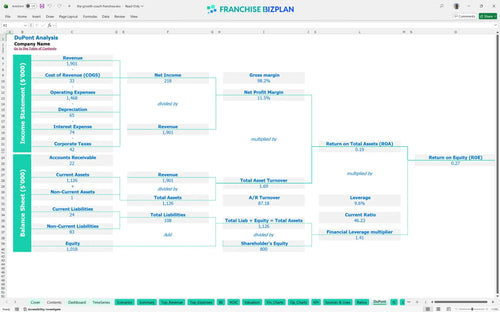
DuPont analysis
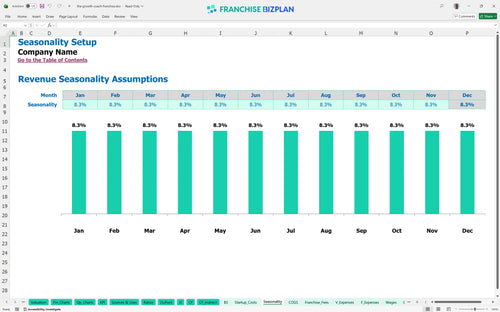
Researched revenue assumptions
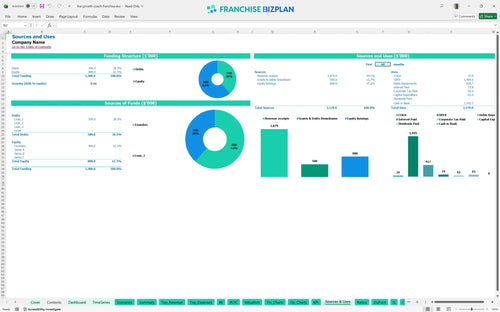
Lender-friendly financial outputs
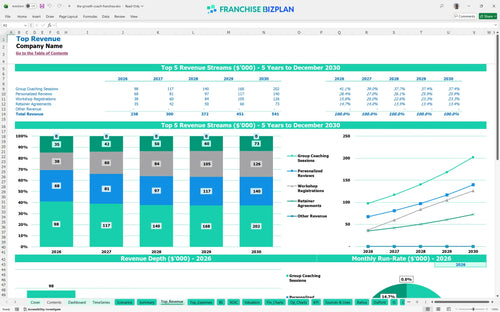
Revenue stream detailed view
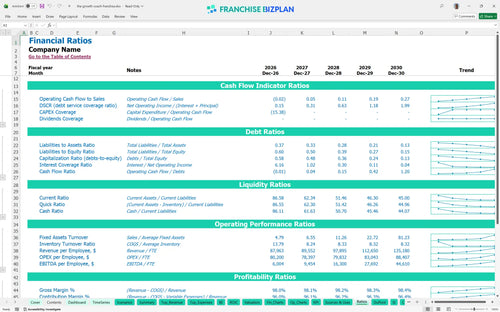
Performance metrics benchmark
We built this franchise unit financial model using intensive research into the hybrid coaching sector and professional service standards. Key assumptions, including the $238,000 year-one revenue and the 10% royalty structure, are pre-filled but remain fully editable to match your local territory. This model gives you a data-driven look at the 6-month break-even timeline and the $178,000 year-five EBITDA potential.
You can expect this unit to reach EBITDA profitability within its first year, generating $16,000 in earnings by the end of 2026. Net profit grows as you scale through year five, provided you manage the 13% total brand fee burden and fixed costs like the $1,500 monthly lease. Exploring business coaching franchise opportunities requires this level of detail to ensure the $541,000 revenue target is achievable.
The total initial investment for this unit is $65,400, which covers everything from the franchise fee to the initial marketing collateral. This startup budget template for business coaching franchise shows that the $39,900 franchise fee is your largest upfront cost, followed by the $6,000 office fit-out. You will also need to budget for $5,500 in computers and $4,500 in furniture to get the doors open.
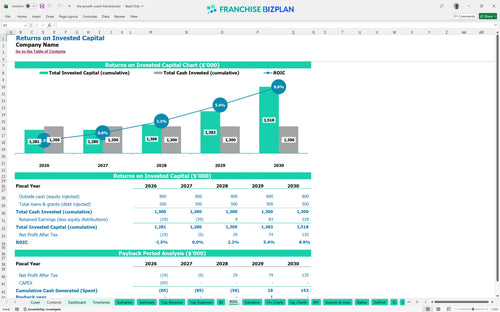
This model shows a 4-year payback period and an Internal Rate of Return (IRR) of 3.29% based on the five-year forecast. When you are learning how to calculate roi for a business coaching franchise, you must look at the ROE of 0.27 and the scaling EBITDA. Evaluating profitability of a business coaching franchise unit means focusing on the long-term cash flow that reaches $178,000 annually by year five.
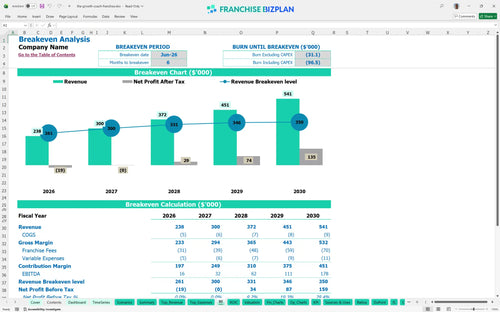
You hit the monthly break-even point in June 2026, just six months after starting operations. The primary driver for this timeline is hitting your $238,000 first-year revenue target while managing the $62,000 Lead Strategic Coach salary. If you miss your workshop registration goals, the fixed $1,500 monthly lease and $220 accounting fees will defintely put pressure on your margins.
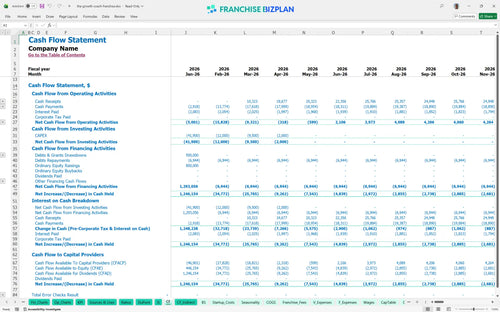
Your lowest cash point occurs in January 2029, with a balance of $1,036, which suggests you should maintain a small additional buffer. Small business franchise financial planning is about managing the timing of your $1,500 lease and the 10% royalty payments during ramp-up. You have enough runway to reach the $300,000 revenue mark in year two if you keep your variable costs at the projected 2% of sales.
A high-performance scenario, where you hit $541,000 in revenue sooner, significantly improves your 3.29% IRR and shortens the 4-year payback. Conversely, if your executive coaching franchise startup costs run over or revenue lags by 15%, your $1,036 cash floor could be at risk. The model allows you to toggle these scenarios to see how year-one EBITDA fluctuates based on your local marketing execution.
This franchise financial model template is built in Excel, allowing you to adjust every formula and assumption to fit your specific territory. You can easily edit the $39,900 franchise fee or tweak the 10% royalty rate to see the immediate impact on your cash flow. It is a flexible franchise unit business plan that adapts to your local market reality, whether you are hiring one coach or four.

Plan your long-term growth with detailed franchise unit financial projections that span 60 months of operation. The model tracks your journey from a year-one revenue of $238,000 to a mature year-five volume of $541,000. It provides a clear view of how EBITDA scales from $16,000 to $178,000 as you build your client base and optimize your hybrid coaching delivery.

This financial model for coaching and consulting franchises handles the heavy lifting of calculating ongoing brand obligations. It automatically applies the 10% royalty and 3% marketing fund contribution to your monthly revenue streams, so you always know your true store-level margin. This ensures you account for the $48,360 in total fees expected in year three before you pay for your co-working space.

Use this franchise startup cost spreadsheet to map out your initial $65,400 investment, from the $6,000 office fit-out to the $5,500 tech stack. The model identifies your break-even point in June 2026, helping you manage the six-month ramp-up period. It is an essential tool for understanding the franchise startup costs for professional coaching services and the volume needed to cover your $1,500 monthly lease.

Our franchise profitability analysis tool includes researched benchmarks for professional service units to help you sanity-check your numbers. We have factored in realistic costs like $180 for utilities and $240 for CRM software to ensure your budget is grounded in reality. Comparing your projected 3.29% IRR against these benchmarks helps you identify if your $62,000 lead coach salary is aligned with industry standards.


Simply purchase and download the financial model template, then access it instantly using Microsoft Excel or Google Sheets. No installation or technical expertise required-just open and start working.

Enter your business-specific numbers, including revenue projections, costs, and investment details. The pre-built formulas will automatically calculate financial insights, saving you time and effort.

Leverage the investor-ready format to confidently showcase your financial projections to banks, franchise representatives, or investors. Impress stakeholders with clear, data-driven insights and professional reports.

Leverage the investor-ready format to confidently present your projections to banks, franchise representatives, or investors.