


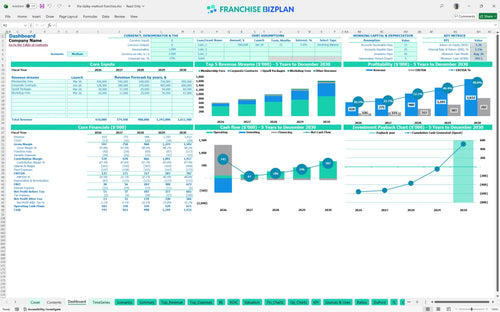
All-in-one Dashboard
Core inputs and core outputs



This boutique fitness studio financial model spreadsheet provides a complete toolkit including dynamic revenue forecasting, detailed capital expenditure schedules, and multi-scenario analysis for studio owners.
Core inputs and core outputs
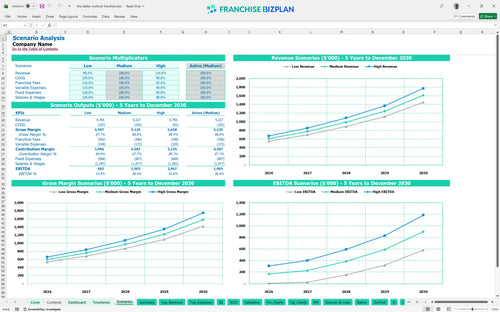
Three scenario analysis
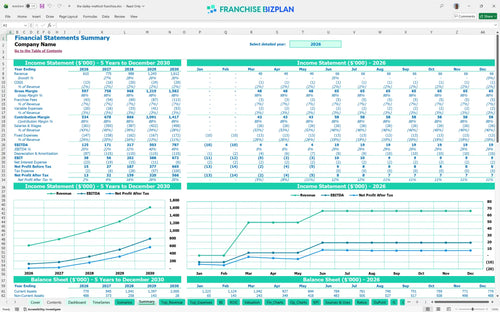
Presentation ready
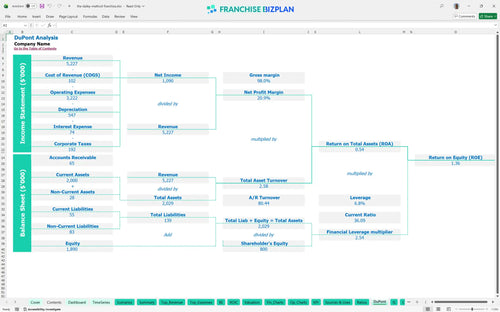
DuPont analysis
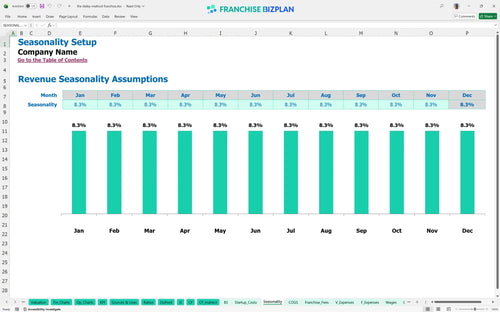
Researched revenue assumptions
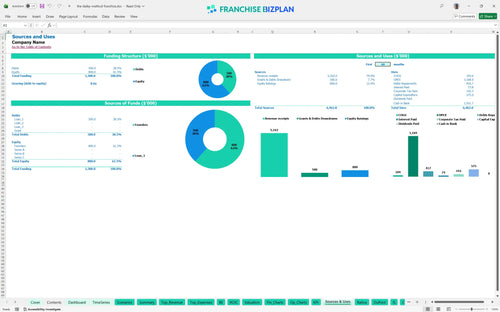
Lender-friendly financial outputs
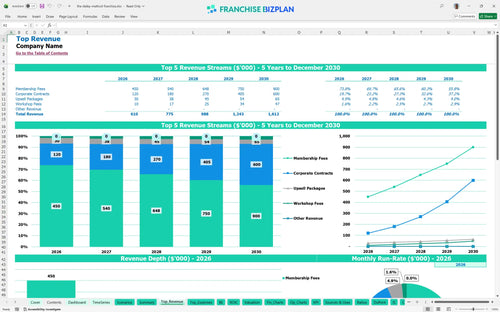
Revenue stream detailed view
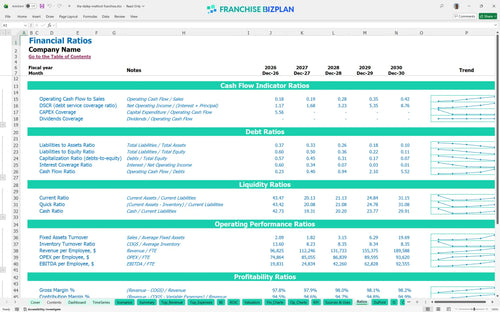
Performance metrics benchmark
We built this franchise unit financial model using our own research into boutique fitness economics and high-end studio operations. Key assumptions like membership fees, specialized labor costs, and royalty structures are pre-populated with researched data and are fully editable. With a year-one EBITDA of $125,000 and a three-month path to break-even, this model provides a realistic look at unit-level performance.
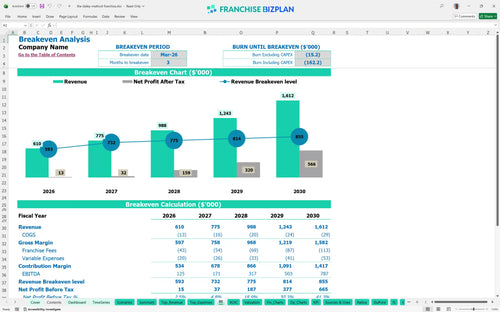
Based on the data, this unit hits its stride quickly, reaching breakeven by March 2026, just three months after launch. When analyzing profitability of a boutique fitness franchise, we see Year 1 EBITDA at $125,000 scaling to $787,000 by Year 5 as membership matures and corporate contracts grow. Still, you need to maintain high retention to keep those margins healthy over the long haul.
You will need approximately $575,000 to get the doors open, plus a cash buffer for the ramp-up phase. The largest capital expenditure items are the $250,000 for leasehold improvements and $110,000 for specialized fitness equipment to meet brand standards. This total includes the $35,000 franchise fee and $70,000 for specialized mirrors and flooring.
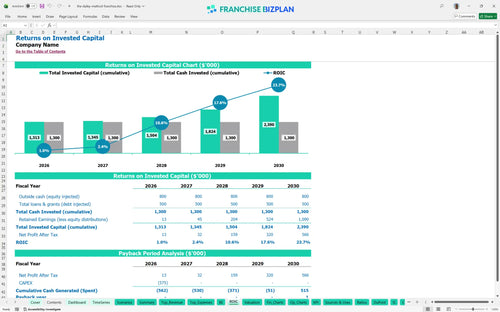
The ROI analysis projects an IRR of 3.13% and a 5-year payback period, which is standard for high-investment boutique fitness. While the initial return on equity is 1.36, the real value lies in the Year 5 cash flow of over $780,000. This franchise unit investment and return on investment calculator helps you see how scaling revenue to $1.6M transforms your bottom line.
You hit the break-even date in March 2026, assuming you hit your initial membership targets. The biggest hurdle is the $9,000 monthly rent, so your volume of recurring membership fees must ramp up fast to cover these fixed costs. Financial planning for opening a wellness studio franchise requires a heavy focus on pre-opening sales to shorten this gap.
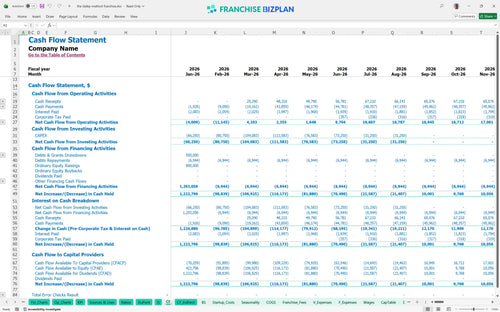
The lowest cash point hits in August 2026 at $705,000, meaning you need to maintain a solid liquidity cushion during the first six months. This comprehensive franchise unit budget template accounts for the timing gap between your $250,000 build-out and your first month of full operations. If construction or permitting delays the launch, that cash runway will shrink defintely fast.
Switching between Low, Medium, and High scenarios shows how a 10% dip in membership retention delays payback by a full year. In the High case, fitness franchise business model financial forecasting shows that hitting $1.6M in revenue by Year 5 significantly boosts your store-level EBITDA. The model helps you see how small changes in average ticket price impact your ability to service debt.
This franchise financial model lives in Excel, so you can tweak every variable to fit your specific territory. It comes with pre-filled formulas for membership tiers and staffing, but you can edit any assumption as your local market data comes in. Managing operating expenses becomes much simpler when you can adjust your rent or utility costs with a single cell update.

Mapping out five years of growth helps you see the jump from $610,000 in year one to over $1.6 million by year five. This long-term view is vital for multi-unit planning and ensuring your boutique fitness franchise profitability stays on track as the market matures. You can track how your margin expands as you scale from a few hundred members to a full studio roster.

We built in the 6% royalty and 1% marketing fee so you see exactly how much goes to the brand before you pay your instructors. It tracks the $35,000 initial fee and ongoing obligations to keep your franchise royalty fee and profit margin analysis accurate. This ensures you never overlook the cost of brand standards and ongoing corporate support.

Use the franchise startup cost calculator to estimate the $575,000 initial investment, covering everything from leasehold improvements to performance tech. Knowing you need to hit break-even by month three keeps the pressure on early membership sales. This tool shows you exactly how to calculate startup costs for a fitness franchise without missing hidden pre-opening expenses.

This franchise unit financial template includes benchmarks for boutique fitness, like keeping cleaning supplies around 1.5% of sales. Comparing your $9,000 monthly rent against these standards helps you spot if your occupancy costs are out of line. It is a critical step when estimating operating costs for a barre studio franchise in a competitive retail corridor.


Simply purchase and download the financial model template, then access it instantly using Microsoft Excel or Google Sheets. No installation or technical expertise required-just open and start working.

Enter your business-specific numbers, including revenue projections, costs, and investment details. The pre-built formulas will automatically calculate financial insights, saving you time and effort.

Leverage the investor-ready format to confidently showcase your financial projections to banks, franchise representatives, or investors. Impress stakeholders with clear, data-driven insights and professional reports.

Leverage the investor-ready format to confidently present your projections to banks, franchise representatives, or investors.