


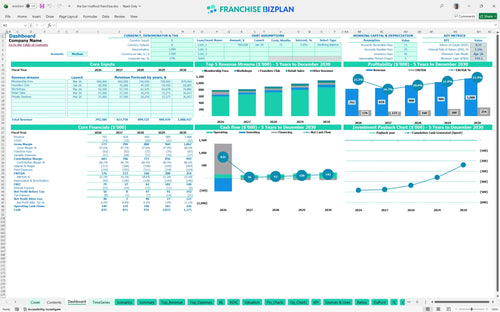
All-in-one Dashboard
Core inputs and core outputs



This franchise financial model template provides a complete Excel-based toolkit for projecting revenue, expenses, and cash flow for a new boutique fitness studio.
Core inputs and core outputs
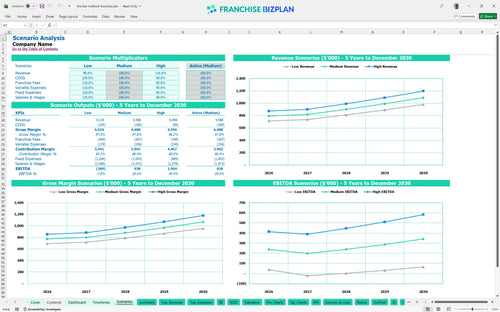
Three scenario analysis
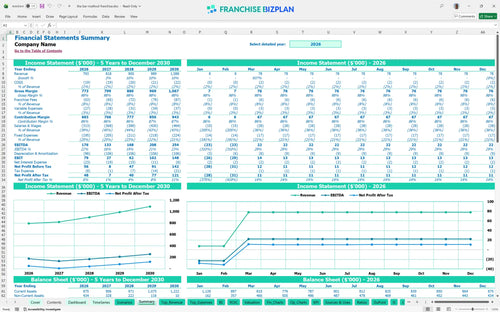
Presentation ready
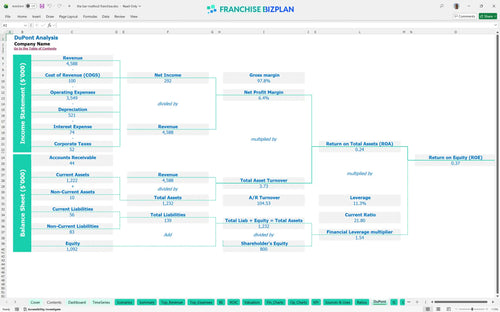
DuPont analysis
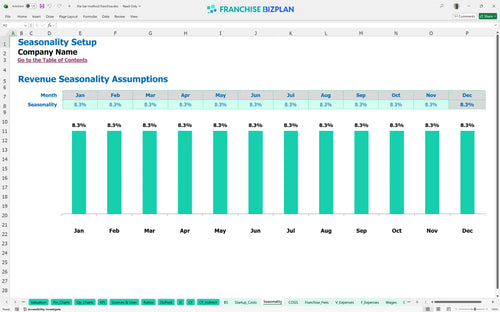
Researched revenue assumptions
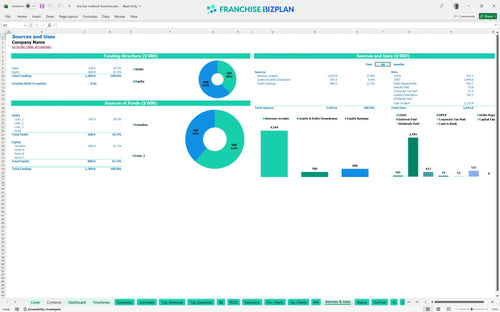
Lender-friendly financial outputs
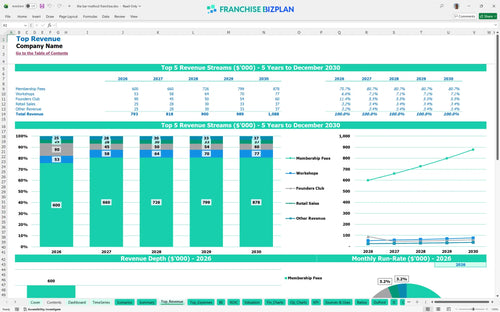
Revenue stream detailed view
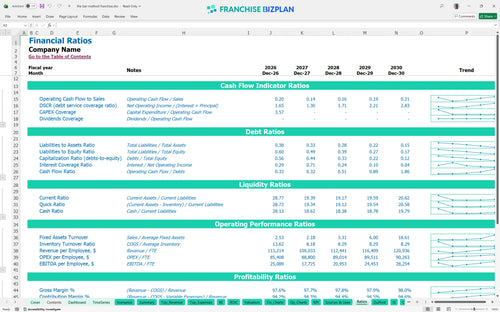
Performance metrics benchmark
We built this fitness franchise business plan model using our own research to ensure your projections are grounded in reality. Key assumptions like the $793,000 year-one revenue and $12,000 monthly rent are pre-populated with researched data specific to this fitness franchise unit and are fully editable. It is a realy practical tool for any operator looking to map out their first 60 months of operation.
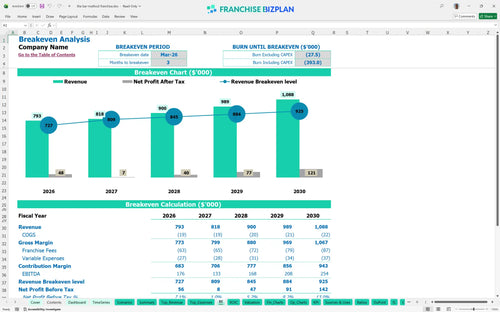
The franchise unit profitability analysis shows this studio becomes profitable in its first year, generating $176,000 in EBITDA (earnings before interest, taxes, depreciation, and amortization). While the breakeven happens in just three months, you need to maintain high membership volume to offset the 6% royalty and 2% marketing fees. Here's the quick math: your revenue grows from $793,000 in year one to over $1 million by year five.
To understand how to calculate startup costs for a fitness franchise, you need to look at the $530,500 total investment. This includes the $42,500 franchise fee, $220,000 for leasehold improvements, and $120,000 for the studio build-out. These boutique fitness startup costs are the biggest hurdle before you reach the $734,000 minimum cash point. Most of your capital goes into the physical space before the first member even walks in.
The return on investment analysis indicates an IRR (internal rate of return) of 1.48% and a payback period that extends beyond the five-year mark. Your unit economics are steady with a 0.37 ROE (return on equity), but the high initial CAPEX (capital expenditures) means you are playing a long game. Honestly, you defintely need to focus on the $254,000 EBITDA potential by year five to justify the initial spend.
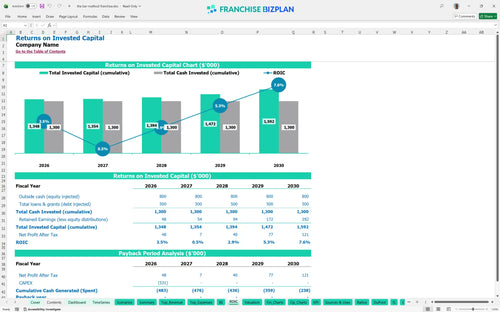
Estimating franchise profitability for new locations shows a break-even point in March 2026, just three months after launch. The primary driver for this is the $12,000 monthly rent for a prime location, which requires consistent membership fees to cover. If your Founders Club launch is soft, your break-even timeline will shift significantly.
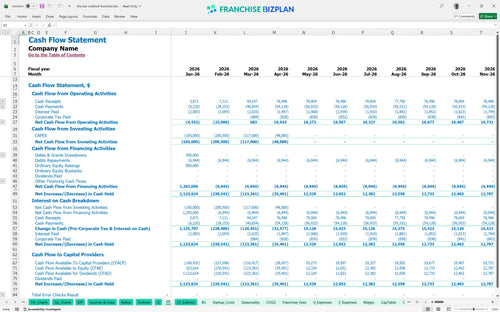
Pre-launch financial planning for franchise units reveals the lowest cash point is $734,000 in April 2026. You will need a solid cash buffer to handle the $50,000 assistant manager salary and $65,000 studio manager salary during the ramp-up phase. Still, managing your $60,000 equipment spend can help protect your runway.
Using financial forecasting tools for new franchise locations, we see revenue climbing from $793,000 to $1,088,000 across five years. Understanding franchise unit economics and margins is key; the high-case scenario assumes you maximize the $585,640 membership fee potential by year five. This shift significantly improves your year-one margin and long-term cash position.
Finance: update unit break-even and payback model by Friday.
This franchise financial model template is a fully editable Excel framework designed for high-precision planning. You can adjust pre-filled formulas and assumptions to match your specific territory, ensuring your financial model template for boutique fitness studios reflects local market conditions and your unique operating scenario.

The model delivers detailed barre studio financial projections covering a five-year horizon to help you visualize long-term growth. It tracks the climb from $793,000 in year-one revenue to over $1,088,000 by year five, providing a clear roadmap for cash flow and profitability as the unit matures.

Managing franchise royalty fees is critical for maintaining store-level margins in a boutique model. This tool automatically calculates the 6% royalty and 2% brand marketing fund contributions based on your revenue forecasts, so you always know exactly how much goes to the franchisor before you pay your local bills.

Determining your startup capital requirements is the first step toward a successful launch. The model breaks down the $530,500 initial investment into clear categories like leasehold improvements and equipment, while identifying the exact sales volume you need to cover your fixed monthly costs.

Your operating expense forecast is sanity-checked against industry standards to ensure your numbers are realistic. The model includes benchmarks for labor, rent, and gross margins, helping you identify if your $12,000 monthly rent or staffing levels for instructors are out of alignment with typical boutique fitness performance.


Simply purchase and download the financial model template, then access it instantly using Microsoft Excel or Google Sheets. No installation or technical expertise required-just open and start working.

Enter your business-specific numbers, including revenue projections, costs, and investment details. The pre-built formulas will automatically calculate financial insights, saving you time and effort.

Leverage the investor-ready format to confidently showcase your financial projections to banks, franchise representatives, or investors. Impress stakeholders with clear, data-driven insights and professional reports.

Leverage the investor-ready format to confidently present your projections to banks, franchise representatives, or investors.