


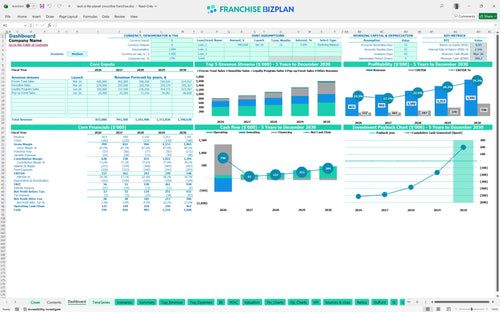
All-in-one Dashboard
Core inputs and core outputs



The franchise unit financial model template includes a comprehensive franchise investment calculator, detailed operational cost forecasting, and a complete franchise business financial planning guide for entrepreneurs.
Core inputs and core outputs
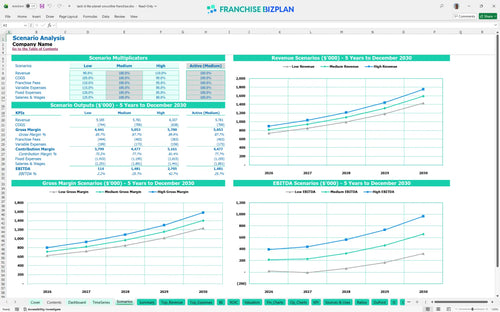
Three scenario analysis
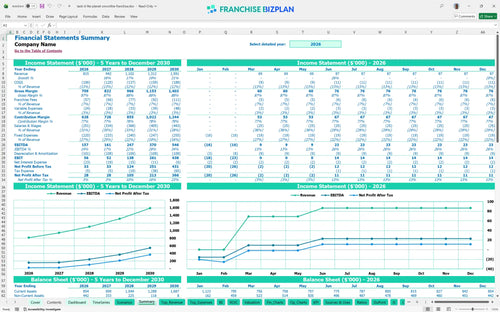
Presentation ready
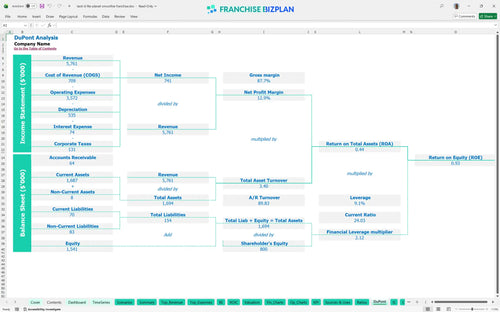
DuPont analysis
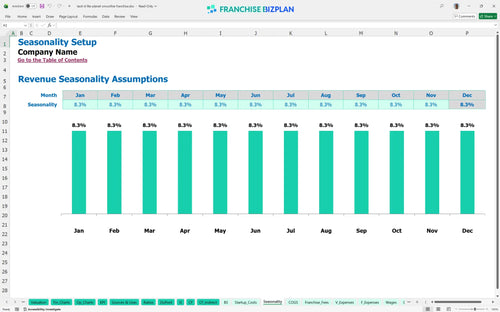
Researched revenue assumptions
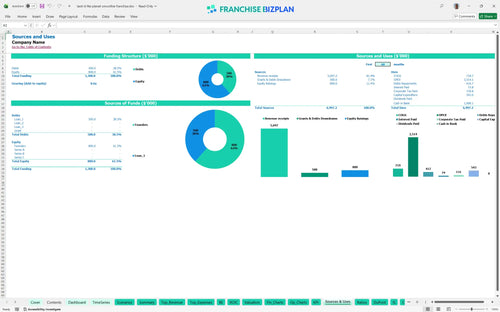
Lender-friendly financial outputs
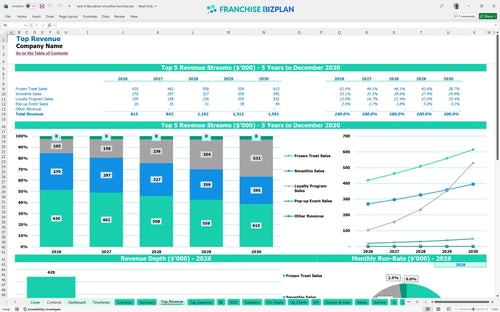
Revenue stream detailed view
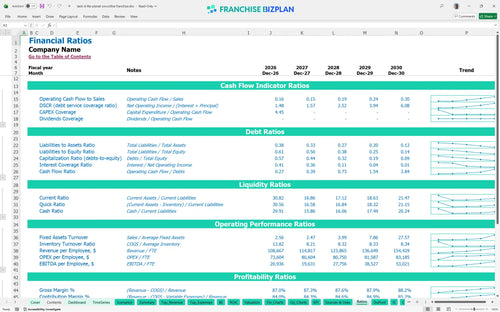
Performance metrics benchmark
We built this franchise unit financial model using our own research into dual-brand dessert and beverage operations. Key assumptions, including the $14,000 monthly rent and 11% food ingredient costs, are pre-populated with researched data specific to this franchise unit and are fully editable. With a Year 1 EBITDA of $157,000, this tool helps you verify if the unit economics actually pencil out for your specific market.
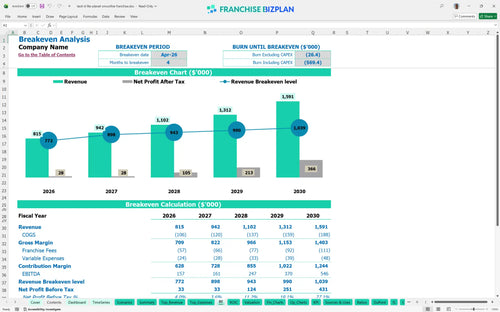
This franchise unit becomes profitable very quickly, reaching its breakeven date in April 2026, just four months after the doors open. By Year 3, the unit generates a healthy $247,000 in EBITDA as loyalty program sales and pop-up events begin to scale. Here's the quick math: keeping food and packaging costs at 13% is the key to maintaining this trajectory.
To launch this franchise unit in the US, you need approximately $543,000 in total initial investment. This covers the $30,000 franchise fee, $220,000 for leasehold improvements, and $160,000 for specialized yogurt and smoothie equipment. You also need to account for the lowest cash point of $710,000 in March 2026 to ensure you have a sufficient opening cash buffer.
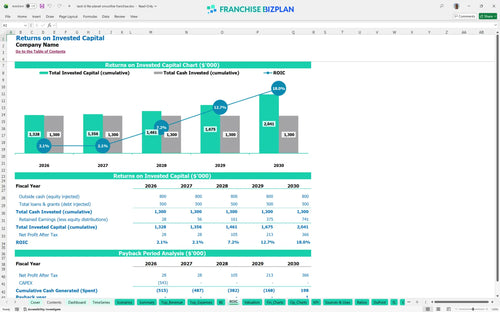
Calculating return on investment for a new franchise unit shows a 5-year payback period and an internal rate of return (IRR) of 2.5%. While the initial years are capital-intensive, the return on equity (ROE) of 0.93 indicates a stable long-term investment. What this estimate hides is the potential for much higher returns if you can drive throughput during peak summer months.
The monthly break-even level is reached in month 4, driven primarily by the high fixed cost of $14,000 for prime location rent. To hit this point faster, you must focus on average ticket size and weekly traffic volume. If your labor costs exceed the planned $168,000 annual management and shift lead payroll, your break-even point will slip into the following year.
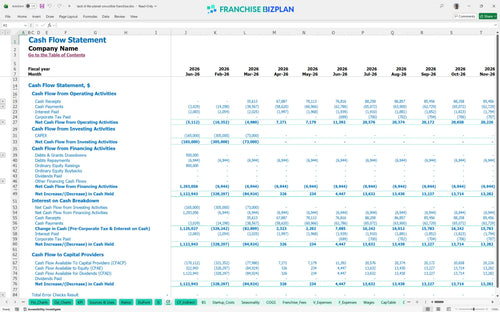
Your lowest cash point hits $710,000 in March 2026, meaning you need a solid runway to cover the $14,000 monthly rent and initial staffing costs. We recommend a 6-month cash buffer to handle any delays in the $220,000 build-out phase. Still, managing your opening inventory tightly is the best way to protect your remaining liquidity during the ramp-up.
Estimating profitability for a health food franchise unit requires comparing Low, Medium, and High scenarios. A 10% drop in revenue in the Low case can significantly delay your 5-year payback and increase peak cash needs. Conversely, hitting the High case through superior local marketing execution can boost your Year 1 margin of $157,000 and accelerate your ROI.
This franchise unit financial model is fully customizable in Excel, allowing you to adjust every variable from local hourly wages to the cost of fruit. With pre-filled formulas and editable assumptions, you can easily adapt the spreadsheet to your specific territory and operating scenario. It defintely saves you dozens of hours of manual entry and logic building.

Success in the food industry requires looking far beyond the grand opening. This model provides detailed 5-year revenue, cost, and cash flow projections, showing how your unit scales from an initial $815,000 in sales to over $1.5 million by year five. It gives you the long-term unit economics analysis needed to satisfy lenders and plan for future expansion.

Operating within a system means managing specific financial obligations that independent shops don't have. This franchise royalty fee structure is built into the model, capturing the 5% royalty and 2% marketing fund contributions automatically. By tracking these ongoing costs against your gross sales, you get a realistic view of your actual store-level margin.

Knowing how to calculate startup costs for a smoothie franchise is vital for securing your startup capital requirements. The model breaks down the $543,000 in initial CAPEX, including $220,000 for leasehold improvements and $95,000 for specialized equipment. This detailed budget template for opening a franchise location ensures you know exactly when your monthly revenue will finally cover your fixed overhead.

This pro forma financial statements for franchise business models tool includes built-in industry benchmarks to sanity-check your projections. We've included researched figures like an 11% food ingredient cost and a $60,000 manager salary to ensure your plan is grounded in reality. Comparing your expected performance against these typical ranges helps identify potential margin leaks before they happen.


Simply purchase and download the financial model template, then access it instantly using Microsoft Excel or Google Sheets. No installation or technical expertise required-just open and start working.

Enter your business-specific numbers, including revenue projections, costs, and investment details. The pre-built formulas will automatically calculate financial insights, saving you time and effort.

Leverage the investor-ready format to confidently showcase your financial projections to banks, franchise representatives, or investors. Impress stakeholders with clear, data-driven insights and professional reports.

Leverage the investor-ready format to confidently present your projections to banks, franchise representatives, or investors.