


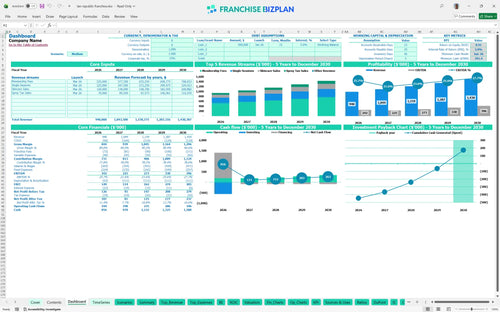
All-in-one Dashboard
Core inputs and core outputs



This franchise financial projection spreadsheet for beginners provides a complete roadmap for estimating startup costs, monthly operations, and long-term profitability for a luxury tanning salon.
Core inputs and core outputs
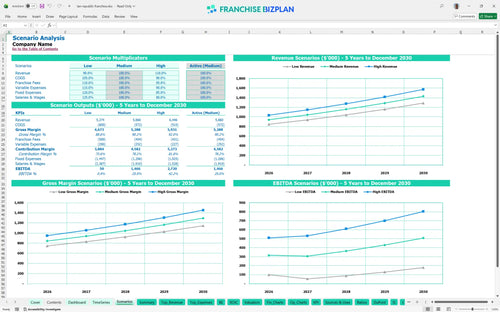
Three scenario analysis
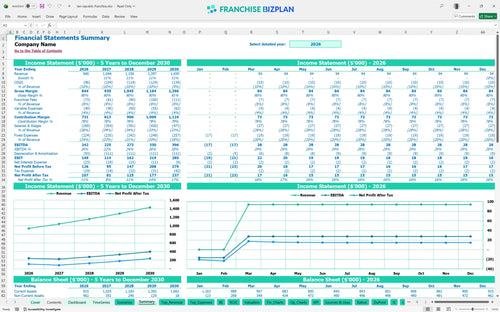
Presentation ready
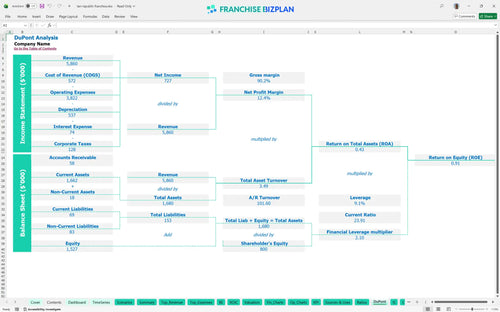
DuPont analysis
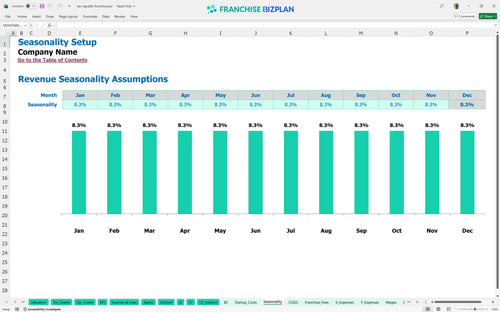
Researched revenue assumptions
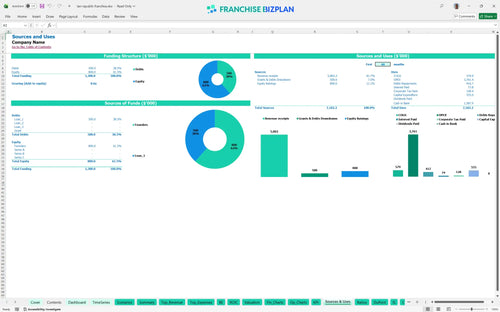
Lender-friendly financial outputs
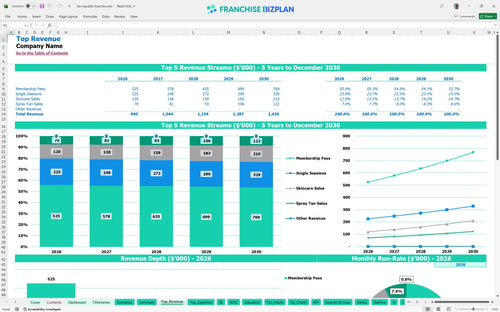
Revenue stream detailed view
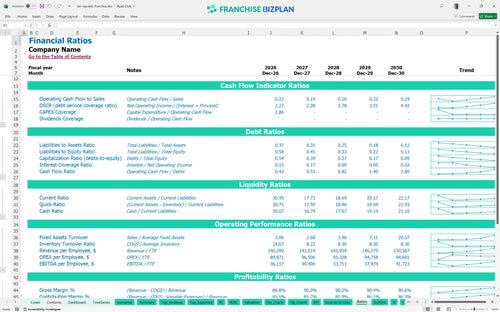
Performance metrics benchmark
We built this franchise unit financial model using our own research into the luxury tanning sector to ensure every driver is grounded in reality. Key assumptions, including the $940,000 year-one revenue and the 6.25% royalty fee, are pre-populated and fully editable to match your specific location. This tool tracks everything from Matrix bed CAPEX to recurring membership fees so you can see the real cash flow potential. Real-world data beats a 'gut feeling' every single time.
The unit hits profitability quickly, showing a year-one EBITDA of $242,000 and growing to $396,000 by year five as membership fees scale. Assessing profitability of a luxury tanning salon franchise requires looking at the $512,435 in annual membership revenue that provides a stable floor for the business. Recurring membership fees are the engine of this business model.
You need a total investment that covers the $25,000 franchise fee and $200,000 in leasehold improvements for a Scottsdale-style luxury build-out. This Excel template for franchise unit financial planning also accounts for $150,000 in tanning beds and $75,000 for spray booths. Planning capital expenditure for a new franchise unit is vital to avoid mid-construction budget shortfalls. Build-out costs are usually where first-time owners blow their budget.
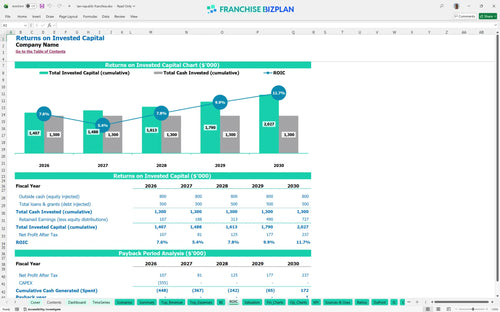
The internal rate of return (IRR) is 3.04% with a 5-year payback period, which is typical for high-CAPEX retail service models. This franchise investment ROI calculation shows a return on equity of 0.91, reflecting the steady accumulation of value as the debt is serviced. A 5-year payback is standard for high-CAPEX retail units.
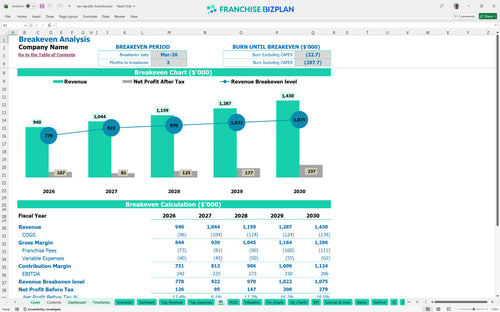
The unit reaches break-even in March 2026, just three months after the doors open for business. Estimating revenue for a new franchise location shows that the $15,000 monthly rent is the biggest fixed hurdle, requiring a steady volume of memberships to clear. Speed to break-even is the most important metric in your first year.
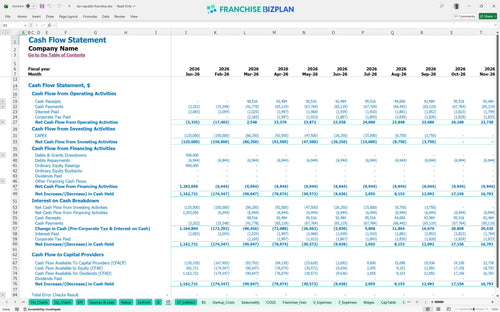
The lowest cash point occurs in June 2026 at $781,000, which includes your initial working capital and opening reserves. Using a monthly operating budget template for franchise units helps you visualize this dip so you don't overspend on marketing before the revenue catches up. Cash is oxygen, and ramp-up is when you're most likely to run out.
A financial feasibility study for franchise business owners must account for a 10% swing in membership retention, which significantly shifts the year-one margin. In the High case, aggressive local marketing pushes EBITDA well above the $242,000 baseline, while the Low case requires tighter mangement of variable costs. High-performance units focus on retention to drive that top-tier scenario. Finance: update unit break-even and payback model by Friday.
This franchise financial model template is built entirely in Excel, giving you total control over every assumption and calculation. You can easily adjust the pre-filled formulas to match your specific territory, local labor rates, or unique lease terms without needing a degree in finance. It functions as a flexible franchise business model spreadsheet that adapts as you gather more precise data from your site selection process. Every formula is open so you can tweak the numbers as the market shifts.

Success in the tanning industry requires a long-term view, so this tool provides a detailed franchise profit and loss projection spanning sixty months. You can track how recurring membership revenue scales over time while monitoring the impact of escalating salon franchise operating expenses. This franchise unit financial forecasting tool ensures you see the full picture of your small business financial projections from opening day through maturity. Long-term planning is the only way to survive the retail grind.

Operating within a system means managing specific brand obligations like the 6.25% royalty and 1.5% marketing fund contribution. This model is essential for developing a comprehensive financial model for retail franchises because it bakes these costs directly into your monthly cash flow. By accounting for the $25,000 initial fee and ongoing percentages, you get an honest look at your store-level margins. Royalties are a reality, so you need to know exactly how they eat into your margin.

Launching a luxury salon requires significant capital, and this franchise startup cost analysis helps you categorize every dollar spent on build-out and equipment. The integrated break-even analysis tool for new franchise locations identifies the exact monthly revenue needed to cover your $15,000 rent and payroll. It removes the guesswork by showing you when the unit stops burning cash and starts generating a surplus. Knowing your break-even point is the difference between sleeping and staring at the ceiling.

We have integrated franchise unit economic modeling benchmarks to help you verify if your labor costs or supply expenses are in line with industry standards. This feature allows you to sanity-check your projections against typical performance for high-end tanning concepts, ensuring your plan is grounded in reality. It helps identify if your $1,000 monthly utility budget or 7% supply cost is realistic for your equipment mix. Benchmarks keep your assumptions from getting too optimistic.


Simply purchase and download the financial model template, then access it instantly using Microsoft Excel or Google Sheets. No installation or technical expertise required-just open and start working.

Enter your business-specific numbers, including revenue projections, costs, and investment details. The pre-built formulas will automatically calculate financial insights, saving you time and effort.

Leverage the investor-ready format to confidently showcase your financial projections to banks, franchise representatives, or investors. Impress stakeholders with clear, data-driven insights and professional reports.

Leverage the investor-ready format to confidently present your projections to banks, franchise representatives, or investors.