


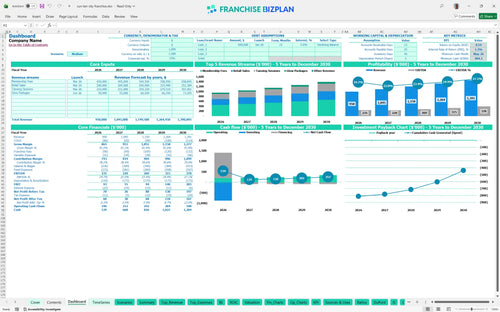
All-in-one Dashboard
Core inputs and core outputs



This franchise unit financial financial model template provides a professional-grade Excel workbook for estimating recurring revenue for tanning membership models and analyzing total unit economics.
Core inputs and core outputs
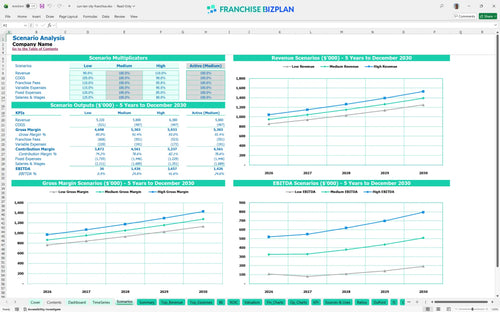
Three scenario analysis
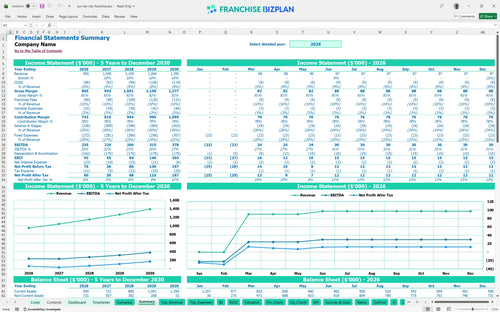
Presentation ready
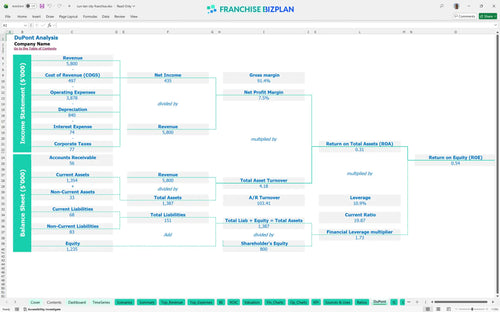
DuPont analysis
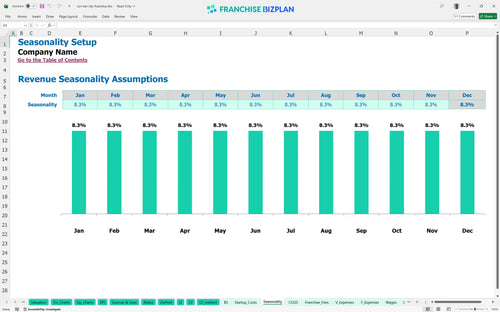
Researched revenue assumptions
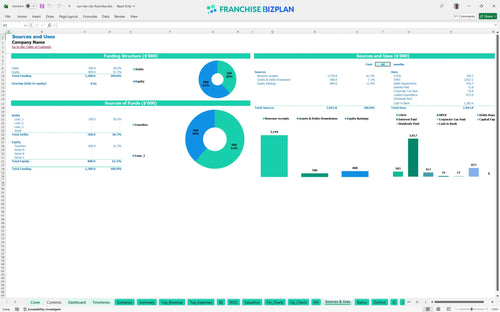
Lender-friendly financial outputs
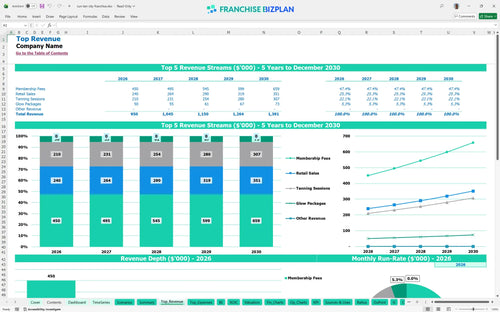
Revenue stream detailed view
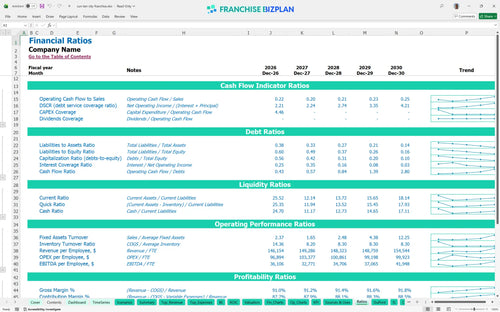
Performance metrics benchmark
We built this tanning salon franchise profit margin calculator using detailed research into the equipment-heavy tanning industry. The pre-populated data includes Year 1 revenue targets of $950,000 and an EBITDA of $235,000, all of which you can edit to reflect your specific site. This model serves as a comprehensive franchise financial feasibility study template for operators who need to move fast but stay accurate.
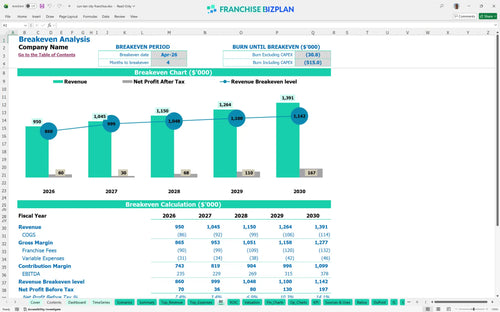
The unit shows strong operational performance early on, generating a positive EBITDA of $235,000 in its first full year. After accounting for the 8% royalty and fixed costs like the $16,000 monthly rent, the model projects the business reaches its monthly break-even point by April 2026. Still, the high initial equipment costs mean you need to watch the bottom line closely during the first 12 months.
Launching this unit requires a significant upfront investment of approximately $873,000 in capital expenditures plus working capital. The largest outlays are the $320,000 for UV tanning beds and $250,000 for leasehold improvements to create that high-end spa feel. You also need to budget for the $30,000 franchise fee and $140,000 for sunless spray booths before opening the doors.
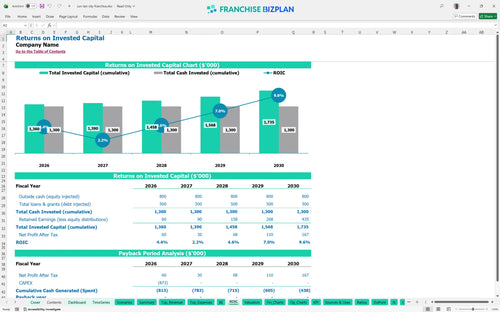
Based on the current projections, the internal rate of return (IRR) is 1.3%, with a return on equity (ROE) of 0.54. Because of the heavy $873,000 initial investment in equipment and build-out, the full payback period extends beyond the five-year mark. This is a long-term play where value is built through consistent recurring revenue and potential multi-unit scale rather than a quick flip.
The business is designed to hit its break-even point in April 2026, just four months after the initial launch phase. The primary lever for reaching this milestone is membership volume, as the fixed costs-led by the $16,000 monthly rent-remain constant regardless of how many people tan. Monthly revenue must quickly scale past the fixed overhead and the 9.5% combined royalty and marketing fees.
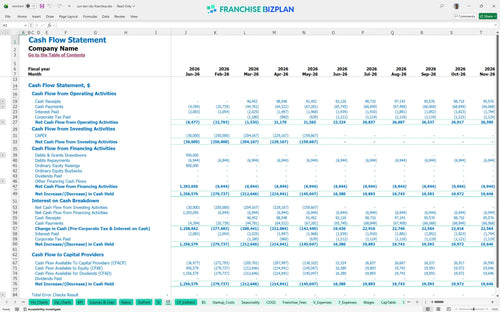
The lowest cash point is projected to hit in May 2026, with a minimum cash balance of $404,000 after the heavy construction and equipment payments are settled. You need a solid runway to cover the gap between the January 2026 start and the revenue ramp-up in the spring. Planning capital investment for a new tanning studio means keeping a buffer for those first few months of high burn.
In a high-growth scenario where membership fees exceed the $300,000 Year 1 target, the EBITDA margin can expand rapidly due to the fixed-cost nature of the rent and equipment. Conversely, a low-revenue scenario puts immediate pressure on the 1.3% IRR and could push the payback period even further out. Small shifts in the $16,000 monthly rent or labor costs significantly change the year-1 margin.
This tanning salon franchise financial model is built in Excel so you can tweak every variable to match your specific territory. We've pre-loaded the formulas, but you can adjust the membership tiers or retail margins to see how they impact your bottom line. It's defintely the fastest way to move from a 'what-if' scenario to a concrete operating plan.

Planning for a beauty and wellness franchise requires a long-term view of recurring revenue and equipment replacement cycles. This model provides a detailed 5-year outlook, mapping out how your tanning salon business plan scales from initial launch to a mature, multi-unit operation. You get a clear view of the P&L, cash flow, and balance sheet to satisfy both your internal planning and external lenders.

The model simplifies the math on franchise-specific costs like the 8% royalty and 1.5% marketing fund contribution. By automating these calculations against your revenue forecasting, you can see exactly how much cash stays in the unit after the franchisor takes their cut. This ensures your tanning salon profitability analysis accounts for every dollar of brand-related overhead from day one.

Knowing how to calculate startup costs for a tanning salon franchise is the first step to avoiding a cash crunch. This tool aggregates your leasehold improvements, equipment leases, and the $30,000 franchise fee to show your total capital requirement. It then maps these against your fixed and variable costs to pinpoint the exact month your revenue covers your burn.

We've integrated essential financial metrics for new franchise owners to help you sanity-check your rent and labor targets. If your prime location rent exceeds the $16,000 monthly benchmark or your skincare COGS (cost of goods sold) drifts above 5.5%, the model highlights the impact on your store-level margin. This allows you to compare your unit against typical performance in the tanning and wellness sector.


Simply purchase and download the financial model template, then access it instantly using Microsoft Excel or Google Sheets. No installation or technical expertise required-just open and start working.

Enter your business-specific numbers, including revenue projections, costs, and investment details. The pre-built formulas will automatically calculate financial insights, saving you time and effort.

Leverage the investor-ready format to confidently showcase your financial projections to banks, franchise representatives, or investors. Impress stakeholders with clear, data-driven insights and professional reports.

Leverage the investor-ready format to confidently present your projections to banks, franchise representatives, or investors.