


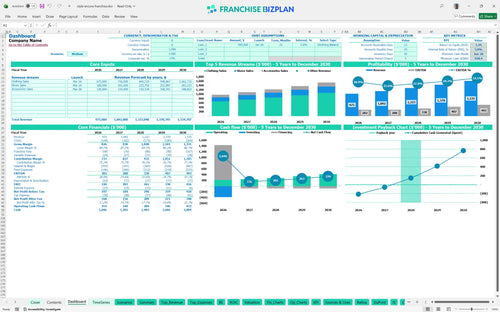
All-in-one Dashboard
Core inputs and core outputs



This franchise financial model template provides a professional-grade pro forma to help you learn how to build a pro forma for a new franchise and secure funding. This is the definitive tool for any serious resale operator.
Core inputs and core outputs
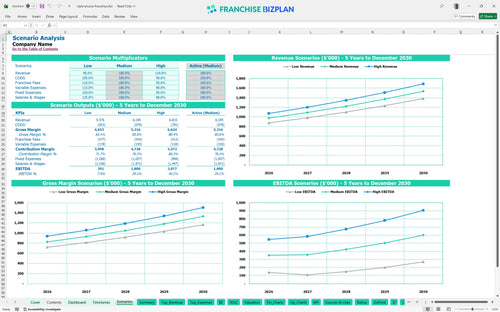
Three scenario analysis
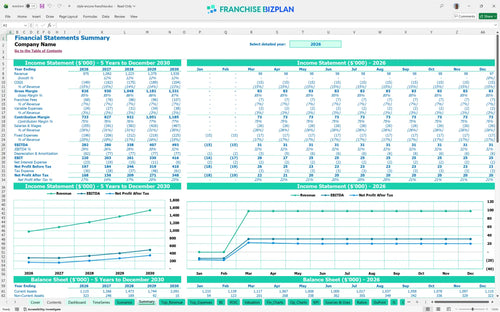
Presentation ready
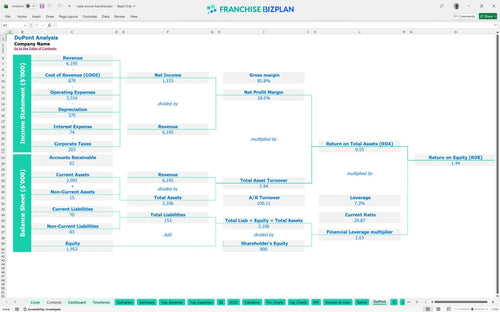
DuPont analysis
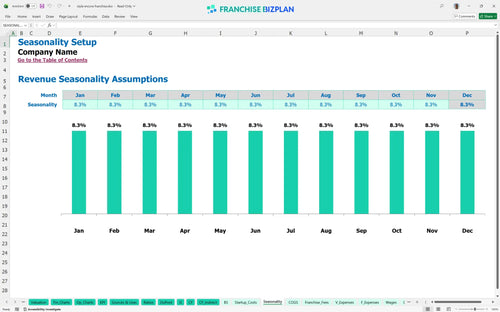
Researched revenue assumptions
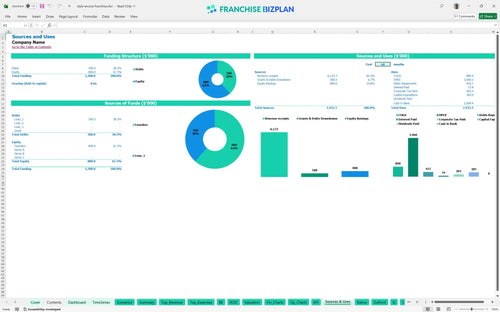
Lender-friendly financial outputs
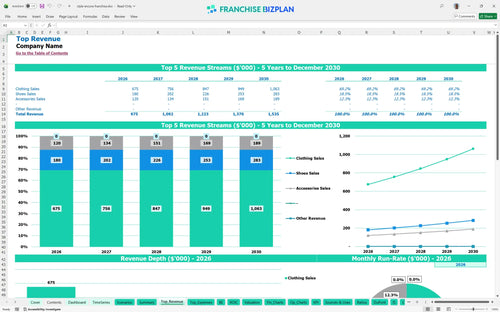
Revenue stream detailed view
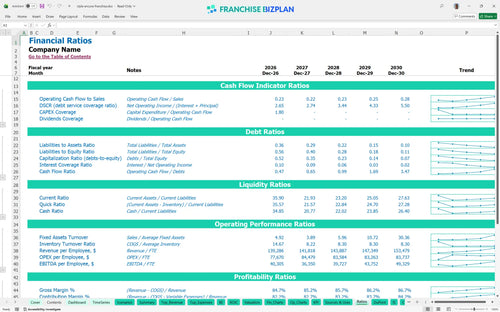
Performance metrics benchmark
We built this franchise unit financial model using our own research into the resale fashion sector to provide a detailed franchise profitability analysis. Key assumptions, including the $975,000 Year 1 revenue target and the 4-month break-even timeline, are pre-populated with researched data but remain fully editable for your specific location. Data beats intuition every time when you're signing a lease. Estimating profit margins for a franchise unit is simplified through these pre-built logic sets.
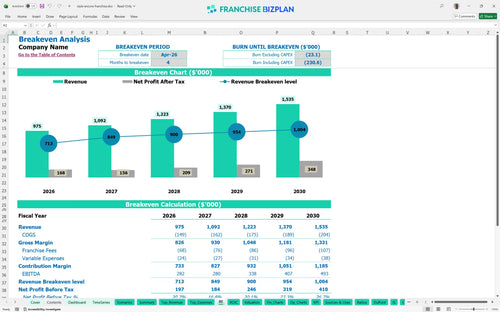
This unit hits profitability fast, reaching break-even by April 2026, just four months after launch. With Year 1 EBITDA projected at $282,000, the model accounts for the 7% total franchise fees and initial inventory ramp-up. Speed to profit is the primary metric for this unit.
You will need approximately $385,000 in startup capital requirements to get the doors open. This covers the $25,000 franchise fee, $180,000 for leasehold improvements, and $65,000 for store fixtures. Every dollar is accounted for before you even sign the lease.
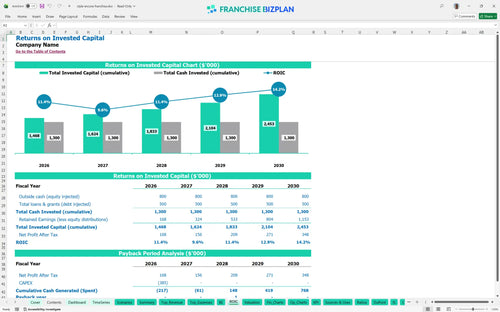
Investors can expect a 3-year payback period on the initial capital outlay using this franchise investment return calculator. The model shows an Internal Rate of Return (IRR) of 5.84% and a Return on Equity (ROE) of 1.44. Three years is a standard but solid timeline for capital recovery in retail.
The store reaches break-even in month 4, requiring roughly $81,250 in monthly revenue to cover fixed costs like the $13,000 rent and $22,000 in monthly wages. Volume is your best friend in a high-margin resale model. This break-even analysis is the core of your operational planning.
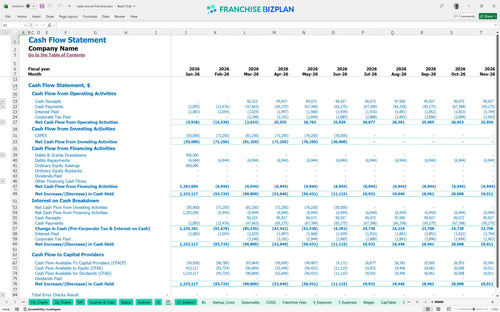
Your lowest cash point is $928,000 in June 2026, which includes your initial funding and early operating expenses for a fashion resale franchise. You need to manage the timing of your $180,000 build-out payments to avoid a liquidity crunch. Cash is oxygen, and this model tracks your breathing.
A 10% drop in revenue pushes the break-even point back and tightens the Year 1 margin significantly in this financial feasibility study for retail franchise. Conversely, the High Case shows how hitting $1.5M in revenue by Year 5 accelerates your ROI. Stress-testing your assumptions is the best way to sleep at night.
Finance: update unit break-even and payback model by Friday.
This retail franchise financial projection spreadsheet is fully customizable in Excel, allowing you to tweak every variable from inventory buy-back rates to local labor laws. We built it with pre-filled formulas and editable assumptions so you can defintely swap out the SouthPark district rent for your specific territory costs. It handles the heavy lifting of math so you can focus on the actual store layout and staffing. It handles the heavy lifting of math so you can focus on the store layout.

Long-term planning is the difference between a job and a real investment. This financial model template for clothing resale business provides 5-year revenue, cost, and cash flow projections specifically for a high-end resale shop. It tracks how your margins evolve as inventory acquisition costs drop from 13.5% to 11.5% over time. Seeing the full horizon helps you plan for future equipment refreshes or multi-unit expansion.

Operating within a brand system means fixed obligations that eat into your top line. The model captures the 5% royalty and 2% marketing fund contributions automatically based on your monthly sales, which is essential for any clothing store business plan. By baking these franchise royalty fees into your projections, you see the true store-level EBITDA after the franchisor takes their cut. It's about knowing exactly what's left for your pocket after the brand takes its cut.

You need to know exactly when you will stop burning cash and start keeping it. This tool helps you learn how to calculate startup costs for a retail franchise, including the $180,000 leasehold improvements and $65,000 for fixtures. The break-even analysis shows the sales volume needed to cover your $13,000 monthly rent and staff payroll. Knowing your 'zero point' reduces the stress of those first few months.

Don't guess if your $156,000 annual rent is too high or if your 1.1% payment processing fee is standard. We have included franchise unit economics benchmarks to help you sanity-check your numbers against typical resale shop performance and retail inventory management standards. If your labor costs for stylists and managers drift too far from the model, you will know it is time to optimize your schedule. If your labor costs drift too far from the model, you'll know it's time to optimize.


Simply purchase and download the financial model template, then access it instantly using Microsoft Excel or Google Sheets. No installation or technical expertise required-just open and start working.

Enter your business-specific numbers, including revenue projections, costs, and investment details. The pre-built formulas will automatically calculate financial insights, saving you time and effort.

Leverage the investor-ready format to confidently showcase your financial projections to banks, franchise representatives, or investors. Impress stakeholders with clear, data-driven insights and professional reports.

Leverage the investor-ready format to confidently present your projections to banks, franchise representatives, or investors.