


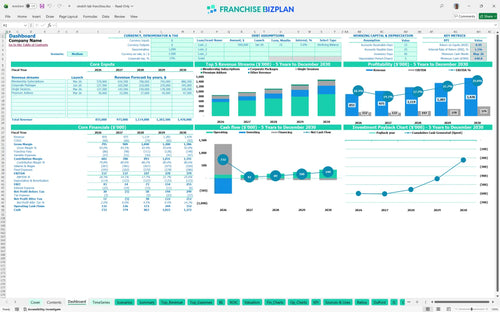
All-in-one Dashboard
Core inputs and core outputs



The franchise unit financial model template includes a complete set of interconnected tabs for revenue drivers, payroll, CAPEX, and 5-year financial statements designed for a wellness studio.
Core inputs and core outputs
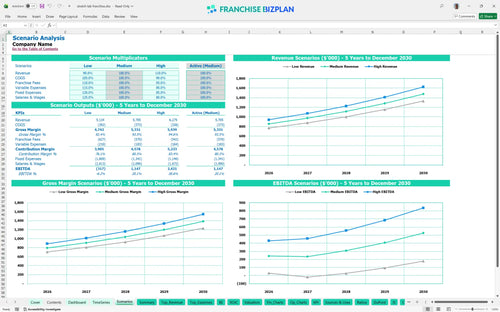
Three scenario analysis
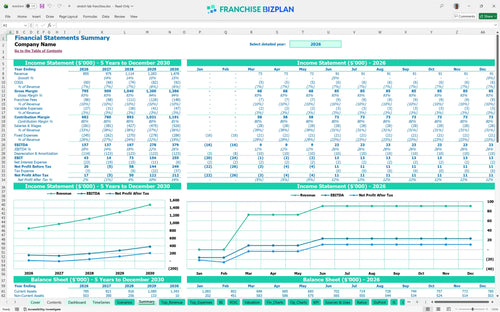
Presentation ready
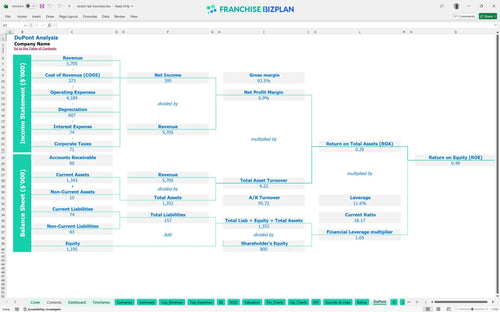
DuPont analysis
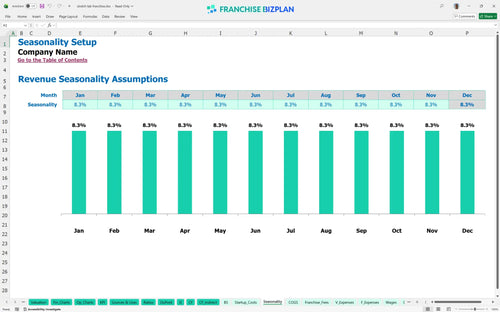
Researched revenue assumptions
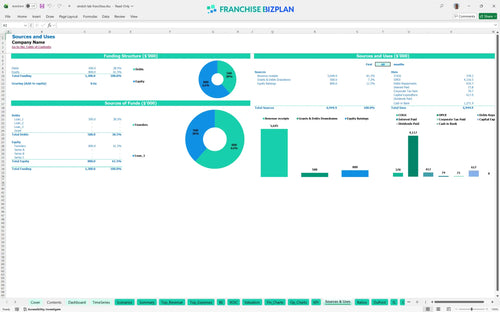
Lender-friendly financial outputs
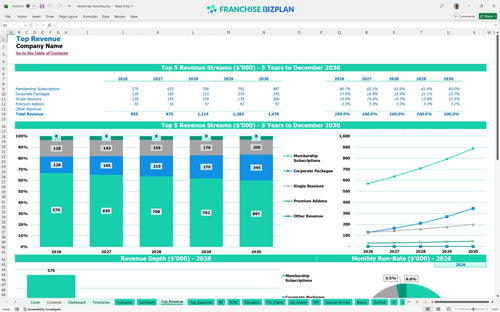
Revenue stream detailed view
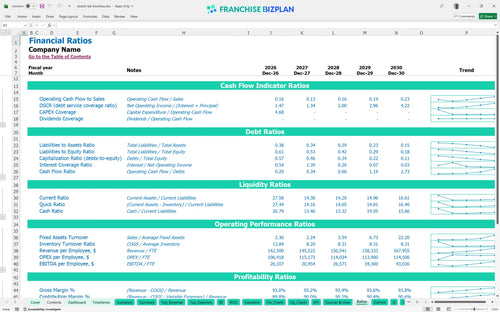
Performance metrics benchmark
We built this assisted stretching franchise financial projections excel model using deep research into the boutique fitness sector. The assumptions for membership tiers, $65,000 franchise fees, and flexologist wages are pre-populated and fully editable to match your specific location. With a year-one revenue target of $855,000, this tool gives you a data-driven roadmap for your investment.
This unit hits profitability in its first year with a projected EBITDA of $157,000. While year two shows a slight dip to $137,000 due to scaling staff, the model shows a strong climb to $379,000 by year five as membership revenue matures. Here is the quick math: your margin expands as you move from 3 to 5 flexologists to meet rising demand.
To launch this unit in the US, you need approximately $617,000 in initial capital for the build-out and equipment. This includes the $65,000 franchise fee and $280,000 for leasehold improvements to meet brand standards. Honestly, you should also plan for the minimum cash low point of $641,000 in May 2026 to stay safe during the ramp-up phase.
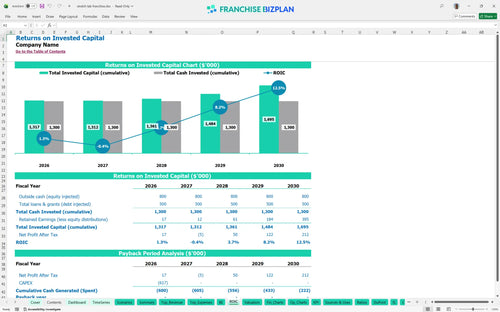
The return on investment calculation shows an IRR of 1.48% and an ROE of 0.49 over the first five years. Because of the high initial build-out costs, the full payback of your initial investment occurs after year five. This is a long-term play focused on building a stable, recurring revenue stream rather than a quick flip.
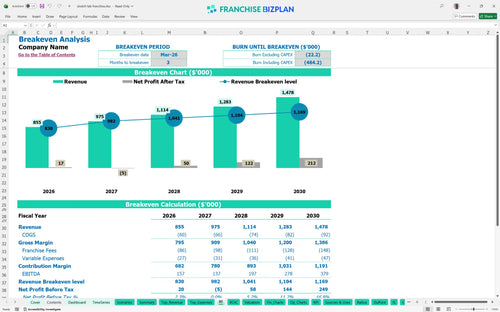
The studio reaches its monthly break-even point in March 2026, just three months after opening. This fast start is driven by the monthly recurring revenue model for fitness franchises, which secures income upfront. Your ability to hit this depends heavily on the $14,000 monthly rent and maintaining a high average ticket for single sessions.
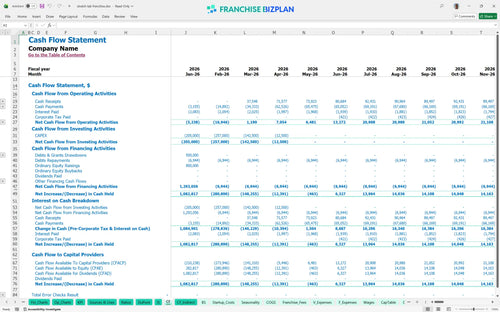
The lowest cash point occurs in May 2026 at $641,000, which accounts for the initial investment and early operating losses. You need enough working capital to cover the gap between your January build-out start and the revenue ramp-up in the spring. If your studio manager hire happens too early, that cash buffer will shrink faster than expected.
Evaluating profitability of a boutique fitness franchise requires looking at Low, Medium, and High cases. A 10% drop in membership volume in the Low case can push your break-even back by several months and significantly increase your peak cash need. Conversely, the High case leverages fixed costs like the $14,000 rent to deliver much higher year-five margins.
Finance: update unit break-even and payback model by Friday.
This franchise financial model template is built in Excel with open formulas, so you can tweak every assumption to fit your specific market. Whether you are adjusting the $14,000 monthly rent for a different territory or changing the $72,000 manager salary, the logic updates instantly. It is a flexible tool designed to handle the moving parts of a wellness studio without the headache of building a spreadsheet from scratch.

Planning for the long haul is vital, and this model provides a clear view of your trajectory from year one through year five. With revenue projected to grow from $855,000 in the first year to over $1.47 million by year five, you can see how scaling membership subscriptions impacts your bottom line. It follows best practices for franchise financial forecasting by mapping out the full P&L, balance sheet, and cash flow statement.

Franchise royalty fees and marketing fund contributions are hard-coded into the logic to ensure you never overlook these recurring costs. At an 8% royalty and a 2% marketing fee, $10 out of every $100 earned goes straight to the franchisor, which defintely impacts your store-level margin. This model tracks these obligations against your projected $380,000 in year-one membership revenue to show your true net take-home.

Getting the doors open requires a significant capital expenditure budget, including $280,000 for leasehold improvements and $120,000 for specialized equipment. This franchise unit break-even analysis template calculates exactly when your monthly membership and session revenue will cover these heavy upfront costs and ongoing fixed expenses. Knowing your numbers helps you manage the $617,000 in total initial CAPEX without running out of runway.

We have baked in researched franchise operating expenses like 2.2% payment processing and 1.0% booking commissions to keep your projections grounded in reality. The model includes labor benchmarks for four flexologists and a studio manager, ensuring your staffing costs align with typical boutique fitness standards. These benchmarks act as a sanity check, so you can see if your $1,400 monthly cleaning bill or $2,200 utility cost is within a normal range.


Simply purchase and download the financial model template, then access it instantly using Microsoft Excel or Google Sheets. No installation or technical expertise required-just open and start working.

Enter your business-specific numbers, including revenue projections, costs, and investment details. The pre-built formulas will automatically calculate financial insights, saving you time and effort.

Leverage the investor-ready format to confidently showcase your financial projections to banks, franchise representatives, or investors. Impress stakeholders with clear, data-driven insights and professional reports.

Leverage the investor-ready format to confidently present your projections to banks, franchise representatives, or investors.