


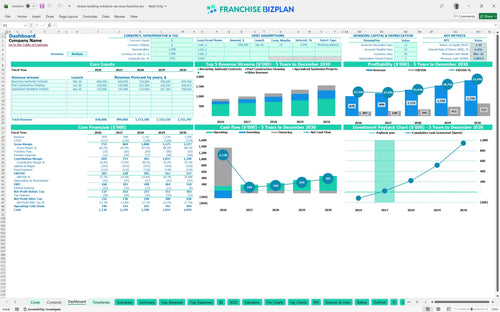
All-in-one Dashboard
Core inputs and core outputs



This Excel template for franchise unit revenue forecasting provides a ready-to-use financial engine for planning and operating a high-growth commercial cleaning territory.
Core inputs and core outputs
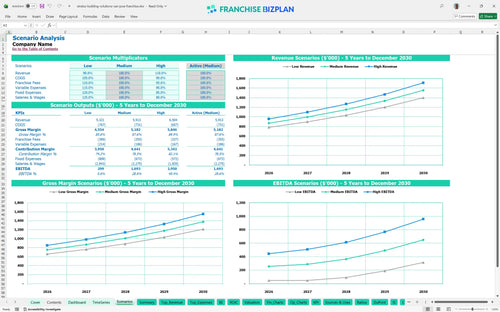
Three scenario analysis
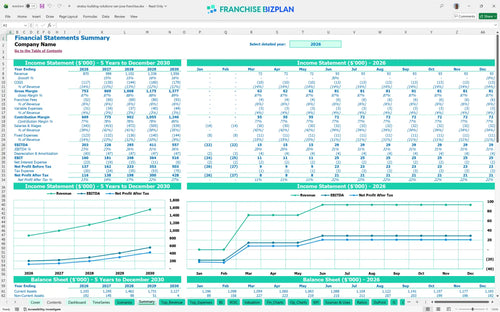
Presentation ready
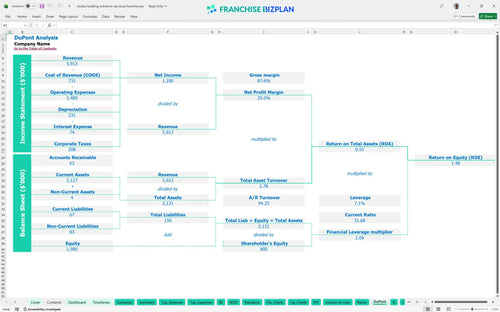
DuPont analysis
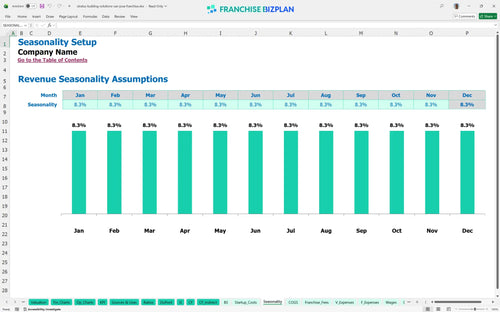
Researched revenue assumptions
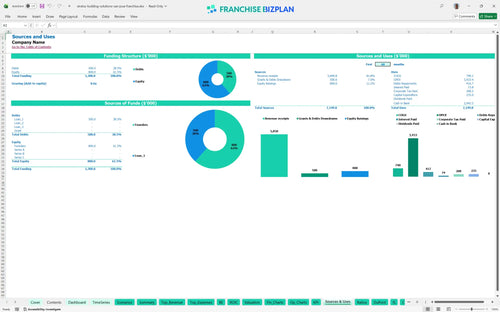
Lender-friendly financial outputs
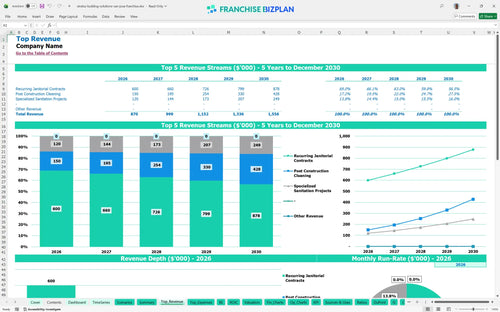
Revenue stream detailed view
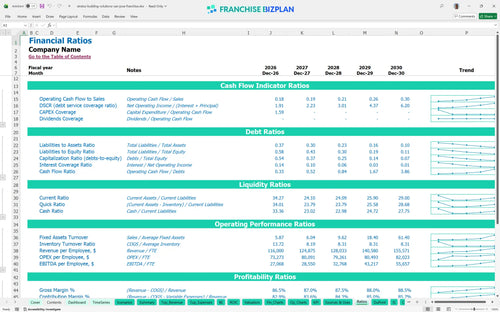
Performance metrics benchmark
We built this financial model for janitorial business with recurring revenue using our own research into service-sector unit economics. Key assumptions like the $870,000 year-one revenue and the $235,000 startup cost are pre-populated and fully editable. This tool gives you a realistic look at how a territory scales from its first contract to a mature $1.5 million operation. Real data beats a gut feeling every time.
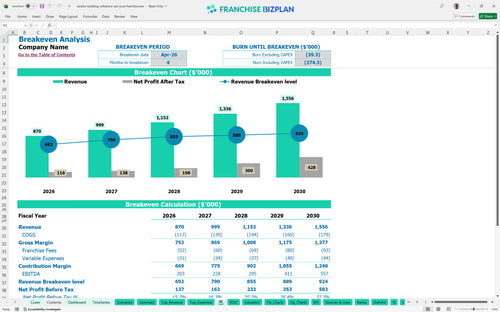
This unit hits profitability fast, reaching break-even by April 2026, just four months after the January start. With year-one EBITDA (earnings before interest, taxes, depreciation, and amortization) at $203,000, the margins are defintely healthy because of the high-margin specialized sanitation work. Profitability is a function of volume and tight supply control.
You need $235,000 in startup capital to cover equipment and fees, plus a significant cash buffer. The largest chunk goes to the $75,000 franchise fee and $60,000 for service vehicles. Here is the quick math: your minimum cash hits $1,005,000 in March 2026, suggesting you need strong liquidity to bridge the gap between hiring and contract payments. Your first $235,000 is just the entry ticket.
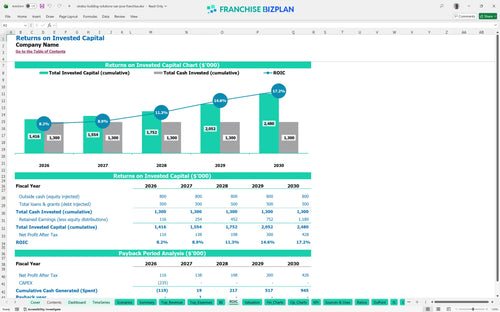
The ROI for service franchises in this sector is strong, with a 2-year payback period on your initial investment. The model shows an IRR (internal rate of return) of 6.63% and a Return on Equity of 1.48. While the IRR looks modest, the cash flow is consistent; you are buying a business that pays a $203,000 profit in year one while covering a $80,000 manager salary. A two-year payback is a solid win in the service sector.
You reach break-even in month four, April 2026. This assumes you launch recurring janitorial contracts in March and post-construction cleaning by June. The biggest hurdle is the $10,650 in monthly fixed overhead, including $5,500 for warehouse rent and $1,200 for local marketing. Four months to break-even is a sprint, not a jog.
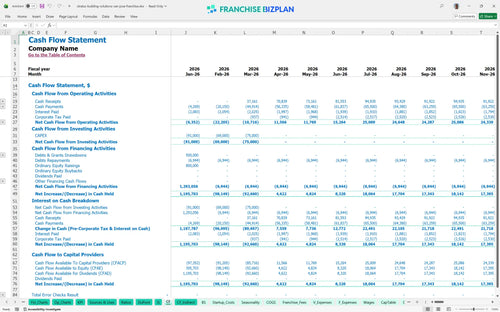
Your lowest cash point is $1,005,000 in March 2026, right as the full crew and vehicles come online. To protect cash flow, you should manage how to budget for franchise cleaning equipment and supplies by only buying what is needed for active contracts. If revenue lags by 20%, you will need an extra 3 months of runway. Cash is king, but runway is the kingdom.
In a high-growth scenario where you capture more tech campus work, year-one revenue could exceed $1 million, shortening payback to 18 months. A low-case scenario would see the 1.48 ROE drop significantly as fixed costs like the $5,500 rent eat the margin. Scenarios show you where the floor is before you fall.
Finance: update unit break-even and payback model by Friday.
This franchise financial model template is built for total flexibility in Excel. You can swap out numbers for local rent or adjust cleaning tech wages as the market shifts. It uses a small business financial projection template style, so the math is already done. You just plug in your specific contract sizes and equipment costs to see the impact. Every cell is open for your local adjustments.

Planning a janitorial service business financial plan requires looking past the first few contracts. This model projects revenue climbing from $870,000 in year one to over $1.5 million by year five. It tracks how recurring revenue from tech campuses builds over time, so you can see when to add that second or third service vehicle. Five years of data turns a guess into a plan.

Royalties and brand funds are a fixed cost of doing business that you must track. Our commercial cleaning franchise royalty and fee calculator handles the 5% royalty and 1% marketing fee automatically. At $870,000 in sales, that is $52,200 annually leaving the business, so you need to know exactly how that impacts your bottom line. Royalties are a top-line hit you must model early.

Knowing how to calculate startup costs for a commercial cleaning franchise is the difference between a smooth launch and a cash crunch. With $235,000 in initial investment, including a $75,000 franchise fee and $60,000 for vehicles, you need to hit the ground running. The model shows a break-even point calculation occurring around month four if you secure those first few recurring contracts. Speed to break-even is the only metric that keeps the doors open.

Do not guess if your green cleaning supplies cost is too high. We have baked in benchmarks like the 11.5% supply cost seen in year one. If your actuals are higher, you are likely overusing product or facing theft. This franchise unit profitability spreadsheet lets you compare your performance against standard service-based franchise metrics. Benchmarks keep your supply closet from eating your profits.


Simply purchase and download the financial model template, then access it instantly using Microsoft Excel or Google Sheets. No installation or technical expertise required-just open and start working.

Enter your business-specific numbers, including revenue projections, costs, and investment details. The pre-built formulas will automatically calculate financial insights, saving you time and effort.

Leverage the investor-ready format to confidently showcase your financial projections to banks, franchise representatives, or investors. Impress stakeholders with clear, data-driven insights and professional reports.

Leverage the investor-ready format to confidently present your projections to banks, franchise representatives, or investors.