


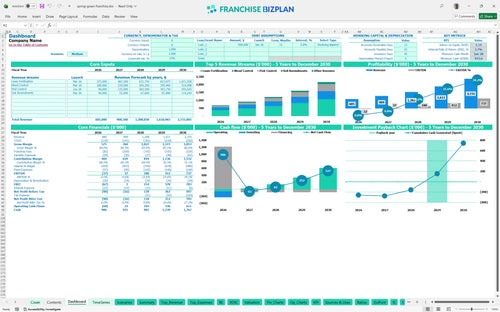
All-in-one Dashboard
Core inputs and core outputs



This Excel template for small business franchise financial planning includes everything from detailed payroll schedules to automated cash flow statements for a multi-truck operation.
Core inputs and core outputs
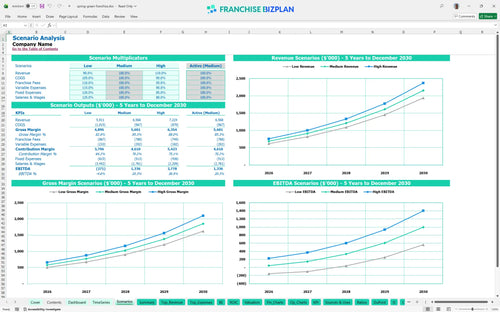
Three scenario analysis
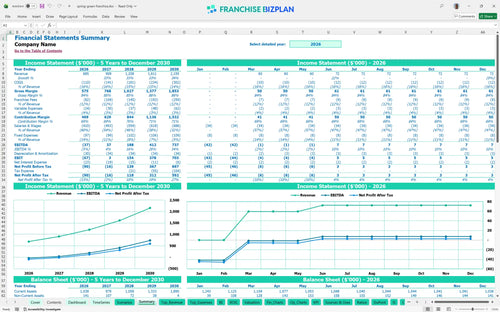
Presentation ready
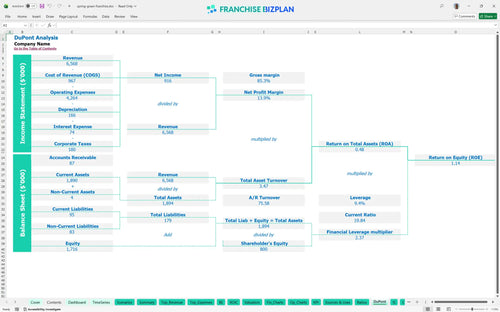
DuPont analysis
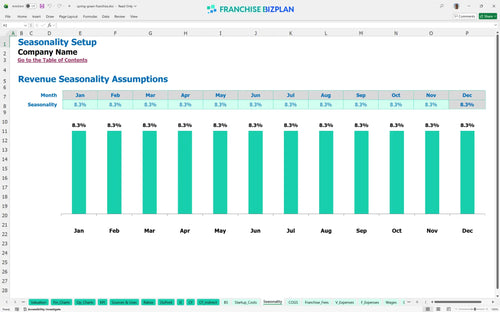
Researched revenue assumptions
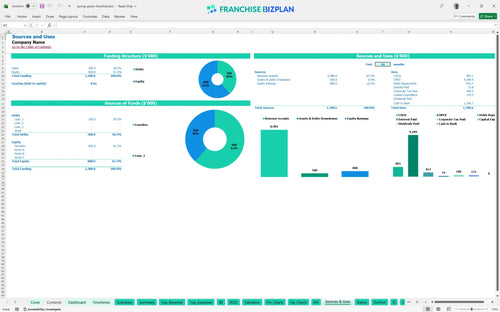
Lender-friendly financial outputs
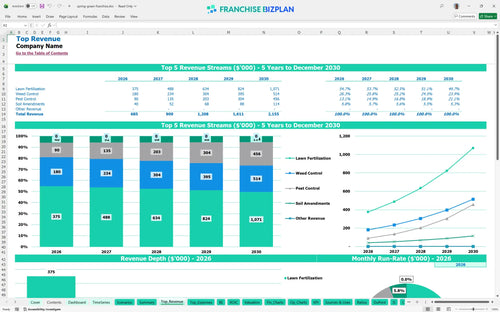
Revenue stream detailed view
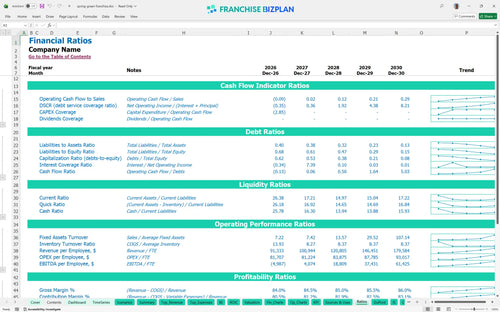
Performance metrics benchmark
We built this franchise unit financial model using our own research into the home services sector. Key assumptions like the $40,000 franchise fee and recurring revenue streams from fertilization are pre-populated and fully editable. With a projected Year 5 EBITDA of $737,000, this model helps you map out a realistic path to scaling your territory and managing your lawn care business startup costs effectively.
Based on the researched data, this unit hits its stride in year two after a small initial loss. While Year 1 shows a $37,000 EBITDA deficit, Year 3 jumps to $188,000 as recurring revenue from fertilization and weed control scales. Profitability is defintely tied to route density and technician efficiency. What this estimate hides is the impact of weather delays on your early-season cash flow.
You will need roughly $170,000 to $200,000 to get the wheels turning and cover the initial ramp-up. This includes the $40,000 franchise fee, $65,000 for service trucks, and $22,000 for sprayers and spreaders. This financial projection spreadsheet for service-based franchises ensures you have enough liquidity to survive the first seven months. Plus, you need to account for signage and uniforms during the pre-opening phase.
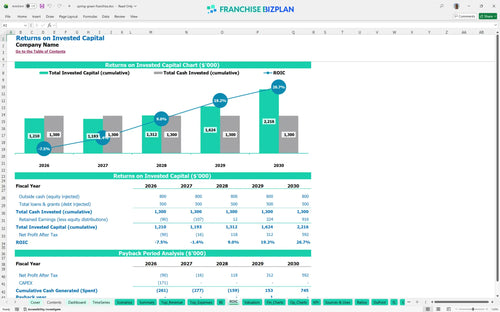
The ROI analysis shows a 4-year payback period and an internal rate of return (IRR) of 3.68%. While the IRR seems modest, the enterprise value grows significantly by Year 5 as EBITDA hits $737,000. It is a long-term equity play rather than a quick cash grab. To be fair, your return on equity (ROE) of 1.14 shows the business is working for you once the fleet is mature.
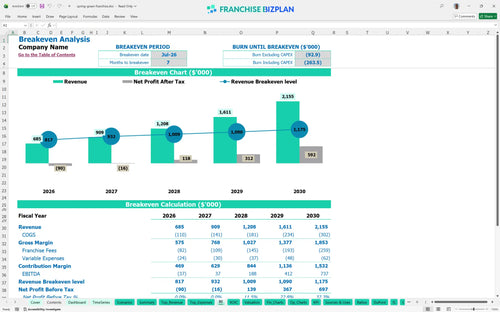
You reach the break-even date in July 2026, just 7 months after your initial launch. This assumes you hit your targets for lawn fertilization and weed control early in the spring season. The franchise unit profit and loss template identifies labor as your biggest hurdle to staying in the black. If you can't keep your trucks full, your break-even point will slide into the next season.
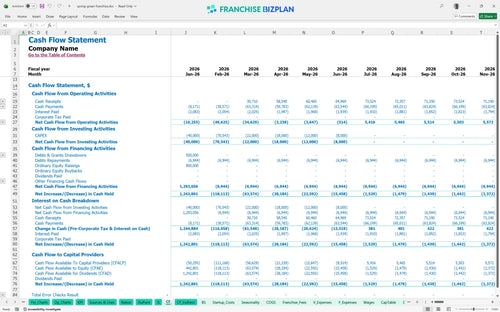
The lowest cash point occurs in January 2028, with about $924,000 in the bank if you follow the aggressive growth plan. This financial model for home service businesses suggests you have plenty of runway, but a buffer is still smart for the winter months. Cash flow management is key during the winter dip when fertilization revenue dries up. Honestly, your off-season pest control is what keeps the lights on.
Testing estimating recurring revenue for lawn care business under different scenarios is vital for risk management. A high-growth case could see Year 5 revenue exceed $2.1 million, while a low-growth case might delay your 4-year payback. Scenarios help you see how a 2% shift in chemical costs or a 10% drop in retention impacts your bottom line. Every 1-point margin leak matters fast in this model.
This lawn care franchise financial model is built in Excel, allowing you to tweak every variable to fit your specific territory. We have pre-loaded the formulas, but you can easily adjust the pricing for lawn fertilization or weed control to match your local competitive landscape. It is a flexible franchise financial forecasting tool that adapts to your specific location and operating scenario without the need for complex programming.

Planning for long-term growth is the only way to survive in the home services sector. This franchise business plan template maps out your expansion from a single truck to a full fleet over 60 months. You will see how adding technicians impacts your unit economics as revenue scales from $685,000 in Year 1 to over $2.1 million by Year 5. Here is the quick math: scaling your fleet is the primary driver of your long-term valuation.

Royalties and brand funds are non-negotiable obligations that directly impact your take-home pay. At a 10% royalty and 2% marketing fee, $12,000 of every $100,000 in sales goes to the franchisor before you pay for gas or chemicals. This tool helps you track these franchise royalty fees so you are never surprised by the cash outflow during peak service months. Still, the brand equity usually pays for itself through higher lead conversion.

Knowing how to calculate startup costs for a lawn care franchise is the first step for any serious operator. Between the $40,000 initial fee and $65,000 for service trucks, the entry price requires careful capital allocation. Our franchise unit breakeven analysis template shows exactly when your monthly ticket volume covers these fixed costs. Honestly, most owners focus on sales, but the real winners focus on the point where fixed costs are fully absorbed.

Do not fly blind when it comes to budgeting for specialized equipment and chemical supplies. We have included benchmarks for fertilizers and pest supplies, which the data shows should trend from 16% down to 14% of revenue as you gain scale. Comparing your lawn care franchise profit margin analysis tool results against industry norms keeps your projections grounded in reality. If your chemical waste is too high, your margins will leak fast.


Simply purchase and download the financial model template, then access it instantly using Microsoft Excel or Google Sheets. No installation or technical expertise required-just open and start working.

Enter your business-specific numbers, including revenue projections, costs, and investment details. The pre-built formulas will automatically calculate financial insights, saving you time and effort.

Leverage the investor-ready format to confidently showcase your financial projections to banks, franchise representatives, or investors. Impress stakeholders with clear, data-driven insights and professional reports.

Leverage the investor-ready format to confidently present your projections to banks, franchise representatives, or investors.