


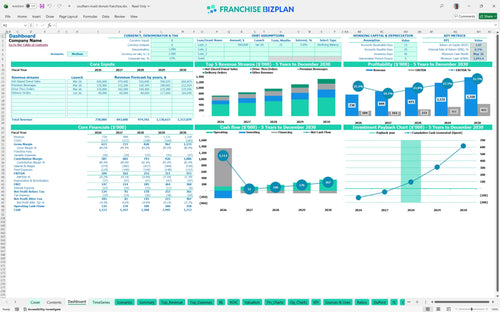
All-in-one Dashboard
Core inputs and core outputs



This comprehensive toolkit provides a dynamic Excel-based framework for projecting five years of revenue, expenses, and cash flow for a high-volume retail bakery unit.
Core inputs and core outputs
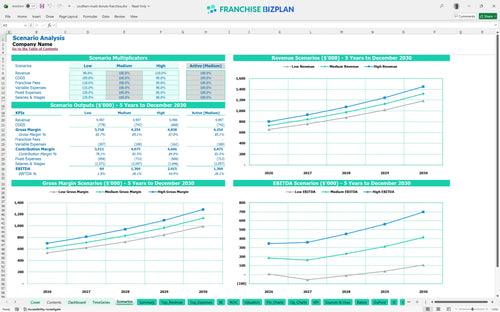
Three scenario analysis
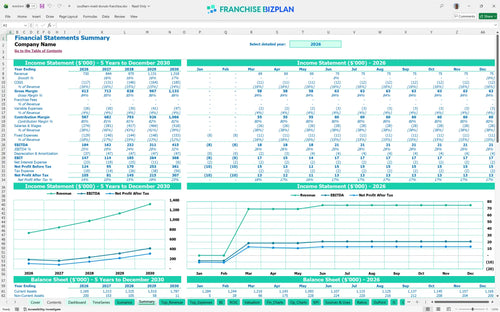
Presentation ready
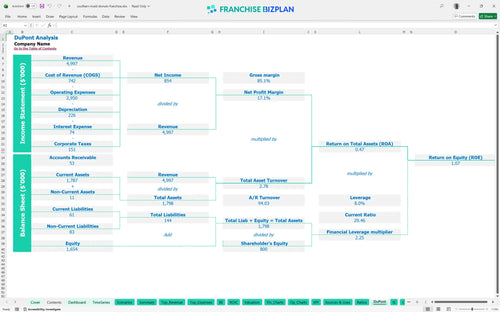
DuPont analysis
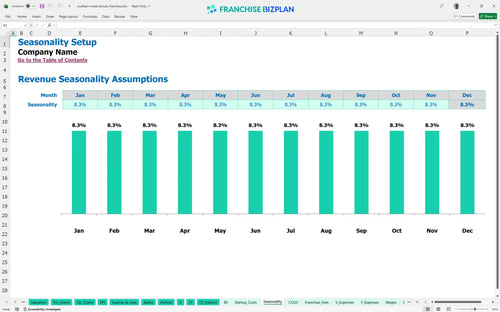
Researched revenue assumptions
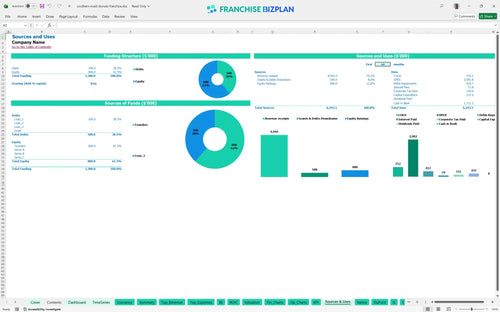
Lender-friendly financial outputs
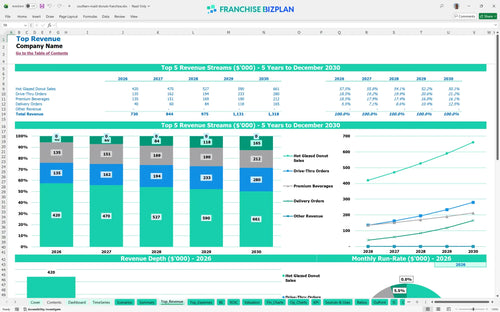
Revenue stream detailed view
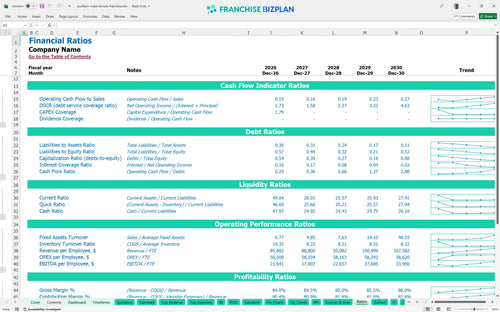
Performance metrics benchmark
We developed this donut franchise financial model based on deep industry research to provide a reliable roadmap for new operators. The template comes pre-populated with data reflecting a $730,000 Year 1 revenue target and a $184,000 EBITDA, covering everything from drive-thru equipment to late-night delivery staffing. All inputs are fully editable, so you can tailor the capital expenditure planning and operating cash flow to your specific location.
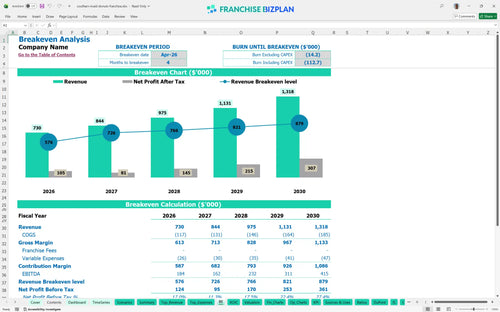
Estimating profitability for a new franchise location shows this unit hits its break-even point in April 2026, just four months after opening. While Year 1 EBITDA is a healthy $184,000, the model projects this will grow to $415,000 by Year 5 as you scale delivery and drive-thru channels. Here's the quick math: with 0% royalties currently modeled, your ability to control food waste and labor efficiency directly dictates your take-home pay.
The total initial investment for this unit is anchored by $237,000 in hard startup costs, including a $5,000 franchise fee and $95,000 for leasehold improvements. To be fair, the model suggests a significant cash buffer, with a minimum cash requirement of $1,043,000 to handle the ramp-up and ensure you never miss a payroll run. This retail franchise startup costs breakdown ensures you aren't caught off guard by the $45,000 needed for fryers or the $25,000 drive-thru setup.
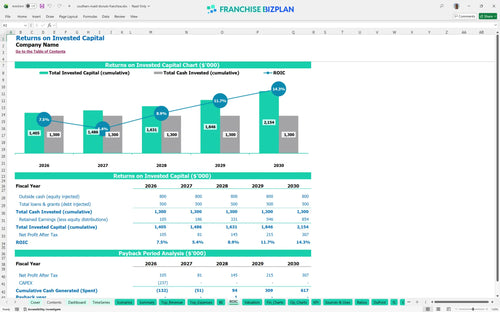
The return on investment for donut shop business units in this projection is highlighted by a 3-year payback period and an internal rate of return (IRR) of 6.14%. You will defintely want to keep an eye on the Return on Equity (ROE) of 1.07 as the unit matures and revenue climbs toward the $1.3M mark in Year 5. Still, the real value lies in the consistent operating cash flow that builds after the initial 36-month recovery window.
Your monthly break-even analysis shows that the unit must cover approximately $11,000 in basic fixed costs, including $6,500 for rent and $1,400 for utilities, before accounting for its $100,000+ management salary burden. The speed at which you reach this point depends heavily on drive-thru volume and the $55 average ticket typical for premium assortments. If you miss your Year 1 revenue target of $730,000, the break-even date will slide past the projected April 2026 mark.
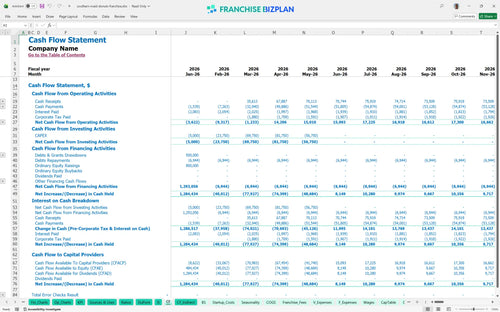
The small business franchise investment calculator identifies May 2026 as the lowest cash point, occurring right after the final construction and equipment payments are settled. You need a robust runway to handle the $1,043,000 minimum cash position required to navigate the initial months of operation. What this estimate hides is the timing gap between paying for $15,000 in POS tech and seeing the first delivery platform payouts hit your bank account.
Financial forecasting for food and beverage franchise operations shows that a 10% increase in high-margin beverage sales can significantly pull forward your payback date. In the high-growth scenario, scaling delivery orders to $164,640 by Year 5 transforms the unit from a steady earner into a high-yield asset. However, if Year 2 revenue dips below the $844,000 baseline, you may need to reassess your assistant manager staffing to protect the $162,000 EBITDA floor.
This donut shop unit economic model template is built in Excel with fully editable assumptions and pre-filled formulas, allowing you to adjust every variable from local tax rates to specific production volumes. You can easily modify the pricing drivers and cost inputs to reflect your specific territory, ensuring the donut franchise financial model matches your real-world operating environment.

Planning for long-term growth requires more than just a one-year outlook, so this model provides a detailed franchise business plan financial projections example spanning sixty months. It maps out your path from the first hot donut sold to a mature multi-unit operation, covering the profit and loss statement, balance sheet, and long-term cash flow needs.

Understanding how to project franchise royalty and marketing fees is critical for protecting your store-level margin, and this tool automates those calculations based on your gross sales. Even if your current agreement shows 0% fees, the model allows you to stress-test future fee increases to see how they would impact your overall operational expense breakdown for retail food franchise units.

Knowing how to calculate startup costs for a donut franchise is the first step toward a successful launch, and this model breaks down everything from leasehold improvements to specialized kitchen equipment. The integrated break-even analysis identifies the exact monthly revenue needed to cover your $6,500 rent and $10,000+ monthly management payroll.

This model includes built-in benchmarks for an operational expense breakdown for retail food franchise locations, helping you compare your projected labor and food costs against industry standards. By sanity-checking your 14.3% ingredient cost against typical ranges, you can identify where your model might be too aggressive or where you have room to optimize.


Simply purchase and download the financial model template, then access it instantly using Microsoft Excel or Google Sheets. No installation or technical expertise required-just open and start working.

Enter your business-specific numbers, including revenue projections, costs, and investment details. The pre-built formulas will automatically calculate financial insights, saving you time and effort.

Leverage the investor-ready format to confidently showcase your financial projections to banks, franchise representatives, or investors. Impress stakeholders with clear, data-driven insights and professional reports.

Leverage the investor-ready format to confidently present your projections to banks, franchise representatives, or investors.