


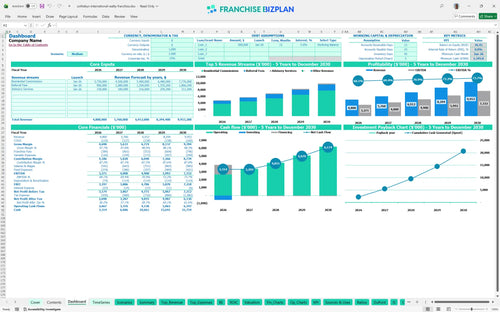
All-in-one Dashboard
Core inputs and core outputs



The franchise unit financial model template includes integrated financial statements, a startup budget template for premium real estate brokerage, and detailed calculators for commission splits and payroll.
Core inputs and core outputs
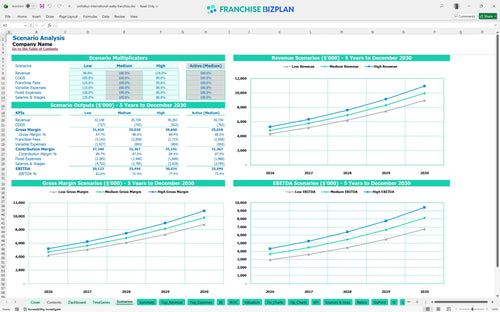
Three scenario analysis
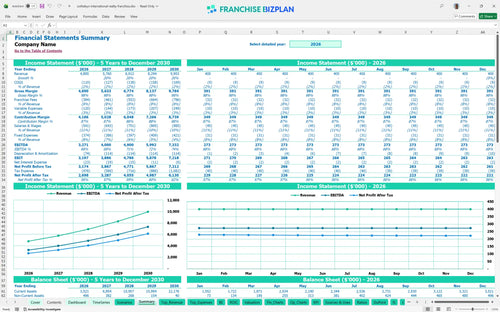
Presentation ready
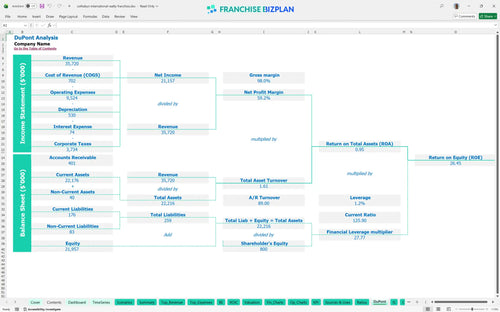
DuPont analysis
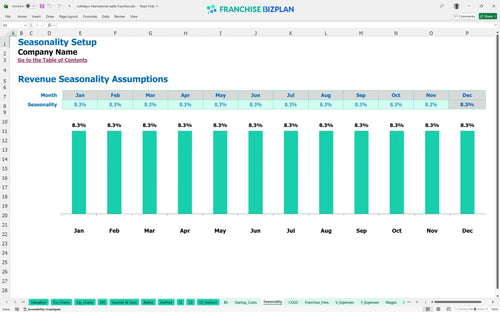
Researched revenue assumptions
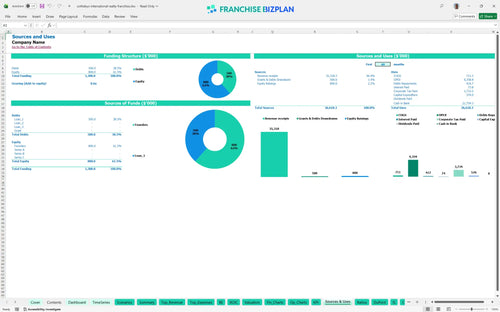
Lender-friendly financial outputs
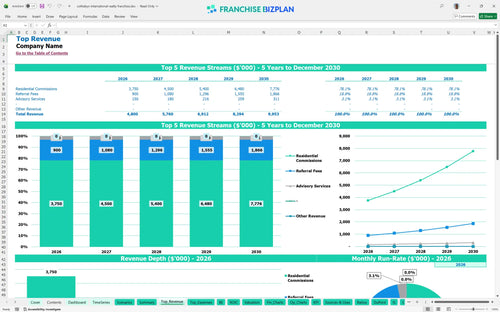
Revenue stream detailed view
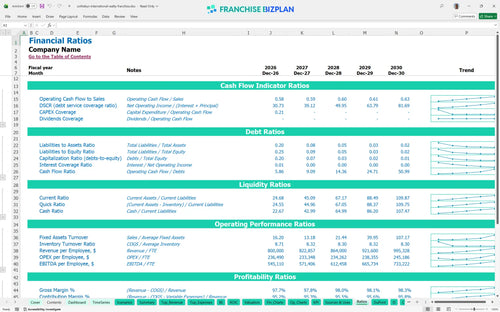
Performance metrics benchmark
We built this financial model using deep research into luxury brokerage operations to ensure every line item reflects actual market conditions. Key assumptions like residential commissions starting at $2.5M and a $20,000 monthly rent for prime locations are pre-populated but fully editable. This tool helps you see how a $4.8M year-one revenue target translates into a $3.27M EBITDA while accounting for all brand-specific fees and local overhead.
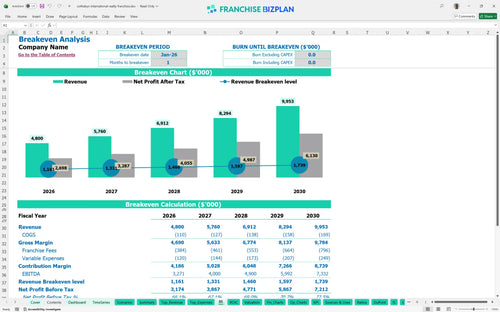
The unit reaches profitability almost immediately, with a break-even date of January 2026. With Year 1 EBITDA projected at $3,271,000, the trajectory is steep as you scale from two agents to four by Year 5. Here is the quick math: high average tickets on luxury estates mean your fixed costs are covered by just a few significant closings.
You need $570,000 in upfront CAPEX to launch, which includes leasehold improvements and high-end VR equipment. The minimum cash needed is $1,345,000, which occurs in January 2026, to cover the initial investment and the first month of operations. Honestly, having this liquid capital is defintely the biggest hurdle for new operators.
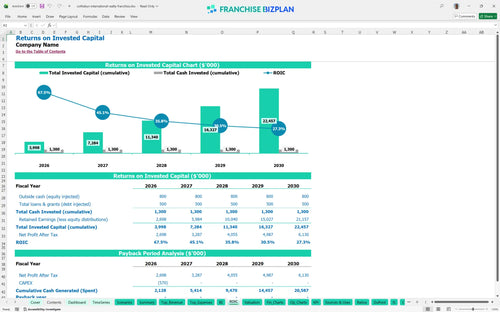
The franchise investment ROI calculator shows a Return on Equity (ROE) of 26.45%. While the full payback of the initial investment occurs after Year 5, the high annual EBITDA margins (over 60%) suggest a very strong long-term valuation. What this estimate hides is the potential for even higher returns if you capture more than the projected $600,000 in annual referral fees.
The monthly break-even point is reached in month one because the revenue from high-end commissions immediately offsets the $31,200 in monthly fixed costs. The biggest lever for maintaining this is agent productivity; if your agents don't close, the $20,000 monthly rent becomes a heavy burden. Still, the high-margin nature of luxury real estate makes the break-even volume relatively low.
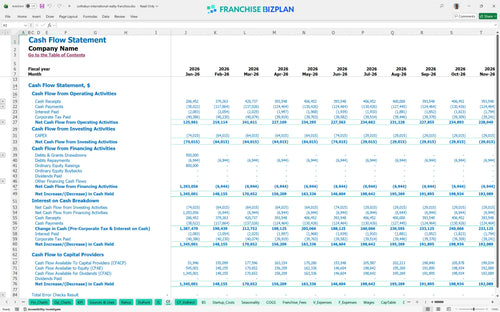
Your lowest cash point is $1,345,000 in the first month of 2026. Since the model shows immediate profitability, your runway is technically infinite after month one, but you must have the full startup capital ready to go. To be fair, any delay in the AI platform setup or VR equipment delivery could shift your cash needs by 30 to 60 days.
A High scenario, driven by faster agent recruitment, could push Year 1 revenue well past $4.8M. In a Low scenario, if listing production stays at 1.5% and revenue drops by 20%, your EBITDA would still be healthy but your cash buffer would tighten. Financial planning for multi-unit real estate franchise expansion requires testing these scenarios to ensure one slow office doesn't sink the whole chain.
This real estate franchise financial model is built entirely in Excel, giving you total control over every variable. You can easily adjust pre-filled formulas and editable assumptions to match your specific territory, whether you are looking at local commission splits or specific office build-out costs. It is designed to be a flexible tool for any prospective owner needing a luxury real estate franchise business plan that adapts to real-world market shifts.

Success in high-end brokerage requires looking beyond the first few closings to understand long-term sustainability. This franchise unit financial projection template provides a detailed 5-year outlook on revenue, costs, cash flow, and profit. It helps you visualize how scaling your team from a single managing broker to a full staff of advisors impacts your store-level margin and overall business value over time.

The model accurately tracks your franchise royalty fee structure, ensuring you account for the 6% royalty and 2% brand marketing fund contributions. These fees are calculated automatically against your gross commission income, so you can see the impact on your net cash flow. Understanding these obligations upfront is vital for maintaining healthy real estate brokerage profit margins while benefiting from a global brand name.

Knowing how to calculate startup costs for a luxury real estate franchise is essential for proper capital expenditure planning. This model maps out the $570,000 initial investment, including the $25,000 franchise fee and $250,000 for leasehold improvements. It then identifies the exact sales volume and timing required to reach break-even, helping you manage your initial cash outlay and working capital requirements effectively.

This model uses researched franchise unit performance metrics to help you sanity-check your operating expense forecasting. We have included benchmarks for listing production costs and agent commission splits so you can compare your projected performance against industry standards for premium brokerages. These built-in guides ensure your revenue projection model for high-end real estate franchise units remains grounded in financial reality.


Simply purchase and download the financial model template, then access it instantly using Microsoft Excel or Google Sheets. No installation or technical expertise required-just open and start working.

Enter your business-specific numbers, including revenue projections, costs, and investment details. The pre-built formulas will automatically calculate financial insights, saving you time and effort.

Leverage the investor-ready format to confidently showcase your financial projections to banks, franchise representatives, or investors. Impress stakeholders with clear, data-driven insights and professional reports.

Leverage the investor-ready format to confidently present your projections to banks, franchise representatives, or investors.