


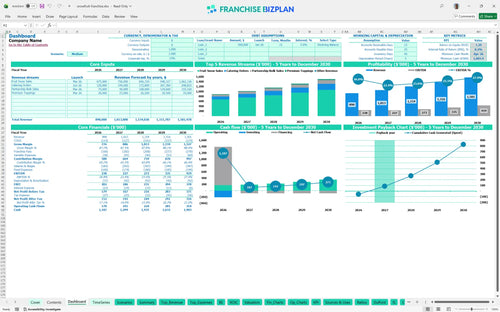
All-in-one Dashboard
Core inputs and core outputs



This franchise financial model template provides a complete roadmap from the initial $50,000 franchise fee to a mature $1.5M revenue operation.
Core inputs and core outputs
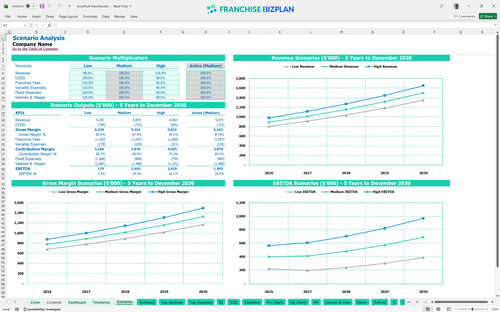
Three scenario analysis
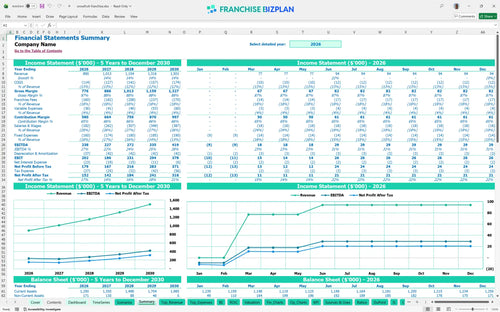
Presentation ready
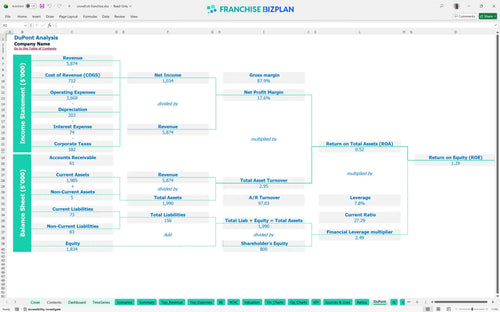
DuPont analysis
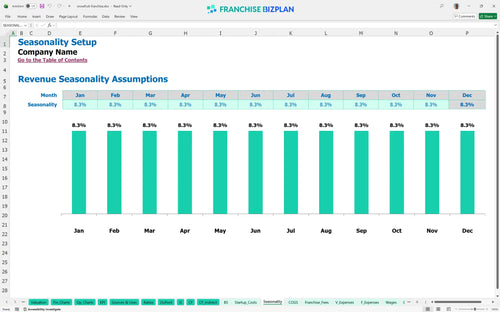
Researched revenue assumptions
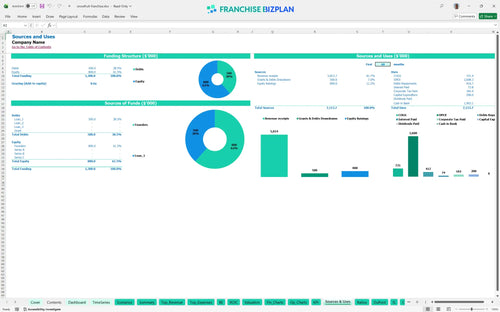
Lender-friendly financial outputs
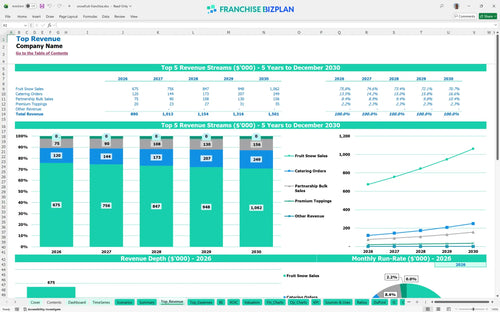
Revenue stream detailed view
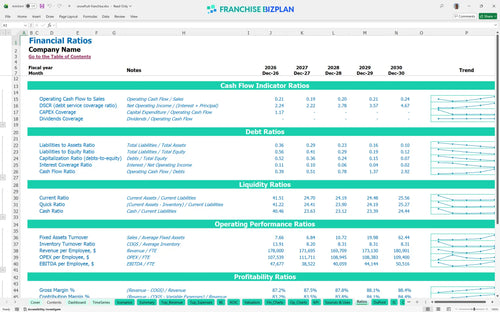
Performance metrics benchmark
We built this franchise unit financial model using our own research to help you navigate the unit economics of a premium dessert concept. Key assumptions, including the $890,000 year-one revenue and the 18% royalty fee, are pre-populated and fully editable to match your specific market conditions. This financial template for prospective franchise owners takes the guesswork out of projecting revenue for a high-traffic retail franchise.
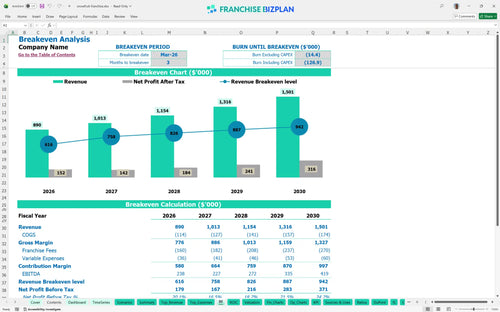
Based on the data, this unit becomes profitable by March 2026, just three months after the initial launch. You can expect a Year 1 EBITDA of $238,000, even after accounting for the high 18% royalty and $7,500 monthly rent. Analyzing franchise profitability metrics shows that the $450,000 in base fruit snow sales is the primary engine for this early success.
You will need to plan for a total initial investment that covers $208,000 in fixed assets plus a significant cash buffer, as the minimum cash point hits $1,066,000 in April 2026. The financial feasibility study for dessert shop shows that the $50,000 franchise fee and $45,000 leasehold improvements are your largest upfront hurdles. Still, the model ensures you have the liquidity to handle the ramp-up phase.
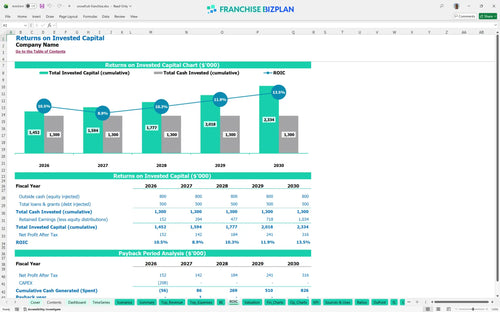
The model projects an Internal Rate of Return (IRR) of 8.15% and a Return on Equity (ROE) of 1.29. When you calculate ROI for a new franchise unit, the two-year payback period stands out as a strong indicator of the concept's efficiency. This financial model template for retail food franchise helps you visualize how the $1.5 million year-five revenue translates into long-term wealth.
You reach the break-even point in March 2026, which is remarkably fast for a retail concept. The biggest pressure on your break-even level is the 18% royalty fee, meaning you must maintain high throughput to cover the $7,500 rent and $1,400 utility bills. Estimating labor costs for food service franchise shows that managing your crew member FTEs is the fastest way to lower this threshold.
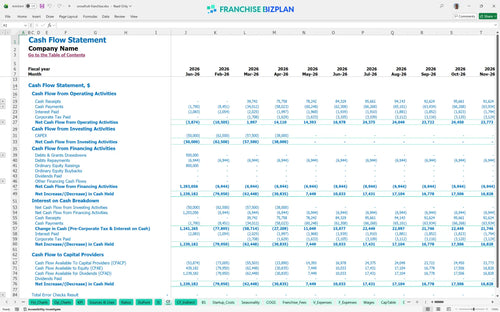
The lowest cash point occurs in April 2026 at $1,066,000, which includes your operating reserves and initial investment. Using the franchise unit cash flow forecasting spreadsheet, you can see that the gap between the January franchise fee and the March opening requires disciplined capital management. Also, keeping $2,000 for local marketing is essential to ensure the ramp-up stays on schedule.
While the base case shows $238,000 Year 1 EBITDA, a low scenario with 10% less traffic could delay your payback past the 2-year mark. High scenarios, driven by growing catering from $80,000 to $165,888, significantly boost your overall IRR. Operating expense forecasting allows you to see how a 1% drop in fruit ingredient costs can add thousands to your annual take-home pay.
This franchise unit financial model is an Excel-based tool designed for quick adjustments. You can swap out the $7,500 monthly rent or tweak the 18% royalty rate to see how it hits your bottom line. It defintely helps you move from 'what if' to a solid plan with editable assumptions that adapt to your specific territory and local labor market.

Mapping out five years of growth is vital for any retail franchise financial projections. With revenue starting at $890,000 in year one and scaling to over $1.5 million by year five, you need to see how margins evolve as labor and COGS shift. This long-term view ensures you are planning for food and beverage business scalability rather than just surviving the first year.

This model tracks the heavy hitters like the $50,000 initial fee and the 18% royalty structure. Knowing that nearly a fifth of your revenue goes to the franchisor is a franchise reality you can't ignore when building your franchise profit and loss statement. We include specific lines for the franchise royalty and fee structure so your net margin is always accurate.

Before you open the doors, you'll need to account for roughly $208,000 in CAPEX, including $45,000 for leasehold improvements and $35,000 for shaving stations. This franchise unit business plan identifies exactly when you stop burning cash and start keeping it. Use the startup cost breakdown for dessert business to ensure you have enough capital to reach the March 2026 break-even point.

Use built-in benchmarks to see if your 11% fruit ingredient cost is realistic for a dessert franchise startup costs profile. Comparing your $60,000 manager salary against industry norms keeps your projections grounded. These best practices for franchise financial planning help you sanity-check your unit economics analysis before signing a lease.


Simply purchase and download the financial model template, then access it instantly using Microsoft Excel or Google Sheets. No installation or technical expertise required-just open and start working.

Enter your business-specific numbers, including revenue projections, costs, and investment details. The pre-built formulas will automatically calculate financial insights, saving you time and effort.

Leverage the investor-ready format to confidently showcase your financial projections to banks, franchise representatives, or investors. Impress stakeholders with clear, data-driven insights and professional reports.

Leverage the investor-ready format to confidently present your projections to banks, franchise representatives, or investors.