


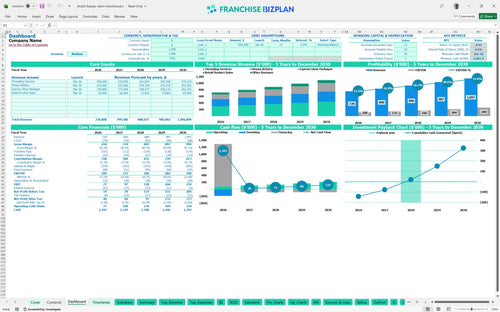
All-in-one Dashboard
Core inputs and core outputs



This financial model for opening a professional beauty salon franchise includes a comprehensive 5-year projection engine, detailed startup cost tracker, and automated royalty calculators tailored for high-end retail environments.
Core inputs and core outputs
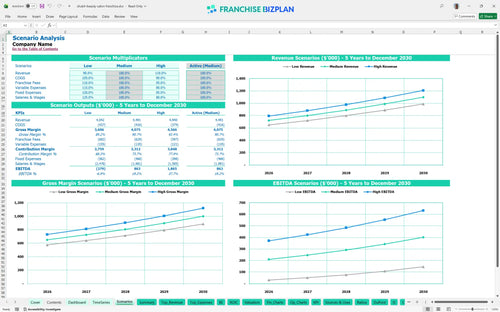
Three scenario analysis
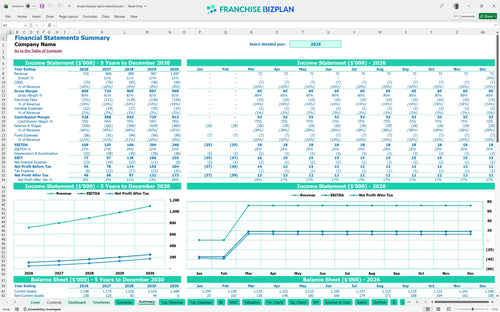
Presentation ready
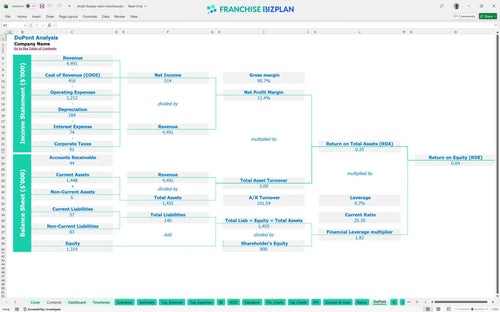
DuPont analysis
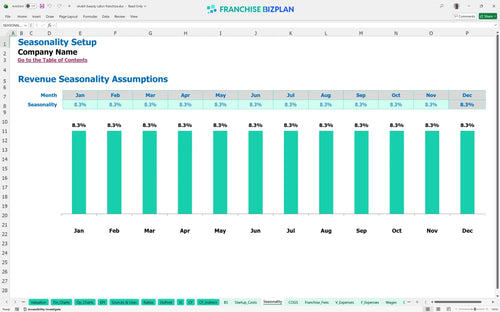
Researched revenue assumptions
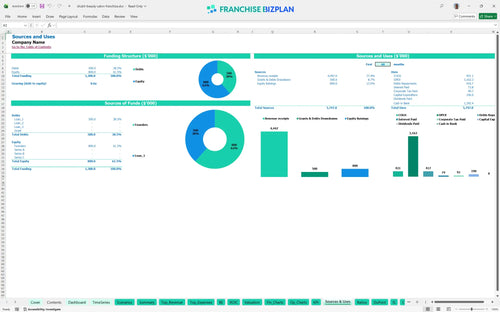
Lender-friendly financial outputs
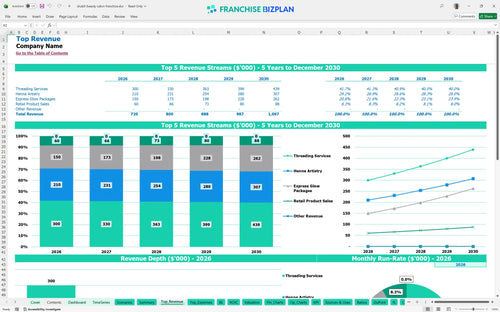
Revenue stream detailed view
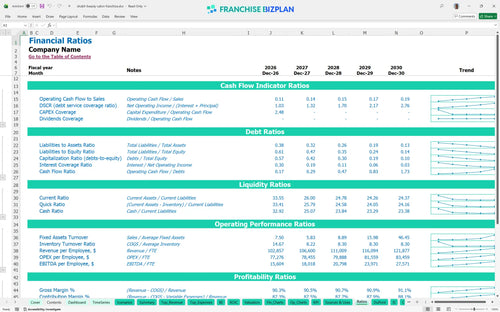
Performance metrics benchmark
We developed this franchise unit financial model through deep research into the unit economics of specialized beauty services. The model comes pre-loaded with data for threading, henna artistry, and retail sales, showing a Year 1 EBITDA of $109,000. It is a practical tool for any owner evaluating franchise financial feasibility for beauty salons without needing a degree in finance.
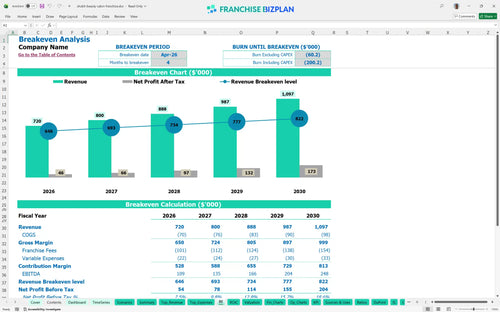
The unit reaches profitability early, showing a positive EBITDA of $109,000 in the first year. After accounting for the 14% total franchise fees and $4,500 monthly rent, the model estimates the unit becomes profitable by April 2026, just four months after launching services. Still, you need to maintain high traffic to cover the $178,000+ annual management and tech payroll.
You need approximately $190,000 to launch this unit in the US market. This covers the $10,000 franchise fee, $80,000 for leasehold improvements, and $35,000 for salon stations. The model also accounts for $15,000 in initial inventory and $12,000 for the POS and tech setup to ensure you are ready for day-one operations. Honestly, having a cash buffer is smart given the $1.06M minimum cash requirement listed in the data.
Investors can expect a 3-year payback period on their initial capital. The internal rate of return (IRR) is 4.62%, with a return on equity (ROE) of 0.64. While the IRR seems conservative, the EBITDA grows steadily from 15% in Year 1 to 22.6% by Year 5, making it a stable long-term play for a multi-unit operator. Here's the quick math: Year 5 profit is more than double Year 1.
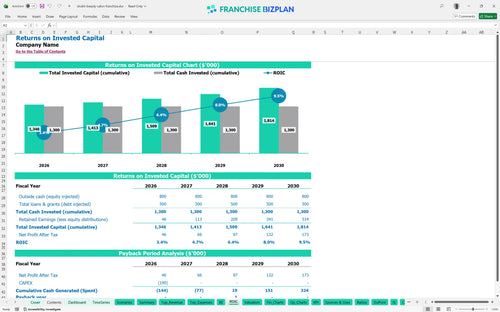
The monthly break-even point occurs in April 2026, four months after opening. The primary driver for this is service volume, as the 14% royalty and marketing burden remains a constant variable cost. To hit this fast, you must maximize the 4.0 initial technician FTEs. If your threading and henna volume lags, the $7,350 in monthly fixed costs (rent, utilities, insurance, marketing) will eat your cash quickly.
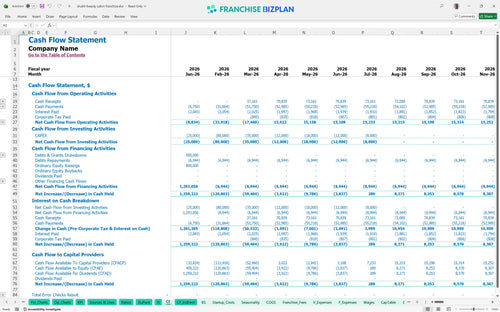
The lowest cash point occurs in June 2026, six months into the project. You need enough runway to cover the $190,000 in startup CAPEX plus the initial months of ramp-up losses. The model suggests a significant cash position is needed to handle the timing gap between the $80,000 build-out and the point where $60,000+ monthly revenue becomes consistent. Defintely monitor the $4,500 rent and $14,800+ monthly payroll during the first 90 days.
In a high-growth scenario, reaching $1.09 million in revenue by Year 5 increases EBITDA to $248,000. A low scenario where revenue stays flat at $720,000 would significantly extend the 3-year payback period. The model shows that adding two additional beauty technicians by Year 5 is the key driver for hitting the high-case margin of 22.6%. What this estimate hides is the impact of local competition on your $55+ average ticket.
Finance: update unit break-even and payback model by Friday.
This beauty salon franchise financial model is a fully editable Excel tool designed to handle the specific nuances of a high-end service business. You can adjust pre-filled formulas for threading, henna, and 'Express Glow' packages to see how different service mixes impact your bottom line. It defintely simplifies complex math so you can focus on site selection and hiring instead of broken spreadsheets.

Planning for a single unit requires looking past the grand opening to see how the business matures over five years. This franchise unit business plan template shows a clear path from $720,000 in Year 1 revenue to over $1.09 million by Year 5. It helps you visualize how scaling your technician count from 4 to 6 FTEs (full-time equivalents) drives long-term profitability and cash flow.

The model specifically tracks the heavy lifting of franchise-specific costs, including the 12% royalty and 2% marketing fund contribution. At $720,000 in annual sales, that is $100,800 leaving the business before you pay rent or staff. Understanding these obligations is vital for a beauty salon investment calculator to provide a realistic view of your take-home pay.

Starting a salon involves significant upfront costs, from $80,000 in leasehold improvements to $35,000 for specialized stations. This salon franchise startup costs Excel tool maps out every dollar spent before the doors open, including the $10,000 franchise fee. It then calculates the exact sales volume you need to cover your $4,500 monthly rent and fixed overhead.

We built in industry-specific benchmarks so you can sanity-check your beauty salon franchise investment return analysis. For example, beauty supplies are modeled at 7.2% of sales, while labor costs are detailed by position, from the $60,000 manager to the $34,000 receptionist. These benchmarks ensure your franchise unit performance metrics stay within a realistic range for the luxury beauty sector.


Simply purchase and download the financial model template, then access it instantly using Microsoft Excel or Google Sheets. No installation or technical expertise required-just open and start working.

Enter your business-specific numbers, including revenue projections, costs, and investment details. The pre-built formulas will automatically calculate financial insights, saving you time and effort.

Leverage the investor-ready format to confidently showcase your financial projections to banks, franchise representatives, or investors. Impress stakeholders with clear, data-driven insights and professional reports.

Leverage the investor-ready format to confidently present your projections to banks, franchise representatives, or investors.