


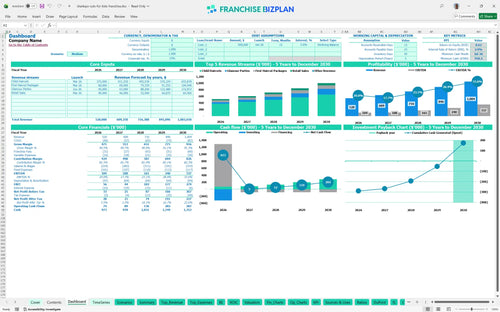
All-in-one Dashboard
Core inputs and core outputs



This franchise unit performance projections spreadsheet provides a complete roadmap from initial investment to mature-unit cash flow.
Core inputs and core outputs
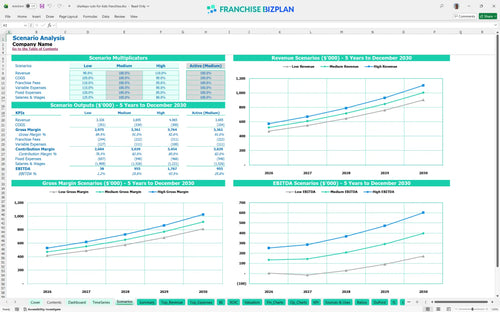
Three scenario analysis
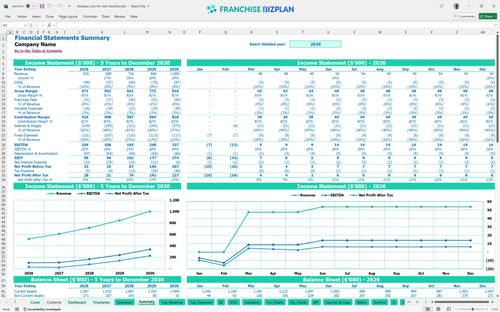
Presentation ready
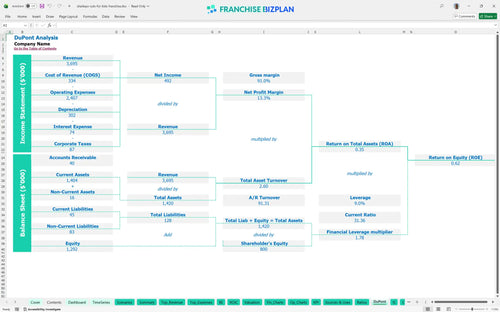
DuPont analysis
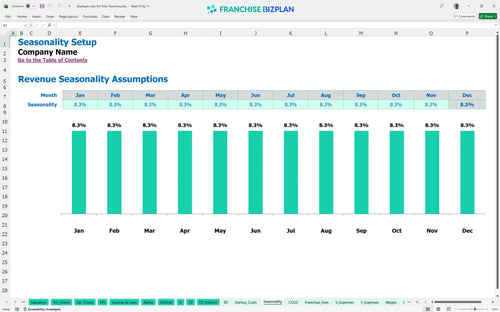
Researched revenue assumptions
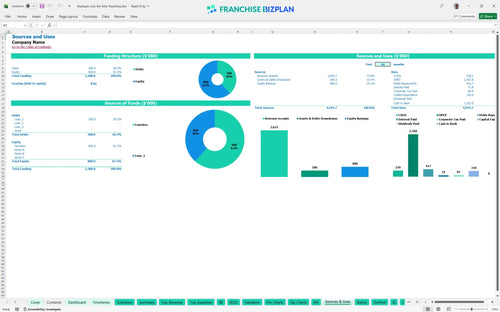
Lender-friendly financial outputs
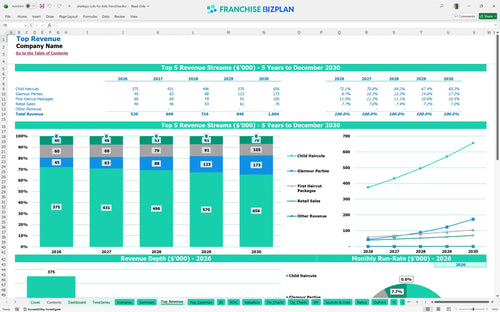
Revenue stream detailed view
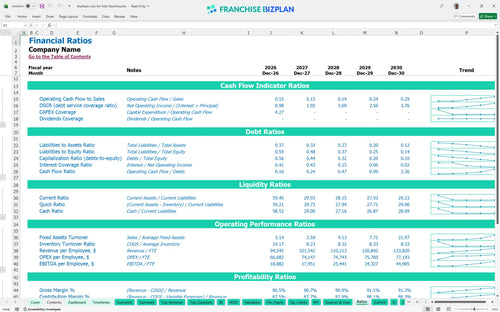
Performance metrics benchmark
We developed this kids hair salon franchise financial model using our own research into unit economics and startup requirements. Key assumptions like the $520,000 year-one revenue and the 3% royalty fee are pre-populated and fully editable. It is a practical tool that maps out everything from stylist payroll to the $318,000 in CapEx (capital expenditures).
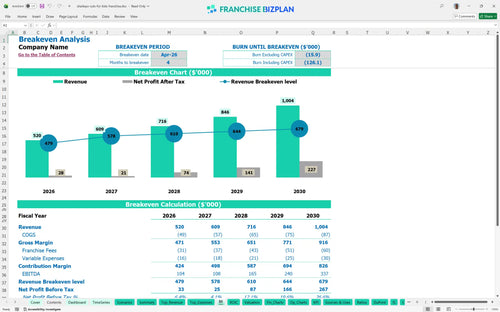
This unit hits its stride quickly, reaching monthly break-even by April 2026, just four months after launching. By year three, EBITDA (earnings before interest, taxes, depreciation, and amortization) climbs to $165,000 as revenue scales. Here's the quick math: once you cover the $6,000 monthly rent and fixed staffing, the high-margin haircuts and glamour parties drive the bottom line.
You will need approximately $318,000 to get the doors open, covering everything from the $45,000 franchise fee to the $120,000 in leasehold improvements. The model also accounts for $15,000 in gaming stations and $50,000 for salon chairs. Still, you should maintain a cash buffer, as the lowest cash point hits $950,000 in July 2026 if you include total liquidity needs.
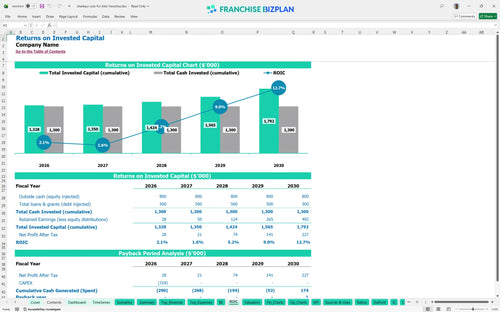
Investors can expect a 2.94% IRR (internal rate of return) and a return on equity of 0.62 over the first five years. The payback period sits at 5 years, which is standard for a retail build-out with high upfront costs. To be fair, this is a long-term play focused on building a stable, local service hub with a year-five EBITDA of $337,000.
The monthly break-even point occurs in April 2026, driven primarily by the volume of child haircuts and glamour parties. Since your rent is fixed at $6,000, increasing your average ticket through retail sales is the fastest way to cover overhead. Manager productivity is the secret sauce here.
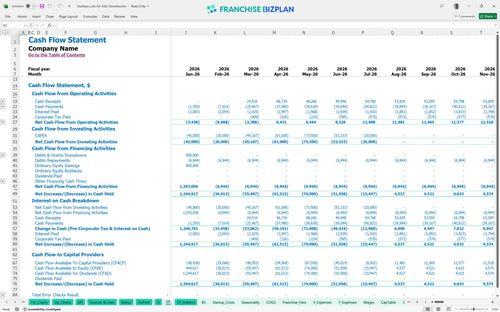
Your lowest cash point defintely occurs in July 2026, roughly $950,000 depending on your initial funding. You need enough runway to cover the ramp-up period where labor costs for your manager and stylists precede your peak revenue months. What this estimate hides is the potential for construction delays, which can burn through working capital fast.
The model compares Low, Medium, and High scenarios to show how a 10% shift in revenue impacts your $337,000 year-five EBITDA. High-performing units usually win on local marketing execution and stylist retention. Analyzing franchise profit margins for kids salons helps you prepare for the worst while aiming for the best. Finance: update unit break-even and payback model by Friday.
This kids hair salon franchise financial model lives in Excel, so you can tweak every variable to fit your specific territory. Whether you are adjusting stylist commissions or local utility rates, the pre-filled formulas handle the heavy lifting. It is a salon franchise financial model Excel template built to be a living document that grows with your multi-unit ambitions.

You need to see beyond the grand opening to understand if the ROI analysis justifies the effort. This tool maps out five years of performance, showing how revenue scales from $520,000 in year one to over $1 million by year five. It defintely helps you conduct a salon franchise profitability analysis to visualize the transition from a single-unit operator to a profitable enterprise.

Franchise royalty fees and brand funds are the franchise tax on your top line that you must manage carefully. This model bakes in the 3% royalty and 3% marketing fee automatically, so you see the impact on your store-level margin (the profit left after operating costs). It ensures you never overlook the $45,000 initial fee or ongoing brand contributions while estimating monthly operating expenses for a retail franchise.

Launching a retail concept requires significant upfront capital for things like leasehold improvements and salon equipment depreciation. We help you learn how to calculate startup costs for a kids salon franchise, identifying the exact moment you stop losing money each month. Knowing your break-even sales level is the best way to sleep better during the first quarter.

Do not guess if your $6,000 monthly rent is too high or if your stylist wages are competitive. The model includes industry benchmarks for kids salons, letting you sanity-check your numbers against proven standards. If your labor costs exceed typical ranges, the model flags it so you can adjust your staffing plan before signing a lease.


Simply purchase and download the financial model template, then access it instantly using Microsoft Excel or Google Sheets. No installation or technical expertise required-just open and start working.

Enter your business-specific numbers, including revenue projections, costs, and investment details. The pre-built formulas will automatically calculate financial insights, saving you time and effort.

Leverage the investor-ready format to confidently showcase your financial projections to banks, franchise representatives, or investors. Impress stakeholders with clear, data-driven insights and professional reports.

Leverage the investor-ready format to confidently present your projections to banks, franchise representatives, or investors.