


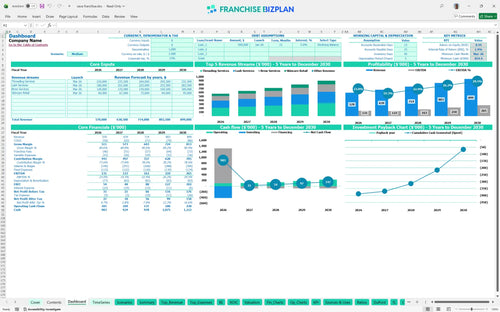
All-in-one Dashboard
Core inputs and core outputs



This detailed franchise unit financial projection spreadsheet includes pre-populated data for threading, lash, and brow services, alongside a complete operating budget template for Excel to manage your daily studio expenses.
Core inputs and core outputs
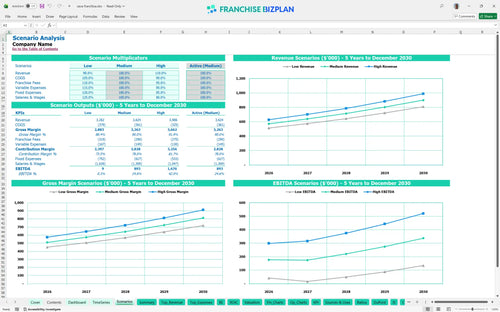
Three scenario analysis
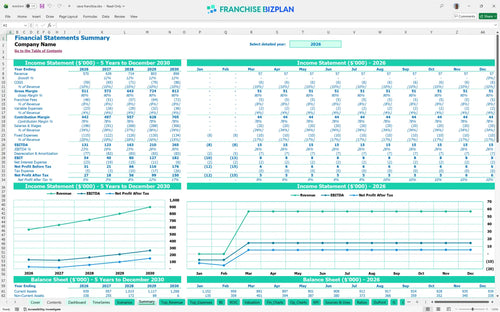
Presentation ready
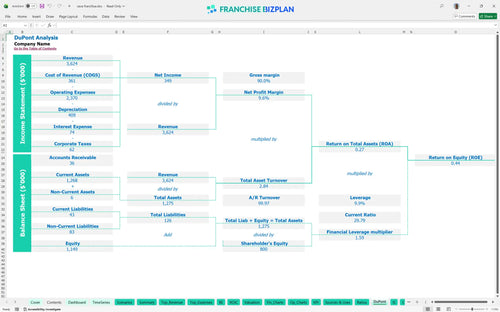
DuPont analysis
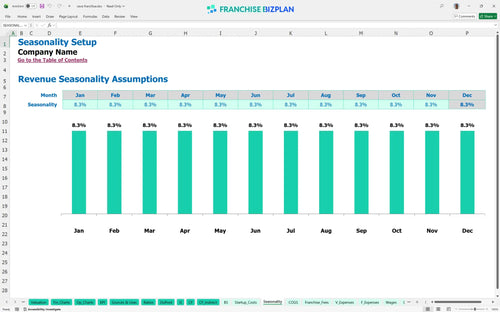
Researched revenue assumptions
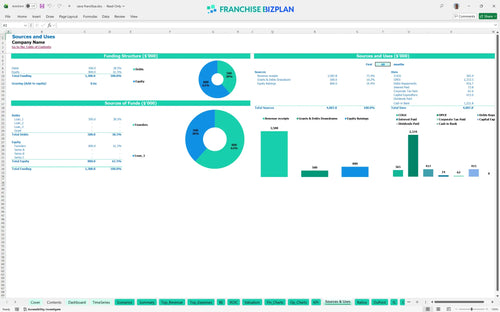
Lender-friendly financial outputs
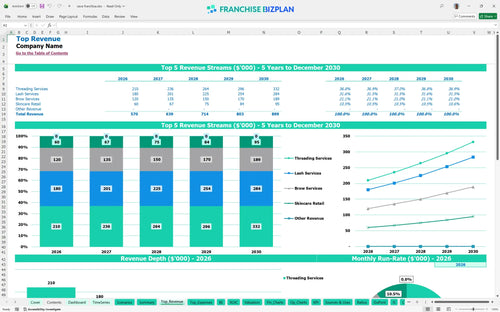
Revenue stream detailed view
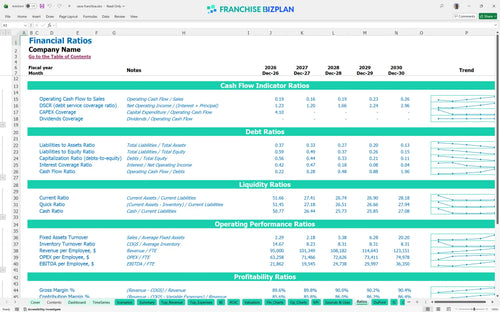
Performance metrics benchmark
We built this franchise unit financial model using our own research into the boutique beauty sector. Key assumptions, including the $570,000 Year 1 revenue target and the $131,000 EBITDA (earnings before interest, taxes, depreciation, and amortization) projection, are pre-populated and fully editable. This tool helps you bridge the gap between a brand's marketing materials and the actual cash flow reality of a high-traffic retail location.
The unit reaches operational profitability by March 2026, just three months after launching. This quick turn is driven by high-margin services like threading and lashes, which offset the $13,900 in total monthly fixed costs. Year 1 EBITDA starts at $131,000 and grows to $265,000 by Year 5 as the customer base matures.
You will need approximately $415,000 in upfront capital to cover the initial franchise fee, leasehold improvements, and equipment. This does not include the minimum cash buffer of $854,000 required to navigate the ramp-up phase through March 2026. Most of your funds go toward the $200,000 build-out and $120,000 in specialized salon equipment and chairs.
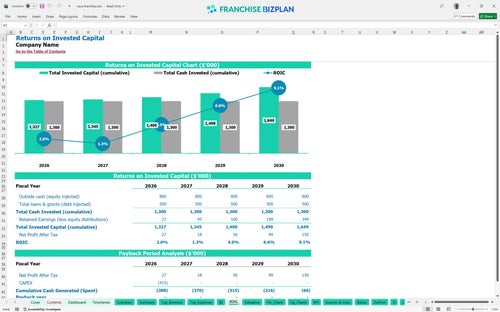
The model shows an Internal Rate of Return (IRR) of 1.91% and a Return on Equity (ROE) of 0.44. While the unit generates strong annual EBITDA, the high initial build-out costs mean the payback period defintely extends beyond the first five years of operation. Calculating return on investment for a service franchise requires looking at this long-term cash flow rather than just Year 1 wins.
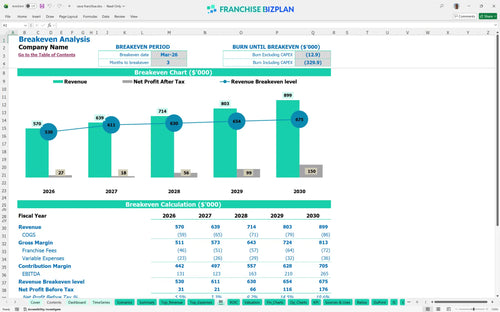
The monthly break-even point is reached in March 2026, assuming you hit your initial service volume targets. The biggest hurdle to breaking even is the $6,500 monthly rent and the $13,000+ monthly payroll for your technicians and manager. Estimating revenue for a retail beauty salon accurately is the only way to ensure you cover these fixed obligations.
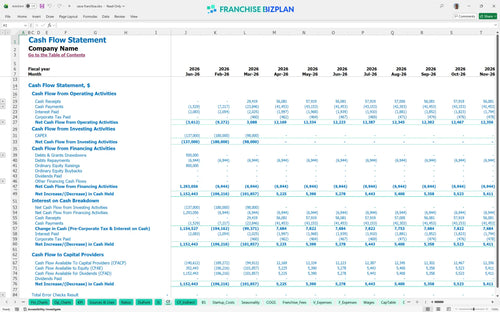
The lowest cash point occurs in March 2026, with a minimum cash requirement of $854,000 to remain solvent during the build-out and initial three-month ramp. You need a significant runway because the $200,000 leasehold improvements and $25,000 franchise fee are paid out well before the first customer walks in. Financial planning for small franchise chain owners must account for these timing gaps.
In the base case, revenue grows from $570,000 to $899,000 over five years, with EBITDA margins improving as fixed costs like rent are diluted. A low-performance scenario where revenue stays flat at Year 1 levels would significantly delay payback and could lead to a cash crunch. High-performance scenarios focus on maximizing the $221,000 threading revenue potential through better staff productivity.
Finance: update unit break-even and payback model by Friday.
This franchise unit financial model is fully customizable in Excel, featuring pre-filled formulas and editable assumptions that allow you to adapt the numbers to your specific territory and local market conditions. You can adjust everything from service pricing to hourly wages, making it a versatile tool for any retail beauty salon financial metrics analysis. The logic is built to handle the nuances of a service-based business, ensuring your franchise unit economics remain accurate as you scale.

Planning for the long term requires more than just a first-year estimate; this model provides detailed 5-year revenue, cost, and profit projections. By mapping out your growth from a $570,000 Year 1 revenue to a projected $899,000 in Year 5, you can visualize the path to maturity. This P&L statement template helps you track how store-level margins evolve as your beauty salon franchise business plan moves from the initial ramp-up to a steady state.

Operating a franchise involves specific financial obligations that can squeeze margins if not tracked precisely. This model captures the $25,000 initial franchise fee and automates the calculation of the 6% royalty and 2% brand marketing fund contributions. Understanding these ongoing costs is essential for any franchise profitability analysis, as they represent a permanent 8% top-line drag before you even pay your rent or technicians.

Getting the doors open is only half the battle; knowing when you stop losing money is the other half. This franchise startup cost calculator aggregates your $200,000 leasehold improvements and $80,000 in equipment to show your total entry price. The model then identifies the exact sales volume needed to cover your $6,500 monthly rent and $1,100 utility bills, providing a clear financial forecasting guide for new franchisees.

We have incorporated built-in industry benchmarks to help you sanity-check your operating budget spreadsheet. By comparing your projected 7.2% consumables cost against typical ranges for a retail beauty salon, you can identify potential margin leaks early. This feature is vital for analyzing profitability for a beauty retail franchise, ensuring your labor and occupancy costs stay within the 'danger zone' limits of the beauty industry.


Simply purchase and download the financial model template, then access it instantly using Microsoft Excel or Google Sheets. No installation or technical expertise required-just open and start working.

Enter your business-specific numbers, including revenue projections, costs, and investment details. The pre-built formulas will automatically calculate financial insights, saving you time and effort.

Leverage the investor-ready format to confidently showcase your financial projections to banks, franchise representatives, or investors. Impress stakeholders with clear, data-driven insights and professional reports.

Leverage the investor-ready format to confidently present your projections to banks, franchise representatives, or investors.