


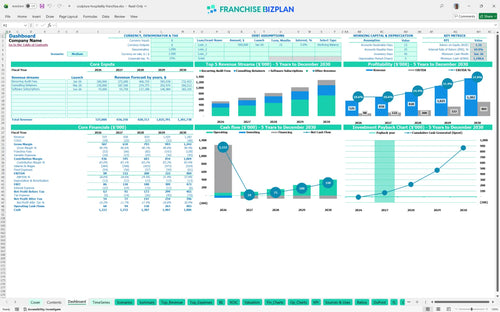
All-in-one Dashboard
Core inputs and core outputs



This product includes a professional-grade Excel financial model for beverage management business units, featuring pre-built revenue drivers, payroll calculators, and 5-year pro forma statements.
Core inputs and core outputs
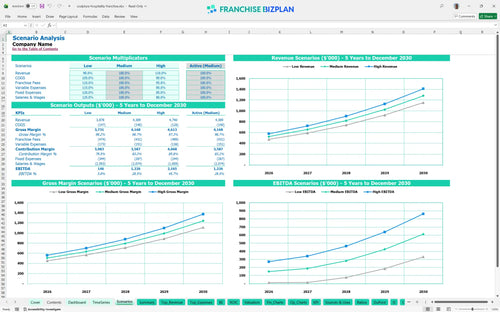
Three scenario analysis
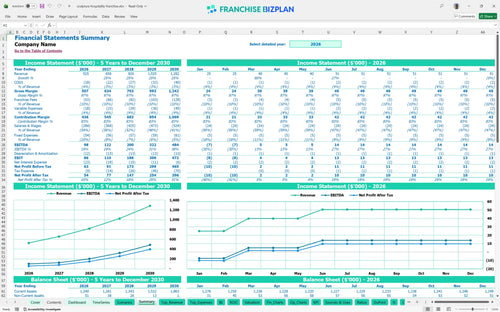
Presentation ready
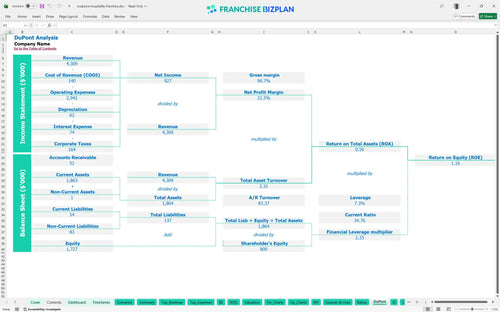
DuPont analysis
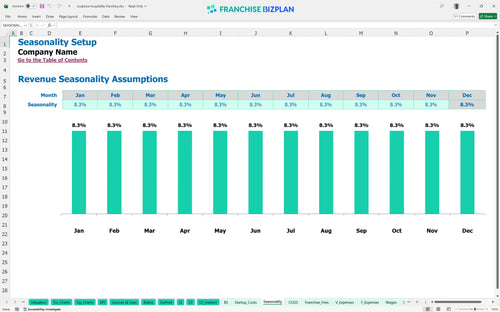
Researched revenue assumptions
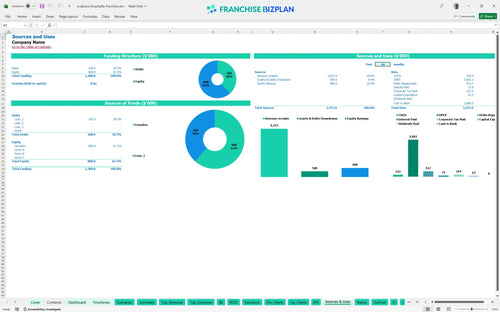
Lender-friendly financial outputs
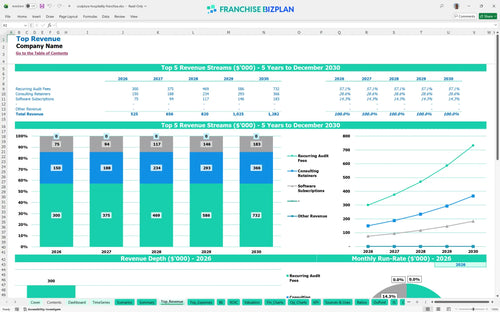
Revenue stream detailed view
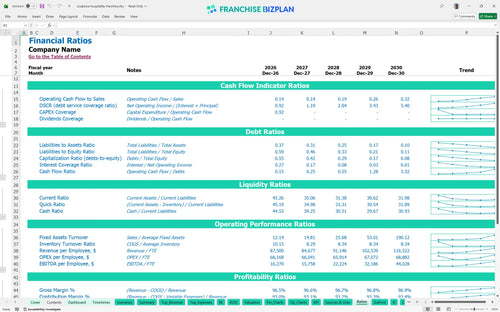
Performance metrics benchmark
We built this franchise unit financial model using detailed research on service-based hospitality audit franchises. Key assumptions like your $200,000 year-one recurring audit fees and 8% royalty payments are pre-populated and fully editable to reflect your specific territory. This model provides a data-driven look at how a $525,000 year-one revenue target translates into a $98,000 EBITDA for a new operator.
The unit reaches its break-even point in January 2026, just one month after launch. You will defintely hit profitability early because the model relies on high-margin recurring audit fees and consulting retainers that cover the $4,500 monthly fixed overhead quickly. After accounting for the 10% total franchise fees and labor, the unit scales to a $484,000 EBITDA by year five.
You need approximately $62,500 in total initial investment to launch this franchise unit in the US. This capital covers the $25,000 franchise fee, $8,000 for office leasehold improvements, and $7,000 for a vehicle downpayment. The model also accounts for $6,000 in computer workstations and $4,500 in specialized audit equipment to ensure you meet brand standards from day one.
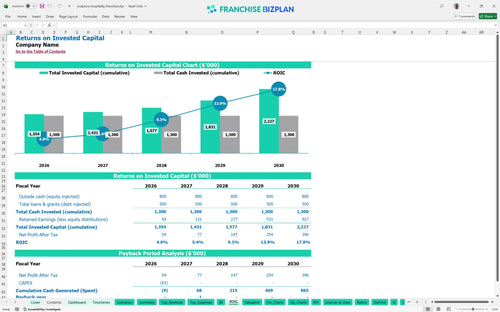
A franchisee can expect an Internal Rate of Return (IRR) of 10.94% and a Return on Equity (ROE) of 1.16. The payback period is 2 years, which is strong for a service-based business. These metrics are driven by the low initial CAPEX and the ability to scale revenue to $1,282,000 by year five while keeping fixed costs like the $2,500 monthly rent stable.
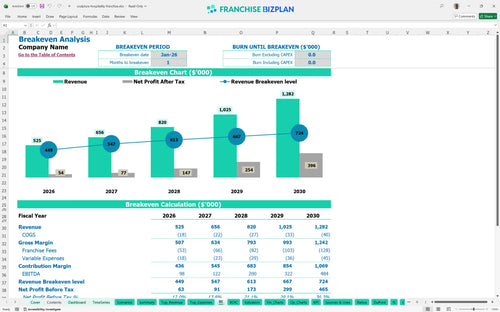
The monthly break-even occurs in the first month of trading because the initial revenue forecast of $525,000 in year one far exceeds the $54,000 annual fixed cost base. The primary driver for maintaining this break-even status is the volume of recurring audit fees. If you secure 10-15 consistent clients early, your fixed costs like rent and insurance are easily covered.
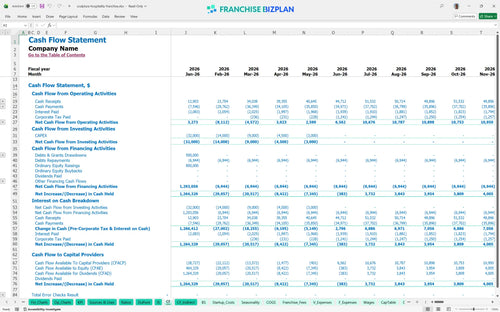
The lowest cash point for this franchise unit is projected at $1,199 in June 2026. While the business breaks even quickly, the ramp-up of audit technicians from 2 to 6 FTEs over five years requires careful cash management. You should maintain a small cash buffer to handle the timing gaps between performing audits and receiving payment from hospitality clients.
The high-growth scenario shows revenue reaching $1,282,000 by year five, which significantly improves the 10.94% IRR. In a low-revenue scenario, the 10% total royalty and marketing burden remains fixed, which puts pressure on the $98,000 year-one EBITDA. Managing the 2.5% client travel expense and the $60,000 operations manager salary is vital if revenue growth slows.
Finance: update unit break-even and payback model by Friday
This franchise financial model template is built in Excel to give you total control over your unit-level planning. You can adjust the pre-filled formulas and editable assumptions to match your specific territory, whether you are looking at a single location in a downtown district or planning a multi-unit rollout. It serves as a dynamic franchise unit business plan that adapts as your local market conditions change.

Long-term planning is the difference between a job and a scalable business. This model provides 5-year revenue, cost, and cash flow projections specifically designed for a service-based inventory management franchise business model. You can track how revenue scales from $525,000 in year one to over $1.28 million by year five, allowing for a clear view of long-term profitability and asset value.

Understanding your franchise royalty structure is critical for protecting your store-level margin. The model automatically calculates the 8% royalty and 2% marketing fund contributions based on your gross sales forecasts. By mapping these ongoing obligations alongside the initial $25,000 franchise fee, you get a realistic picture of the total capital leaving the business before you pay your local bills.

Knowing how to calculate startup costs for a hospitality franchise is the first step to securing funding. This tool breaks down your $62,500 in initial capital needs, including leasehold improvements and equipment, to determine your monthly fixed cost load. The break-even analysis then shows you exactly what volume of recurring audit fees and consulting retainers you need to stop the burn and start generating positive cash flow.

We include built-in benchmarks for hospitality audit services so you can sanity-check your operational efficiency metrics. If your labor for audit technicians or your client travel expenses (budgeted at 2.5% of revenue) drift too far from industry norms, the model flags the variance. This helps you maintain a competitive store-level EBITDA while adhering to brand standards and local market demands.


Simply purchase and download the financial model template, then access it instantly using Microsoft Excel or Google Sheets. No installation or technical expertise required-just open and start working.

Enter your business-specific numbers, including revenue projections, costs, and investment details. The pre-built formulas will automatically calculate financial insights, saving you time and effort.

Leverage the investor-ready format to confidently showcase your financial projections to banks, franchise representatives, or investors. Impress stakeholders with clear, data-driven insights and professional reports.

Leverage the investor-ready format to confidently present your projections to banks, franchise representatives, or investors.