


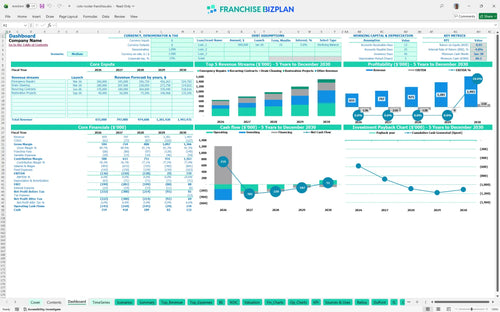
All-in-one Dashboard
Core inputs and core outputs



This plumbing franchise business financial projection model includes detailed schedules for fleet expansion, technician staffing, and tiered revenue streams.
Core inputs and core outputs
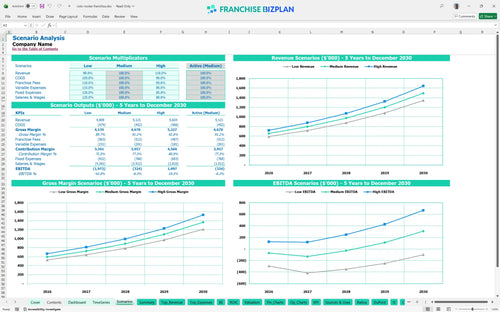
Three scenario analysis
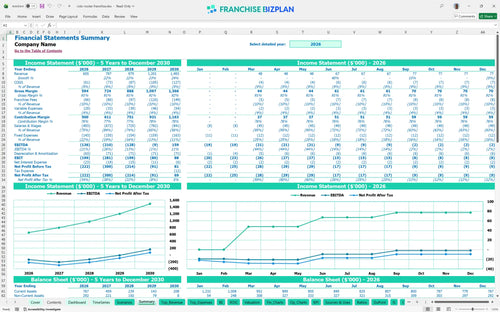
Presentation ready
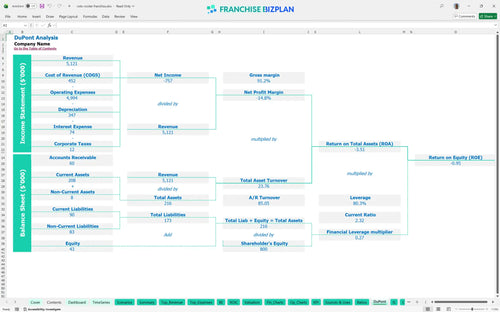
DuPont analysis
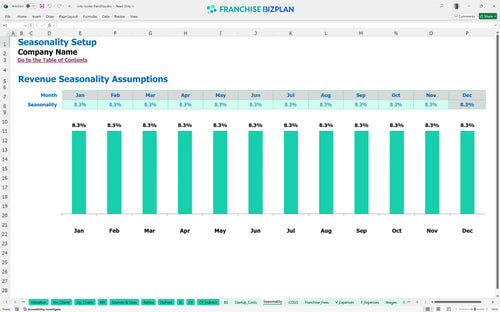
Researched revenue assumptions
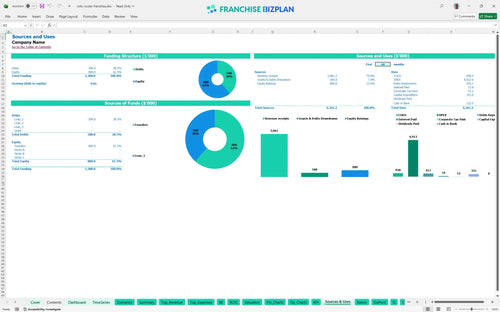
Lender-friendly financial outputs
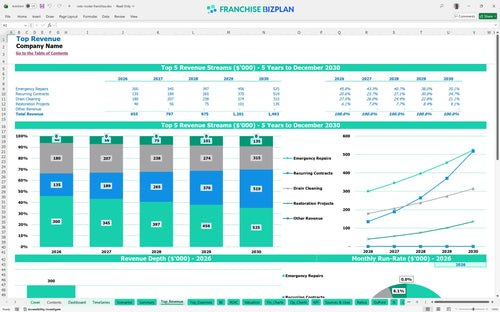
Revenue stream detailed view
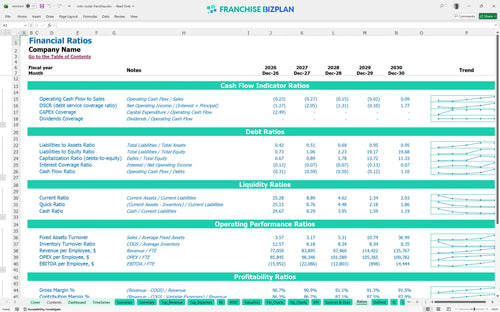
Performance metrics benchmark
We built this franchise unit financial model using our own research into the service sector. Key assumptions like emergency repair volume, technician wages, and vehicle maintenance are pre-populated and fully editable. At $655,000 in year-one sales, the model shows how initial overhead impacts your early-stage cash flow.
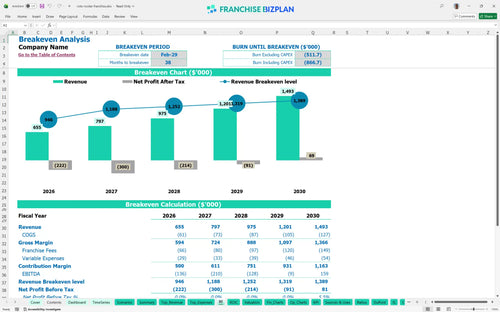
Profitability for this unit is a long game, with EBITDA finally turning positive at $159,000 in year five. You will likely face negative earnings for the first four years as you scale the technician team and fleet. Here's the quick math: the 38-month break-even means you need a strong cash reserve to survive the ramp-up.
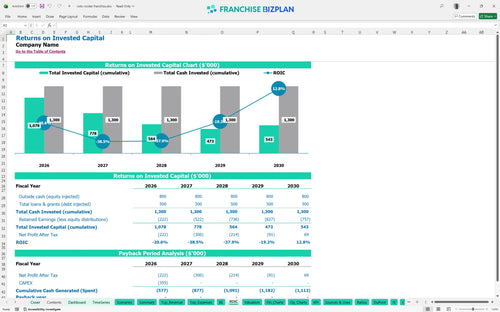
You need approximately $355,000 in initial capital to cover the franchise fee, service trucks, and warehouse fit-out. This excludes the $80,000 minimum cash buffer you'll want to keep for the lowest cash point in early 2030. Calculating ROI for a plumbing service business starts with getting these day-one numbers right.
The projected IRR is -4.77%, which is a sobering reminder that service franchises take time to mature. Payback occurs after year five, meaning this is a long-term equity play rather than a quick cash grab. Honestly, the value lies in the $1.49 million revenue scale you reach by the end of the forecast.
You hit the monthly break-even point in February 2029, roughly 38 months after launch. The biggest drag on your timeline is the high fixed cost of warehouse rent ($7,500) and the large professional staff. To move this date up, you must maximize the average ticket on emergency repairs.
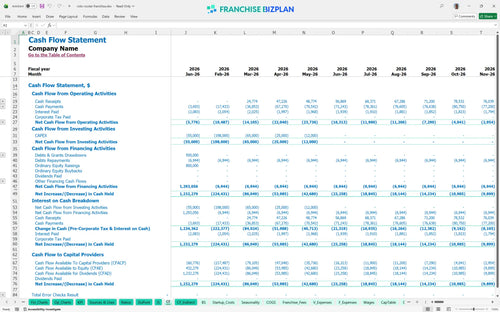
Your lowest cash point hits in January 2030 with only $80,000 remaining, which is tight for a business of this size. You defintely need to monitor the timing of your truck purchases and technician hires to avoid a liquidity crunch. A financial planning guide for franchise owners would suggest keeping an extra line of credit open.
In the High scenario, faster adoption of recurring commercial contracts can pull the break-even date into year two. Conversely, a Low scenario with weak emergency demand could extend losses past the five-year mark. Forecasting revenue for residential plumbing services requires testing these sensitivities to see how labor costs impact the bottom line.
This plumbing franchise financial model is built in Excel to be fully flexible for any territory. You can adjust the pre-filled formulas and editable assumptions to match your specific market density and labor rates. It handles everything from technician headcount to local fuel price swings. Every 1-point margin leak matters fast in a service-based model.

Long-term planning is vital when scaling a service business from one truck to a full fleet. This model provides 5-year revenue, cost, and cash flow projections tailored for a franchise unit or small chain. It helps you see the transition from initial losses to the $1.49 million revenue target in year five. Growth is a marathon, not a sprint.

Managing the franchise royalty structure is a non-negotiable part of your monthly cash flow. The model tracks the 8% royalty and 2% marketing fund contributions against your gross sales automatically. This ensures you know exactly how much goes to the franchisor before you pay your local bills. Royalties are a fixed reality of the brand system.

Estimating profitability for a new franchise location requires a clear view of your upfront 'burn.' This tool breaks down the $355,000 in capital expenditures, including trucks and equipment, to find your break-even point. Knowing you need 38 months to hit break-even helps you plan your working capital. Cash is the oxygen of your new service territory.

We include benchmarks for labor and occupancy to help you sanity-check your plumbing business plan Excel. If your parts and materials costs deviate from the 6.7% to 7.5% range, the model flags it for review. It's a reality check against typical unit economics in the service sector. Benchmarks keep your assumptions grounded in reality.


Simply purchase and download the financial model template, then access it instantly using Microsoft Excel or Google Sheets. No installation or technical expertise required-just open and start working.

Enter your business-specific numbers, including revenue projections, costs, and investment details. The pre-built formulas will automatically calculate financial insights, saving you time and effort.

Leverage the investor-ready format to confidently showcase your financial projections to banks, franchise representatives, or investors. Impress stakeholders with clear, data-driven insights and professional reports.

Leverage the investor-ready format to confidently present your projections to banks, franchise representatives, or investors.