


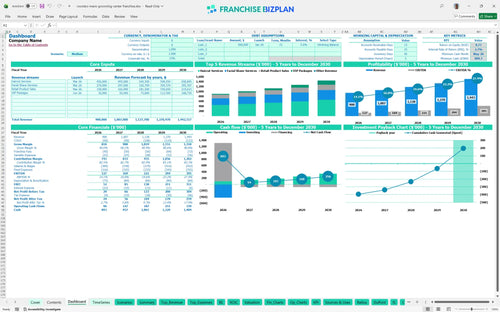
All-in-one Dashboard
Core inputs and core outputs



The franchise unit financial model template includes dynamic 5-year projections, detailed startup cost breakdowns, and automated cash flow statements to simplify your investment decision.
Core inputs and core outputs
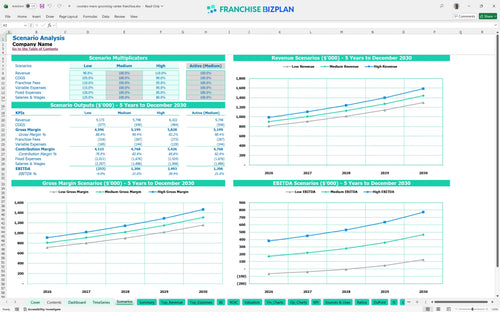
Three scenario analysis
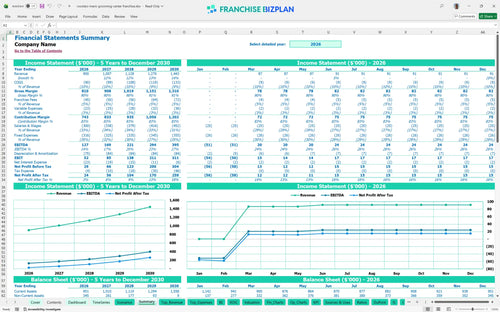
Presentation ready
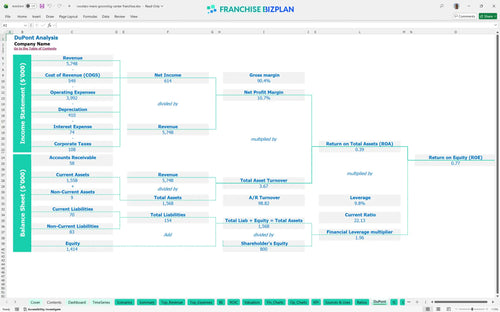
DuPont analysis
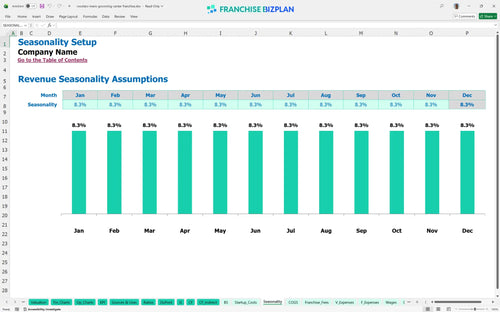
Researched revenue assumptions
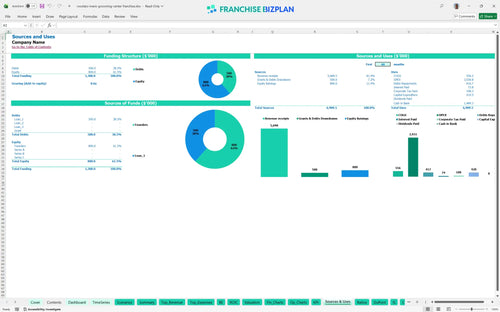
Lender-friendly financial outputs
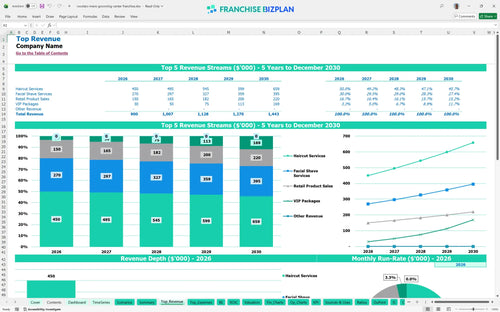
Revenue stream detailed view
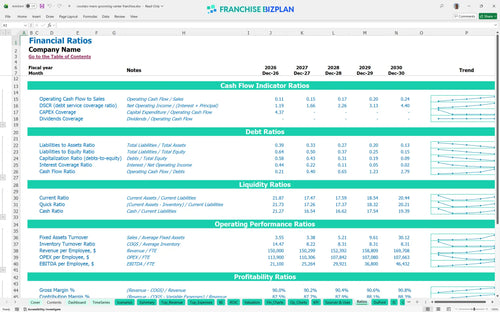
Performance metrics benchmark
We built this men's grooming franchise financial projection Excel using researched data to ensure accuracy for prospective owners. Key assumptions, including the $900,000 year-one revenue target and the 4% royalty fee, are pre-populated and fully editable to match your specific site selection. The model tracks everything from the $39,500 initial fee to the $18,000 monthly rent, providing a clear path to the projected $127,000 year-one EBITDA.
The franchise unit economics show a fast path to operational profitability, with the unit becoming EBITDA positive in its first year. By year two, revenue is projected to hit $1.007 million, generating $169,000 in EBITDA after accounting for the 4% royalty and 1% marketing fees. Profitability scales as you move from basic haircuts to high-margin VIP packages and retail sales.
To launch this unit, you need to know how to calculate franchise startup costs across several categories. The total initial investment includes a $39,500 franchise fee, $200,000 for leasehold improvements, and $60,000 for barber chairs and stations. You also need to account for a $810,000 minimum cash requirement to handle the ramp-up period through early 2026. This capital ensures you can cover the $18,000 monthly rent while building your client base.
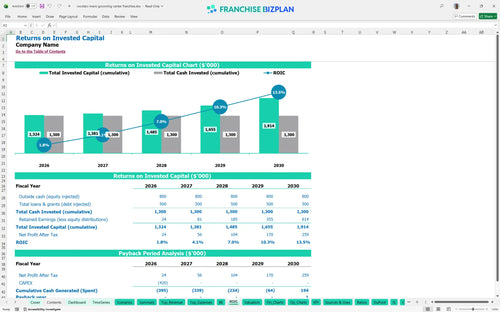
The ROI calculation for professional salon franchise units suggests a 5-year payback period for the initial investment. The model projects an internal rate of return (IRR) of 2.75% and a return on equity (ROE) of 0.77 over the five-year forecast. While the initial years focus on recouping the $419,500 in total CAPEX, the year-five EBITDA of $395,000 represents a significant jump in cash flow as the unit matures.
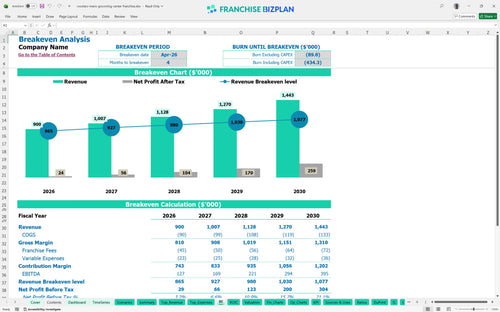
The unit reaches its break-even date in April 2026, just four months after the January launch. Estimating operating costs for franchise unit success requires covering $18,000 in monthly rent and approximately $15,800 in monthly base salaries for managers and receptionists. The key driver for break-even is service volume, specifically maintaining a high average ticket through the 7-step facial shave and retail product sales.
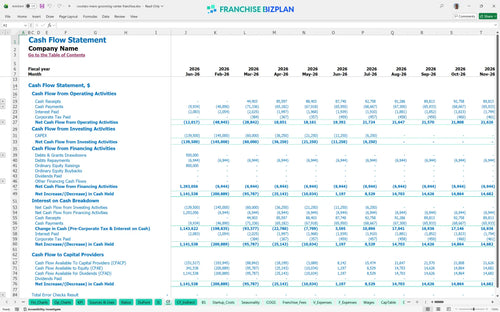
The lowest cash point occurs in May 2026, with a minimum cash balance of $810,000. You will defintely need a solid cash buffer to navigate the first four months before the break-even point is hit. The franchise cash flow statement shows that while revenue starts at $300,000 for haircuts in year one, the fixed costs of rent and insurance remain constant, making early-stage liquidity vital for survival.
The barbershop franchise business model template allows you to compare Low, Medium, and High scenarios to see how sensitivity impacts your bottom line. In a high-growth scenario, pushing VIP packages to $168,000 by year five significantly improves your year-1 margin and shortens the payback period. Conversely, a 10% drop in haircut revenue or a spike in labor costs could push the break-even date further into 2026 and increase your peak cash need.
Finance: update unit break-even and payback model by Friday
This franchise financial model template is built in Excel to give you total control over your numbers. You can adjust pre-filled formulas and editable assumptions to match your specific territory, whether you are looking at a high-traffic retail corridor or a quiet suburban pocket. The model handles everything from revenue and pricing drivers to detailed staffing and payroll inputs, ensuring your salon franchise business plan is grounded in reality. Every 1-point margin leak matters fast in a single-unit model, so we made it easy to stress-test your assumptions.

Planning for a men's grooming franchise investment requires a long-term view that goes beyond the grand opening. This tool provides detailed 5-year revenue, cost, cash flow, and profit projections tailored for a high-end service environment. At $900,000 in annual unit sales for the first year, the model tracks how your margins evolve as you scale toward $1.44 million by year five. What this estimate hides is the timing gap between opening costs and mature-unit performance, which is why the 5-year view is critical for multi-unit growth.

Understanding the real economics of a barbershop franchise startup costs means accounting for every dollar that leaves the store. This model captures specific financial obligations, including the $39,500 initial franchise fee and ongoing 4% royalty payments. We also include the 1% brand marketing fund contribution so you can see the impact on store-level EBITDA. If royalties plus ad funds are 5%, and rent is 24% of revenue, contribution gets tight quickly without high throughput. Here's the quick math: your gross margin must absorb these fees before you even pay for a single barber.

Our franchise unit profitability analysis helps you estimate the total initial investment, from leasehold improvements to the first month of supplies. You can map out fixed and variable costs to determine the exact sales level required to cover your monthly nut. With a $200,000 budget for leasehold improvements and $60,000 for barber chairs, your upfront capital is significant. Break-even depends less on headline sales and more on repeat demand and manager productivity. This tool ensures you don't fly blind during the critical first six months of operation.

This salon franchise business plan incorporates built-in benchmarks for labor, occupancy, and gross margins to help you sanity-check your projections. If your grooming supplies run higher than the 8% benchmark or labor exceeds 40%, the model flags these as risks to your store-level margin. Use these ranges to compare your expected performance against typical industry standards for luxury grooming. It is much easier to fix a labor leak on paper than it is once you have already hired a full staff. Benchmarks turn a guess into a plan.


Simply purchase and download the financial model template, then access it instantly using Microsoft Excel or Google Sheets. No installation or technical expertise required-just open and start working.

Enter your business-specific numbers, including revenue projections, costs, and investment details. The pre-built formulas will automatically calculate financial insights, saving you time and effort.

Leverage the investor-ready format to confidently showcase your financial projections to banks, franchise representatives, or investors. Impress stakeholders with clear, data-driven insights and professional reports.

Leverage the investor-ready format to confidently present your projections to banks, franchise representatives, or investors.