


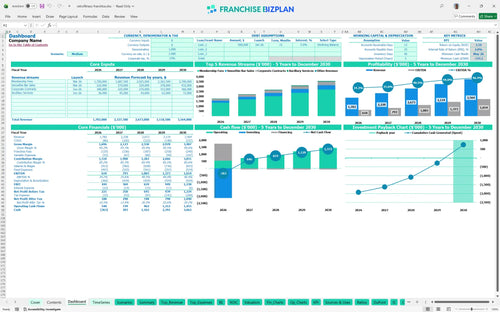
All-in-one Dashboard
Core inputs and core outputs



This model is the bridge between a dream and a bankable reality, providing a full pro forma, startup budget, and sensitivity analysis for your gym unit.
Core inputs and core outputs
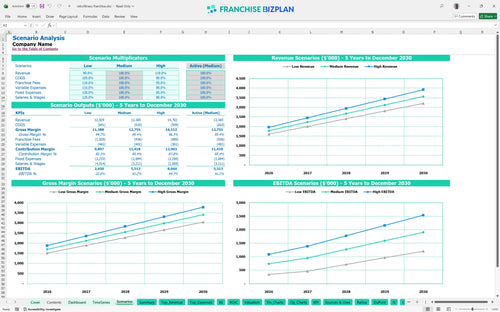
Three scenario analysis
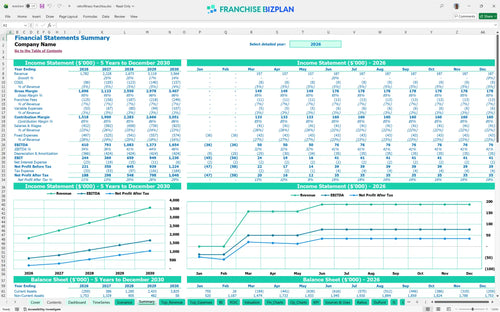
Presentation ready
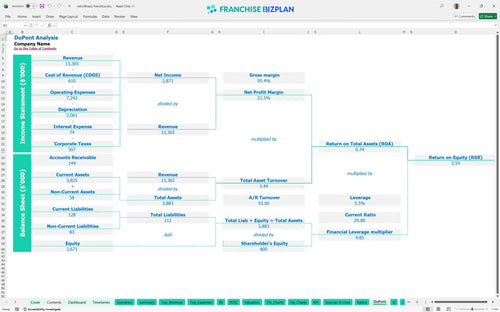
DuPont analysis
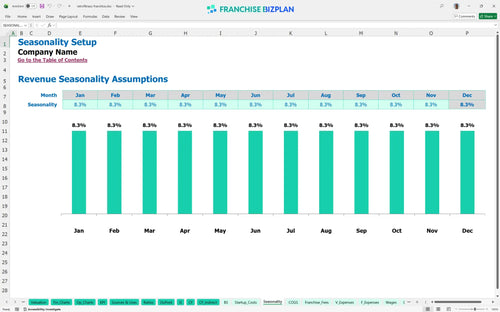
Researched revenue assumptions
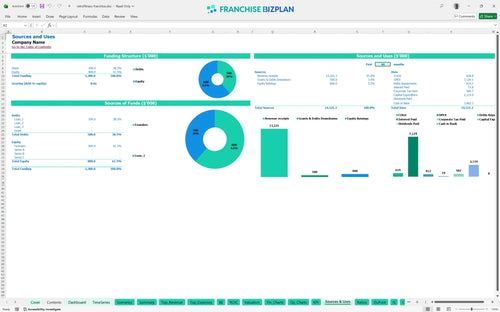
Lender-friendly financial outputs
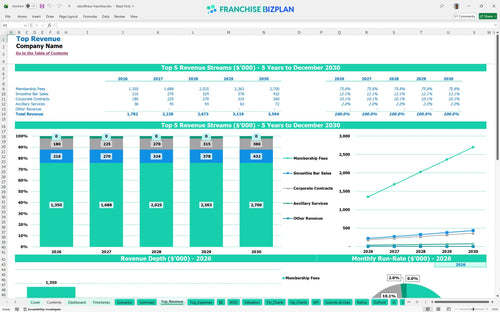
Revenue stream detailed view
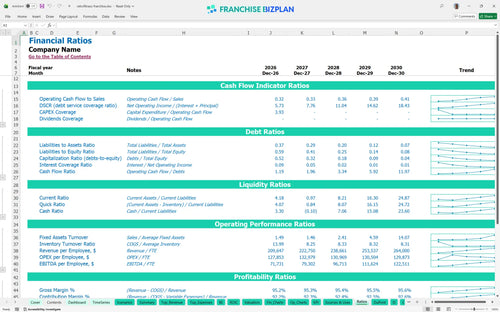
Performance metrics benchmark
We built this franchise unit financial model using intensive research into high-volume fitness concepts to ensure your planning is based on reality, not just optimism. Key assumptions like the $1.78M year-one revenue and $610k EBITDA (earnings before interest, taxes, depreciation, and amortization) are pre-populated and fully editable. This tool covers everything from boutique gym revenue streams to the revenue model for gym smoothie bar operations to give you a complete picture of the unit economics.
The unit reaches profitability in its first year, generating $610,000 in EBITDA by the end of 2026. This assumes you hit the membership targets and manage the 5% royalty and 2% marketing fund obligations effectively. Gym franchise profitability analysis excel tools show that year-one success depends heavily on your pre-opening membership drive.
You will need roughly $2.12 million to launch this unit, with the largest chunk going toward $900,000 in leasehold improvements. The startup budget template for fitness franchise owners also accounts for $750,000 in gym equipment and a $29,000 franchise fee. This franchise unit capital expenditure (CAPEX) is high, but it builds a premium 'third place' environment for members.
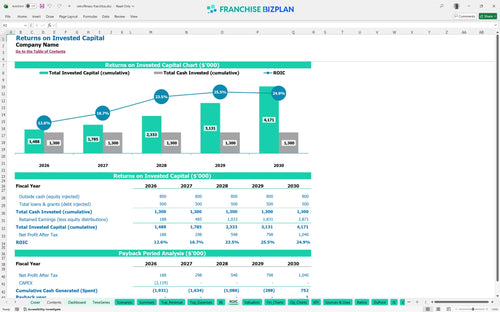
This fitness franchise investment return calculator shows a 2.82% IRR and a 3.59% ROE based on the heavy initial asset investment. You can defintely expect a full payback within 5 years as annual revenue scales toward $3.56 million. ROI for gym franchise owners is often found in the long-term equity of the business rather than immediate cash distributions.
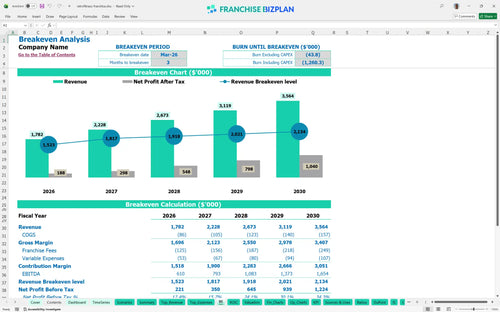
The unit hits its break-even point in March 2026, just three months after launching membership sales. Success depends on maintaining a high average ticket and keeping the $25,000 monthly rent from exceeding 15% of your gross sales. Reaching break-even in 90 days requires a massive pre-opening membership push to cover fixed costs immediately.
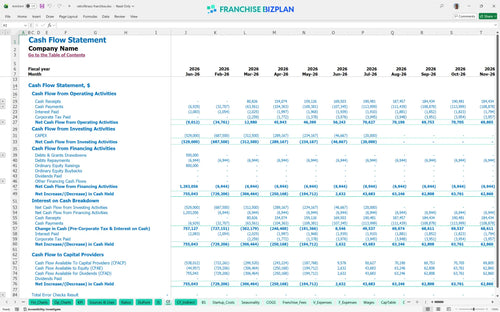
Your lowest cash point is -$726,000 in May 2026, meaning you need significant working capital beyond the initial build-out. This fitness business cash flow analysis suggests a 6-month runway to survive the initial equipment payment cycles and staffing ramp-up. The -$726,000 cash hole is where most under-capitalized owners fail if they don't have a buffer.
Analyzing franchise business model feasibility means planning for the $1.78M floor and the $3.56M ceiling. Moving from year-one revenue to the year-five target requires aggressive corporate contract growth and smoothie bar upsells. Franchise financial forecasting for new gym owners shows that even a 10% drop in membership retention can delay your payback by over a year.
Finance: update unit break-even and payback model by Friday.
This fitness center business plan excel tool is built for flexibility, allowing you to adjust every variable from membership pricing to smoothie bar margins. You can easily modify the pre-filled formulas to match your specific territory or local labor market conditions. This fitness franchise financial model lets you swap numbers until the deal makes sense for your bank. Honestly, a financial model template for boutique fitness studio operations is only as good as its ability to adapt to real-world rent hikes or staffing shifts. This tool ensures your projections stay grounded in your actual site reality.

A five-year franchise unit financial projection shows you the long game, not just the honeymoon phase of your grand opening. This model tracks your growth from a year-one revenue of $1,782,000 up to a mature $3,564,000 by year five. We include a full franchise profit and loss template so you can see how scaling membership and corporate contracts impacts your bottom line over time. To be fair, knowing how to create a pro forma for a franchise unit is the only way to secure traditional SBA financing or private investment. It maps out the path from initial struggle to long-term stability.

Royalties are a top-line tax that doesn't care if you had a bad month, so we built them directly into the cash flow logic. This model accounts for the 5% royalty fee and 2% marketing fund contribution based on your gross sales. We also include the $29,000 initial franchise fee in your startup costs to ensure your day-one liquidity is realy accurate. Tracking these franchise operational expenses is vital because they represent a permanent 7-point margin drag on every dollar you collect. Still, seeing these costs clearly helps you plan for the volume needed to offset them.

Knowing how to calculate startup costs for a gym franchise keeps you from running out of air before you even open your doors. This model breaks down the massive $900,000 leasehold improvement cost and the $750,000 combined equipment package for cardio and strength. We then map this against your revenue to find the exact moment you stop burning cash and start keeping it. Here's the quick math: with a three-month break-even target, your pre-opening marketing must be flawless to hit the ground running. What this estimate hides is the potential for construction delays that can stretch your burn rate.

Benchmarks help you spot if your $25,000 monthly rent is an anchor or an engine for your specific location. This model includes researched data for estimating operating expenses for a fitness center, such as $6,500 for utilities and $4,000 for equipment maintenance. We use these figures to sanity-check your assumptions against typical high-volume gym operations in the US. If your labor costs for trainers and front desk staff deviate too far from these norms, the model flags the risk to your store-level margin. Plus, it helps you explain your numbers to skeptical lenders who know the industry averages.


Simply purchase and download the financial model template, then access it instantly using Microsoft Excel or Google Sheets. No installation or technical expertise required-just open and start working.

Enter your business-specific numbers, including revenue projections, costs, and investment details. The pre-built formulas will automatically calculate financial insights, saving you time and effort.

Leverage the investor-ready format to confidently showcase your financial projections to banks, franchise representatives, or investors. Impress stakeholders with clear, data-driven insights and professional reports.

Leverage the investor-ready format to confidently present your projections to banks, franchise representatives, or investors.