


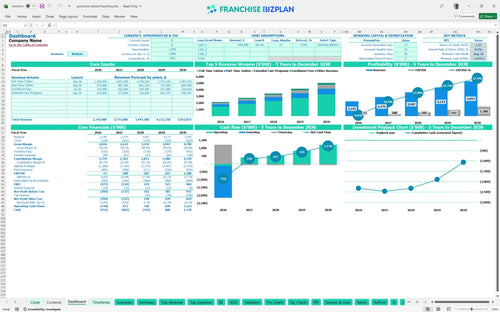
All-in-one Dashboard
Core inputs and core outputs



This Excel spreadsheet for franchise unit financial planning provides a comprehensive view of unit economics, from the initial $80,000 franchise fee to Year 5 EBITDA projections of $1,388,000.
Core inputs and core outputs
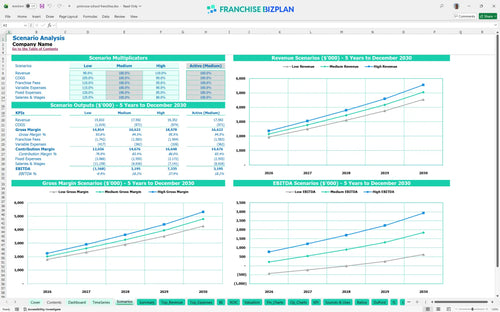
Three scenario analysis
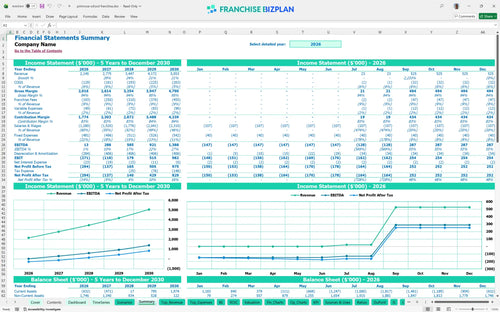
Presentation ready
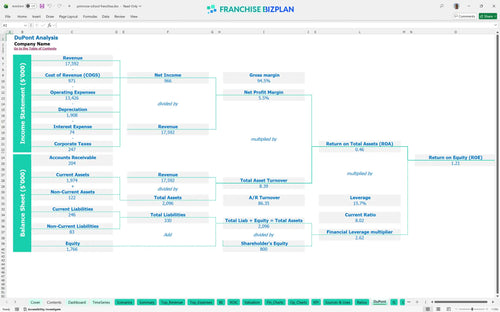
DuPont analysis
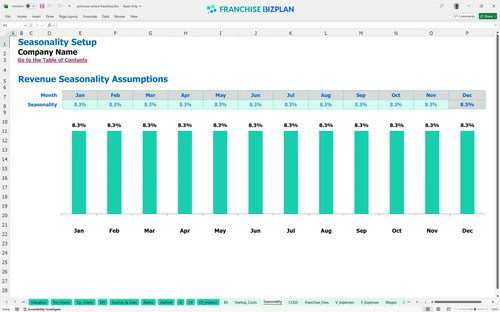
Researched revenue assumptions
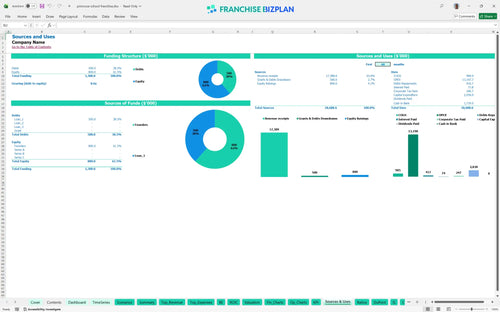
Lender-friendly financial outputs
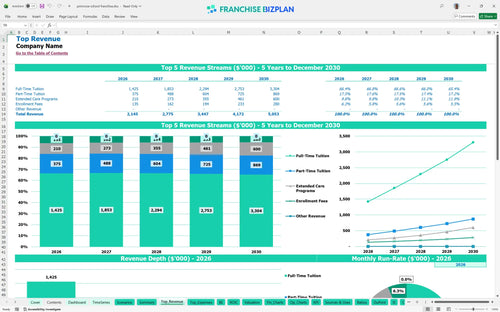
Revenue stream detailed view
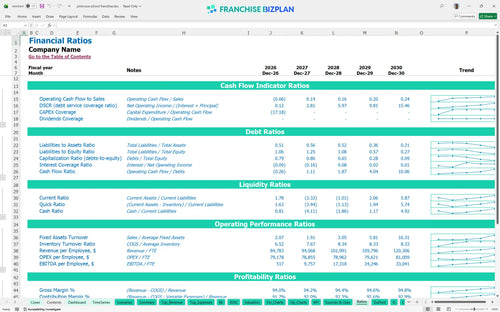
Performance metrics benchmark
We built this franchise unit financial model using our own research to provide a realistic view of the childcare sector. Key assumptions, including the $2.1M Year 1 revenue and the 9-month timeline to break-even, are pre-populated and fully editable to match your specific territory. This tool helps you manage the $1.8M peak cash need while tracking enrollment revenue forecasting across full-time and part-time programs.
You will see a razor-thin EBITDA of $13,000 in Year 1, but profitability scales quickly to $288,000 in Year 2 as enrollment climbs. By Year 5, the model projects $1,388,000 in EBITDA after accounting for the 9% combined royalty and marketing burden. Still, the real profit kicks in once you move past the initial 9-month break-even period in September 2026.
Launching this unit requires substantial capital, primarily driven by $1,200,000 in leasehold improvements and $250,000 for classroom furniture. Your lowest cash point hits -$1,829,000 in August 2026, meaning you need enough liquidity to bridge the gap until the September breakeven. This is how to calculate startup costs for a private preschool without missing the hidden pre-opening expenses.
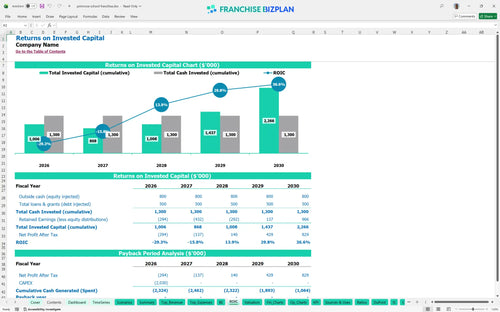
The model shows an IRR of 0.87% and a Return on Equity of 1.21 over the first five years. While the payback period extends beyond Year 5, the significant Year 5 EBITDA of $1.3M suggests a high terminal value for the asset. Honestly, the ROI calculator for independent early learning centers often overlooks the long-term equity built in the facility and brand reputation.
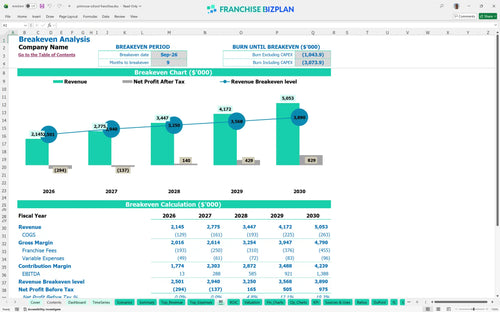
You hit the break-even point in September 2026, roughly 9 months after starting the build-out. The primary driver here is the $28,000 monthly rent; you need to move through the enrollment waitlist fast to cover that fixed overhead. Determining break-even points for new childcare facilities is the best way to set your local marketing budget for the first year.
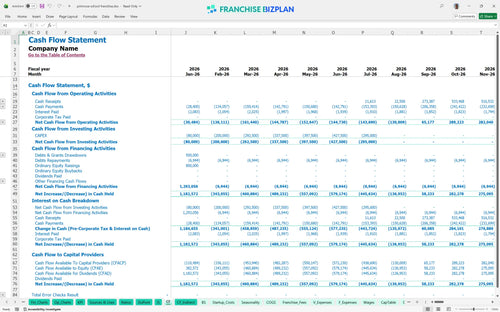
Your cash runway is tightest in August 2026, where the balance dips to -$1,829,000. This is the valley of death where construction is done but tuition revenue hasn't fully ramped, so having a cash buffer is a smart move. Estimating labor costs for early education franchises during this ramp-up is critical to avoid running out of funds before the first tuition checks clear.
A Low scenario where enrollment lags by 15% could push your break-even date into 2027 and deepen the cash hole. Conversely, hitting the High case with Year 1 revenue above $2.1M significantly improves your Year 2 margin and shortens the long-term payback timeline. Analyzing franchise royalty and marketing fund impact across these scenarios helps you understand your true downside risk.
This preschool franchise financial model is built in Excel, allowing you to swap out every assumption from tuition rates to teacher salaries. It is not a static PDF; it is a living tool where pre-filled formulas handle the heavy lifting while you adjust the local variables. Here is the quick math: you can toggle enrollment percentages to see how they impact your bottom line instantly.

Mapping out a five-year horizon is critical when your Year 1 revenue starts at $2,145,000 and scales to over $5,053,000 by Year 5. This model tracks that trajectory, showing how your margin expands as enrollment matures and fixed costs like the $28,000 monthly rent stabilize. It provides a clear view of long-term early childhood education financial projections for multi-unit planning.

We built in the specific 7% royalty and 2% marketing fund obligations so you see the exact impact on your bottom line. At $3,447,000 in Year 3 revenue, that is over $310,000 leaving the unit, so understanding this franchise royalty fee calculation is vital for your cash flow planning. It ensures you account for every dollar owed to the franchisor before calculating your take-home pay.

With $1,200,000 earmarked for leasehold improvements alone, your total entry cost is significant. This model identifies the exact month you stop burning cash and start covering your fixed overhead, which is defintely the most stressful part of the ramp-up. It functions as a daycare franchise startup cost analysis tool to help you secure financing and manage investor expectations.

Use our pre-loaded benchmarks to see if your 3.2% food cost or teacher-to-student ratios align with top-tier childcare center operational expenses. It helps you spot margin leaks before they become permanent fixtures in your P&L. By comparing your projections against industry standards, you can perform a more accurate franchise investment feasibility study.


Simply purchase and download the financial model template, then access it instantly using Microsoft Excel or Google Sheets. No installation or technical expertise required-just open and start working.

Enter your business-specific numbers, including revenue projections, costs, and investment details. The pre-built formulas will automatically calculate financial insights, saving you time and effort.

Leverage the investor-ready format to confidently showcase your financial projections to banks, franchise representatives, or investors. Impress stakeholders with clear, data-driven insights and professional reports.

Leverage the investor-ready format to confidently present your projections to banks, franchise representatives, or investors.