


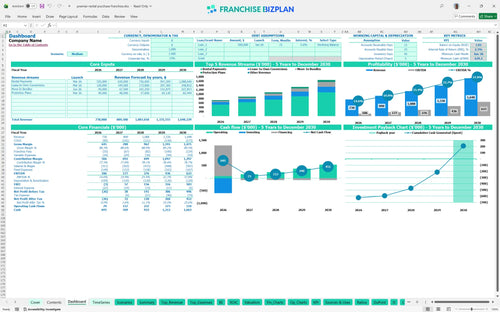
All-in-one Dashboard
Core inputs and core outputs



This franchise unit financial model template is a complete professional toolkit designed to forecast revenue, track expenses, and calculate investor returns for a single-unit retail operation.
Core inputs and core outputs
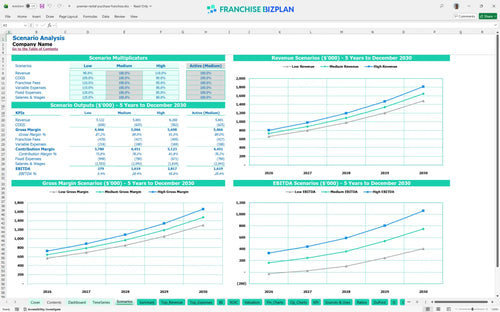
Three scenario analysis
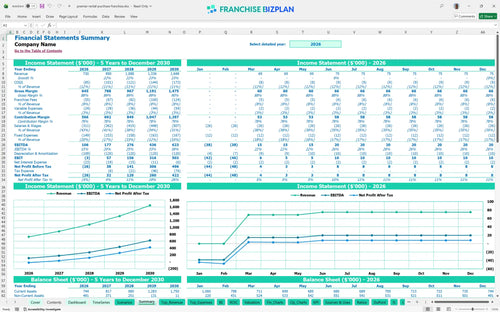
Presentation ready
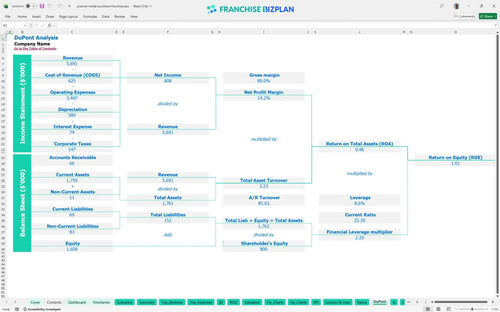
DuPont analysis
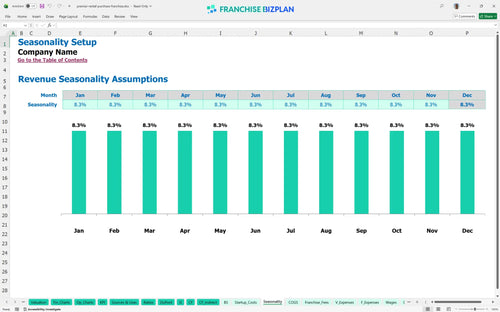
Researched revenue assumptions
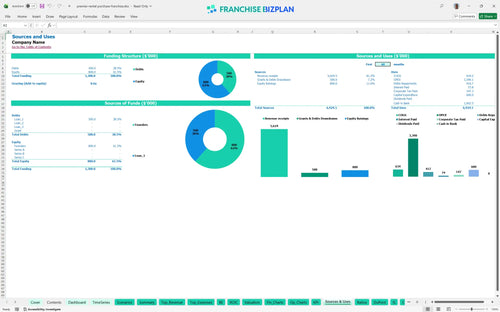
Lender-friendly financial outputs
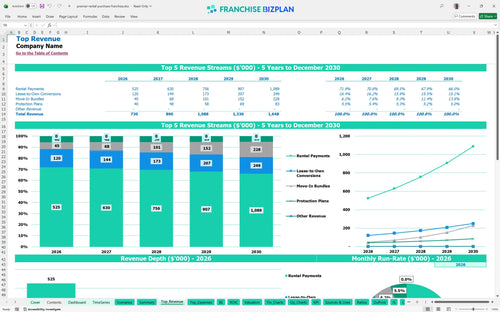
Revenue stream detailed view
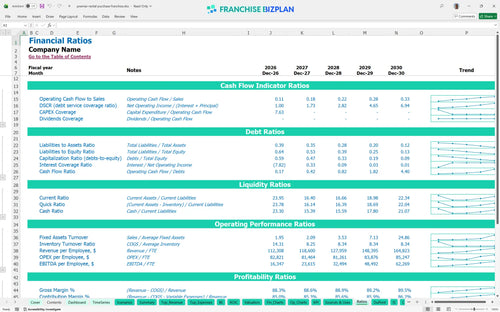
Performance metrics benchmark
We built this franchise unit financial model using our own research to ensure accuracy for prospective owners. Key assumptions, including the $730,000 year-one revenue and $106,000 EBITDA, are pre-populated with researched data and are fully editable to match your specific location. Profitability is a marathon, not a sprint.
The unit reaches EBITDA profitability in its first year with $106,000 in earnings, but net profit depends on the 'Path to Ownership' financial literacy program business model for franchises. Revenue forecasting for lease-to-own franchise units shows EBITDA growing to $623,000 by year five as the rental portfolio matures. Here's the quick math: your margin expands as you stop paying for the initial inventory buy and start collecting pure rental income.
Launching this unit requires a significant initial investment, with the model showing a minimum cash requirement of $629,000. This financial model for new franchise unit opening covers the $250,000 initial inventory, $150,000 for leasehold improvements, and $75,000 for delivery vehicles. Cash is king during the build-out.
Analyzing ROI for retail franchise locations reveals a 5-year payback period and an internal rate of return (IRR) of 2.32%. While the upfront cost is high, the recurring revenue models provide a stable 1.01 return on equity by the end of the projection period. Your capital should work as hard as you do.
The store hits its break-even date in April 2026, just four months after the March launch. This rapid break-even is possible because the $350,000 in first-year rental payments quickly covers the $8,500 monthly rent and $218,000 in total annual wages. Speed to break-even is your first goal.
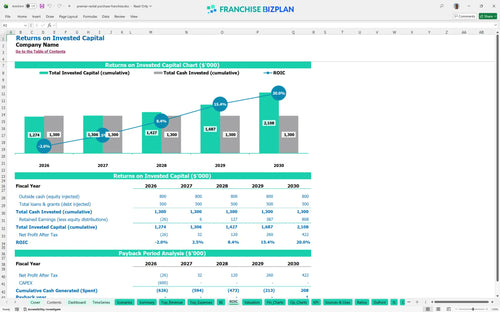
The lowest cash point is $629,000 in June 2026, roughly three months after opening. Managing inventory costs for rent-to-own retail is critical during this ramp-up, as any delay in rental payments could strain your cash buffer. Watch the dip before the climb.
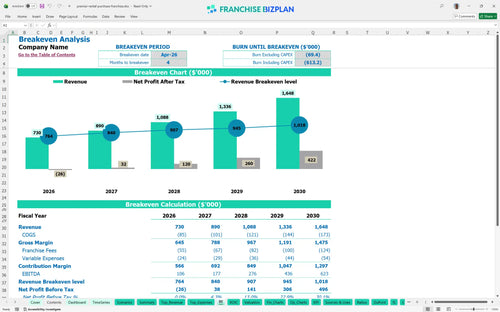
In a high-growth scenario, increasing lease-to-own conversions and protection plan sales can push year-5 EBITDA well above the $623,000 base case. Conversely, a low-volume scenario may extend the payback period beyond five years, requiring a larger cash reserve to cover fixed expenses. Prepare for the best and the worst.
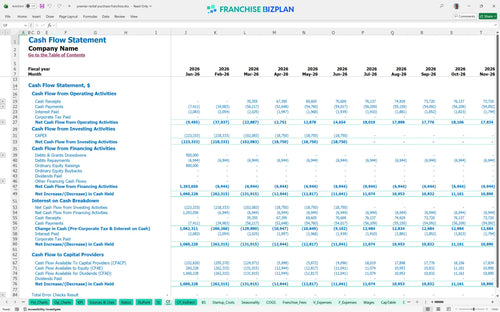
This rent-to-own store financial projection template includes a franchise operational expense tracking template to manage your $218,000+ annual payroll and $8,500 monthly rent. Monitoring the 1.8% payment processing fees and 1.5% delivery costs is essential for maintaining your store-level margin as the business scales. Watch the pennies and the dollars follow.
Finance: update unit break-even and payback model by Friday.
This franchise unit financial model is a fully customizable franchise business plan financial spreadsheet built in Excel. It features pre-filled formulas and editable assumptions that allow you to adapt the numbers to your specific territory, local rent prices, and staffing needs. One tool for all your numbers.

This rent-to-own franchise financial plan provides a clear roadmap for long-term growth, scaling from $730,000 in year-one revenue to over $1.6 million by year five. It includes a detailed franchise profitability analysis that tracks how recurring rental income builds over time while accounting for merchandise depreciation. Plan for five years, not just five months.

The model accurately captures the specific franchise unit economics of this system, including the 5% royalty and 2.5% brand marketing fund contributions. By factoring in the $25,000 initial franchise fee and ongoing obligations, you can see the real impact of the franchisor's take on your store-level margin. Know your fees before you sign.

We show you how to calculate startup costs for a rental-purchase franchise, including the $150,000 for leasehold improvements and $250,000 for initial inventory. The model identifies the exact monthly sales volume needed to cover your $8,500 rent and other fixed costs to reach the break-even point. Know your number to stay in the black.

This model uses retail financial forecasting to provide built-in benchmarks for a lease-to-own retail business, helping you sanity-check your projections. It defintely helps to compare your $65,000 manager salary and 10.5% inventory costs against best practices for rental-purchase store profitability. Don't fly blind without industry data.


Simply purchase and download the financial model template, then access it instantly using Microsoft Excel or Google Sheets. No installation or technical expertise required-just open and start working.

Enter your business-specific numbers, including revenue projections, costs, and investment details. The pre-built formulas will automatically calculate financial insights, saving you time and effort.

Leverage the investor-ready format to confidently showcase your financial projections to banks, franchise representatives, or investors. Impress stakeholders with clear, data-driven insights and professional reports.

Leverage the investor-ready format to confidently present your projections to banks, franchise representatives, or investors.