


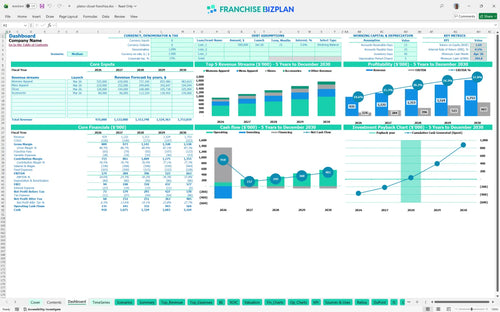
All-in-one Dashboard
Core inputs and core outputs



This professional franchise financial model template delivers a complete 60-month outlook including CAPEX (capital expenditures) planning, detailed staffing modules, and automated royalty tracking for a retail resale unit.
Core inputs and core outputs
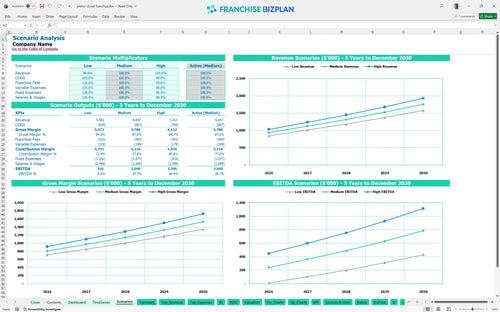
Three scenario analysis
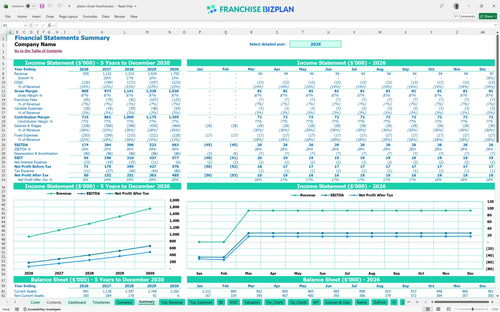
Presentation ready
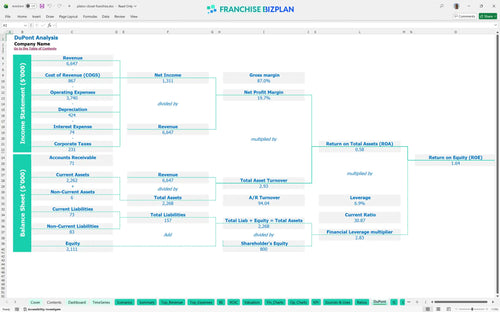
DuPont analysis
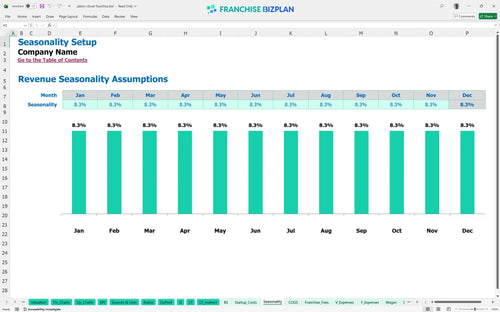
Researched revenue assumptions
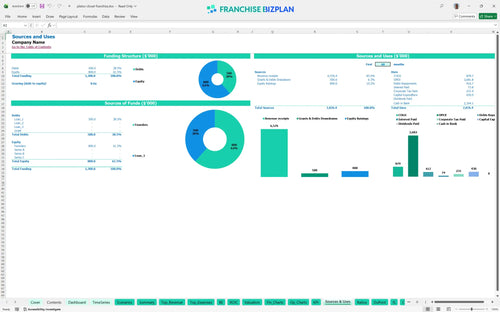
Lender-friendly financial outputs
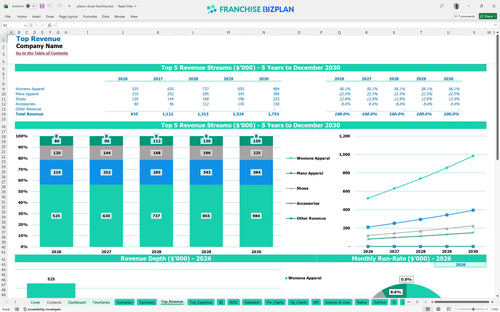
Revenue stream detailed view
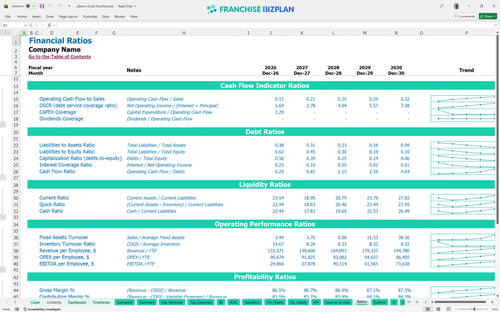
Performance metrics benchmark
We built this franchise unit financial model using our own research, pre-populating assumptions like the 5% royalty and 2% marketing fees. With Year 1 revenue starting at $935,000 and growing to $1.75 million by Year 5, these editable inputs let you stress-test the Austin market's specific labor and rent costs.
This retail franchise profitability analysis shows the unit reaching a positive EBITDA of $174,000 in its first year, scaling to $663,000 by Year 5. Profitability is driven by the circular fashion business model, where merchandise acquisition costs stay below 12% of total sales. Profitability is about managing the margins, not just the sales.
The resale business startup costs for this unit total approximately $430,000 in CAPEX (capital expenditures) plus working capital to reach the April 2026 breakeven point. This covers the $25,000 franchise fee and significant leasehold improvements needed for a high-energy retail environment. Capital allocation determines your early-stage survival.
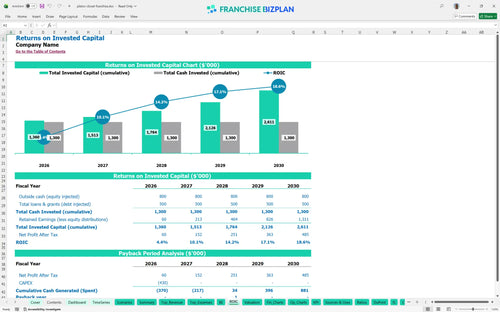
When calculating return on investment for retail franchises, this model projects an IRR (internal rate of return) of 4.45% and a 3-year payback period. While the ROE (return on equity) is 1.64, the long-term value is found in the steady $663,000 annual EBITDA potential at maturity. Returns are the ultimate measure of your risk.
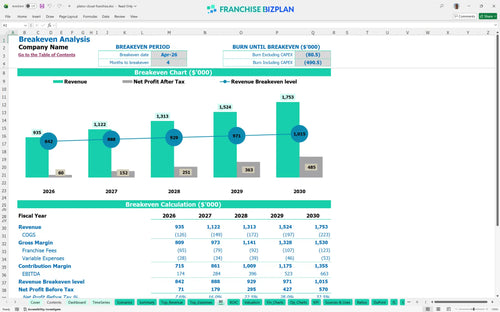
The franchise unit financial projections indicate you will reach the monthly break-even point in April 2026, just four months after launching. This assumes you hit Year 1 revenue of $935,000 while keeping fixed costs like the $11,000 monthly rent under control. Breakeven timing dictates your early cash pressure.
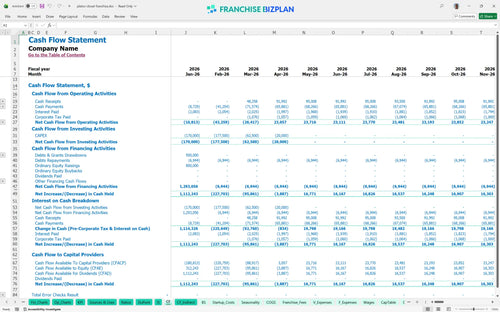
Cash flow forecasting for franchises shows your lowest cash point occurs in April 2026 at $785,000, which includes your initial liquidity buffer. You defintely need to manage your buy-back spending carefully during the first 90 days to avoid a working capital crunch. Cash is king, especially during the ramp-up phase.
Analyzing profitability for trendy clothing resale stores requires looking at the 10% variance in student traffic. A High-case scenario accelerates your Year 5 EBITDA beyond $663,000, while a Low-case scenario might extend your payback period by 12+ months. Scenarios prepare you for the best and worst days.
This excel template for franchise unit financial planning is built for flexibility, allowing you to adjust every driver from clothing buy-back rates to local Austin labor costs. You can edit the pre-filled formulas and assumptions to match your specific territory, ensuring your clothing resale franchise business plan is based on your actual site selection and local market density. Customization is the difference between a guess and a plan.

This financial model for clothing store franchise ownership provides a detailed roadmap from your first $935,000 in Year 1 sales to a mature $1.75 million operation by Year 5. It includes a pre-written financial forecast for franchise operations that tracks EBITDA (earnings before interest, taxes, depreciation, and amortization) growth as your store gains local student traction. Five years of data keeps you ahead of the curve.

The model accurately tracks your franchise royalty fee structure, including the 5% royalty and 2% marketing fund contributions that come off the top of every dollar. By automating these calculations, you can see exactly how much cash remains for retail store operating expenses and owner draws after meeting brand standards. Royalties are a fixed reality, not a variable suggestion.

Knowing how to estimate startup costs for a resale franchise is critical, and this model covers everything from the $25,000 initial fee to the $225,000 leasehold improvements. This small business financial projection model for resale shops identifies your 4-month path to breakeven, helping you manage the gap between opening day and consistent profitability. Breakeven is the first real milestone of success.

We have integrated real-world benchmarks for retail store operating expenses, such as the $11,000 monthly rent and $193,000 Year 1 base payroll, to ensure your projections are realistic. These targets help you evaluate your store-level margin against industry standards for high-volume resale units near major universities. Benchmarks keep your assumptions grounded in reality.


Simply purchase and download the financial model template, then access it instantly using Microsoft Excel or Google Sheets. No installation or technical expertise required-just open and start working.

Enter your business-specific numbers, including revenue projections, costs, and investment details. The pre-built formulas will automatically calculate financial insights, saving you time and effort.

Leverage the investor-ready format to confidently showcase your financial projections to banks, franchise representatives, or investors. Impress stakeholders with clear, data-driven insights and professional reports.

Leverage the investor-ready format to confidently present your projections to banks, franchise representatives, or investors.