


Executive Summary
Your concept at a glance



You will receive a comprehensive, pre-written franchise unit business plan in an editable Microsoft Word format, complete with integrated financial tables and section-by-section guidance.
Your concept at a glance
What you sell and why
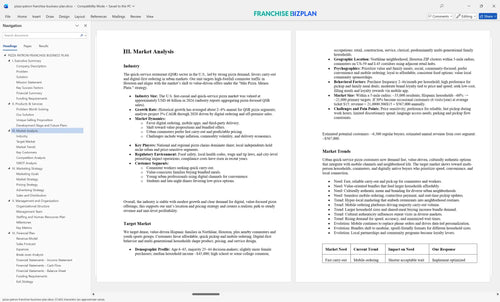
Market size and rivals
Channels, promotions, conversions
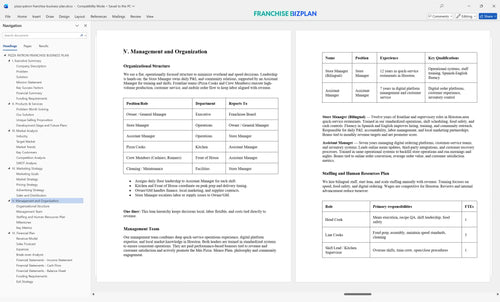
Team roles and org chart
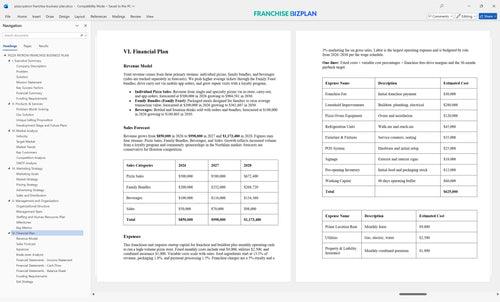
P&L cash flow break-even

Edit fast on any device

All core chapters included
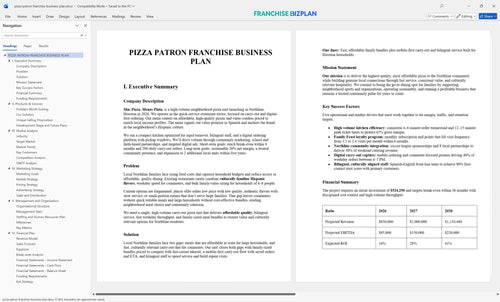
We developed this pizza franchise business plan template in Microsoft Word using our own independent research into the quick service restaurant business model. All six chapters are pre-populated with data specific to opening and operating a high-volume, community-focused pizza franchise unit, including startup costs that cover a $30,000 franchise fee and $280,000 in leasehold improvements. The entire document is defintely easy to edit, allowing you to tailor every detail to your local market and financial situation.
The opportunity is to launch a quick-service pizza franchise unit in a high-traffic urban location, targeting a large, price-sensitive demographic with a culturally resonant brand. The business model focuses on a 'Más Pizza. Menos Plata.' value proposition, combining affordability with high-volume carry-out service driven by a strong digital and mobile ordering platform.
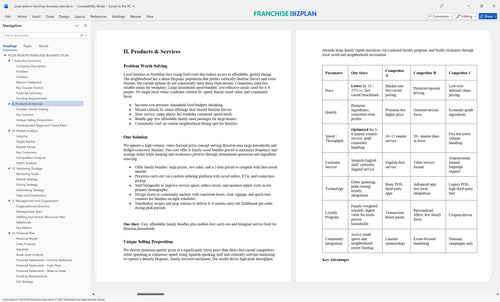
The unit primarily sells affordable, high-quality pizzas, supplemented by family-sized bundles, beverages, and sides. The menu is engineered for speed, value, and appeal to large households, directly supporting the brand's core value proposition of offering more for less. In the first year, pizza sales are projected to generate $500,000, with family bundles adding another $200,000.
The primary customer segment is Hispanic families in the local area who seek affordable and culturally relevant dining options for large households. Secondary targets include daily commuters and shoppers in the high-traffic retail area looking for quick carry-out meals, as well as local youth organizations needing group-friendly food solutions.
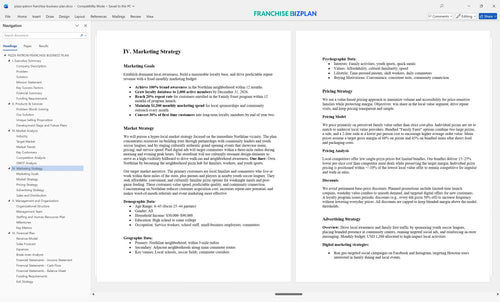
Customer acquisition will be driven by a hyper-local marketing strategy focused on community engagement, including sponsorships of youth soccer leagues. A monthly local marketing budget of $1,200 will support these efforts. Customer retention will be powered by a robust mobile ordering platform for convenience and a 'Family Feast' loyalty program designed to encourage repeat business from large households.
The unit will be run by a full-time Store Manager with an annual salary of $68,000, supported by an Assistant Manager. This leadership team will oversee a staff of Pizza Cooks and Crew Members, with a focus on recruiting bilingual employees to create a culturally authentic and welcoming service environment. The staffing model is designed to scale, growing from 9.0 full-time equivalent employees in year one to 12.5 by year five.
The total startup investment is estimated from the capital expenditures, including a $30,000 franchise fee and $523,000 for build-out, equipment, and signage. The financial model projects first-year revenue of $1,250,000, growing to over $2,300,000 by year five. With a 5% royalty and 3% marketing fee, the unit is projected to reach its breakeven point in just 3 months and achieve a full payback in 3 years.
This pizza franchise business plan is a complete, pre-written template designed to save you dozens of hours. It's delivered as a Microsoft Word document, making it fully editable so you can align the content with your specific location, local market data, and ownership strategy. This combination of a ready-made structure and customization flexibility helps you create a professional plan that meets franchisor and lender expectations without starting from scratch.

Our pizza restaurant business plan template includes detailed financial projections tailored to a franchise unit. The Word document contains tables for your Profit & Loss, Cash Flow, and Balance Sheet, populated with realistic assumptions for startup costs, operating expenses, and revenue streams. These franchise financial projections provide a clear framework for evaluating profitability, determining your total funding requirements, and proving the financial viability of your new location.

Developing a business plan for startups can be expensive, but this template offers a practical and cost-effective alternative to hiring consultants. It provides a professional, lender-ready document at a fraction of the cost, allowing you to allocate your capital where it matters most: the franchise fee, equipment, build-out, and initial working capital. This small business investment strategy helps you start smarter by preserving cash for operations.

This franchise business plan for an SBA loan is structured to make a strong, professional impression on lenders, investors, and the franchisor's review committee. The clear financial logic, organized narrative, and comprehensive market analysis demonstrate that you have a thorough understanding of the business opportunity. Using this template enhances your credibility and supports your funding discussions with a well-researched and polished presentation.

The template provides a comprehensive overview of your proposed franchise unit, covering everything from your mission and vision to your local market positioning and operational plan. It gives you a well-structured narrative for presenting the business within the brand's framework. This restaurant franchise ownership guide ensures you cover all critical components, including your value proposition, target customers, and management structure, leaving no stone unturned.


Purchase the template and download it immediately. Open and edit it seamlessly using Microsoft Word or Google Docs, making it easy to start working on your business plan right away.

Modify each section to align with your business concept, industry, and financial goals. Personalize the content to reflect your target market, unique value proposition, and key financial details.

Leverage the provided example financial projections or seamlessly incorporate your specific figures, utilizing an optional financial model available for purchase.

Conduct a thorough review of your business plan, refining the content to ensure it's investor-ready and serves as an effective operational guide.