


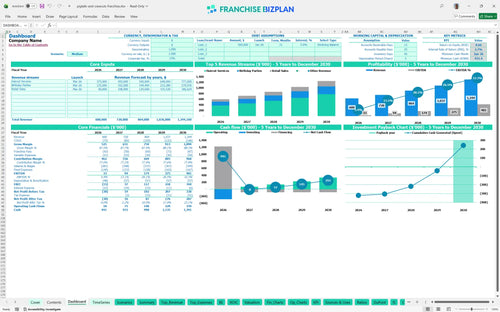
All-in-one Dashboard
Core inputs and core outputs



This franchise unit financial model provides a detailed roadmap for managing salon franchise startup costs, revenue forecasting, and long-term profitability.
Core inputs and core outputs
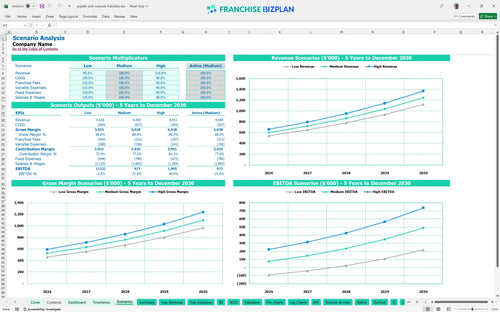
Three scenario analysis
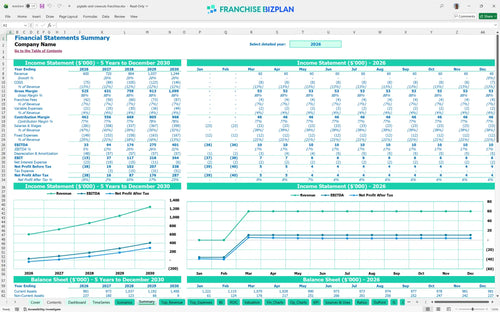
Presentation ready
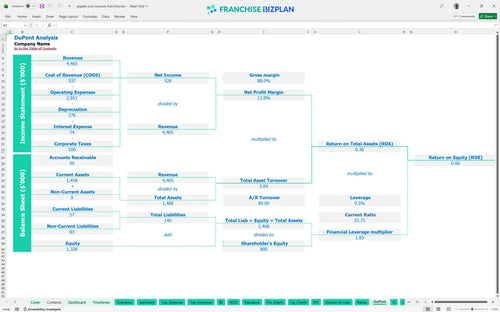
DuPont analysis
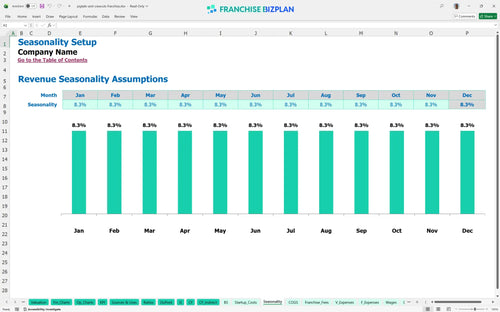
Researched revenue assumptions
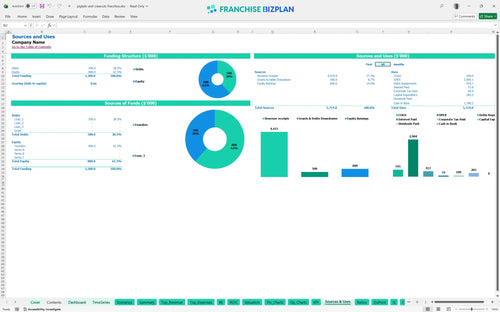
Lender-friendly financial outputs
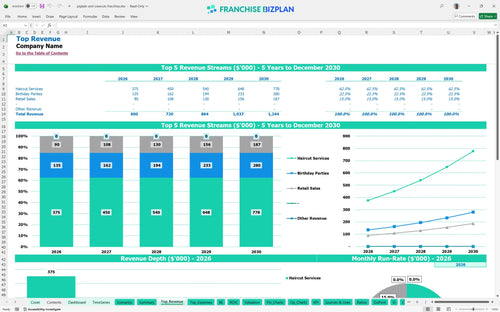
Revenue stream detailed view
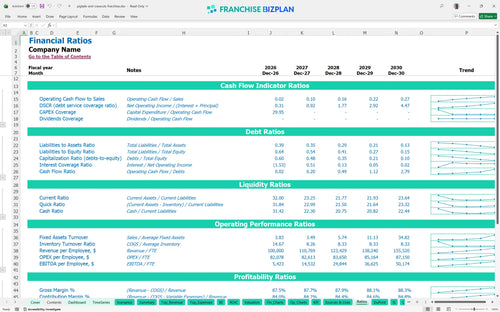
Performance metrics benchmark
We built this franchise unit financial model using our own reasearch into the children's hair care sector. Key assumptions like the $30,000 franchise fee and tiered stylist staffing are pre-populated with researched data and are fully editable. Here is the quick math: with EBITDA growing from $33,000 in year one to $401,000 in year five, the model helps you track every dollar of your unit economics.
Analyzing profitability for a niche service franchise shows a steady climb as you build local density. The unit hits a positive EBITDA of $33,000 in the first year, scaling significantly by year five as revenue doubles to $1.24 million. You'll see net profit stabilize once the initial ramp-up phase and marketing push settle into a routine.
Startup financial planning for independent franchise units starts with a clear budget for the $285,000 in total capital expenditures. This covers everything from the $30,000 initial fee to the $120,000 needed for leasehold improvements in a prime location. You'll also need to account for the $45,000 spent on specialized vehicle chairs that define the brand experience.
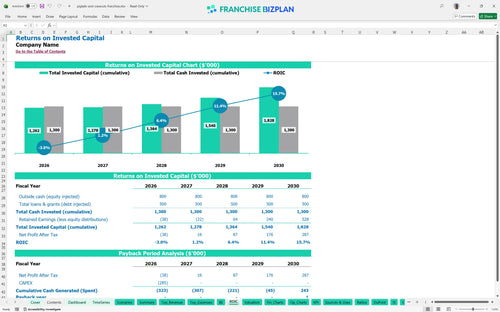
Estimating revenue for a children's hair salon business is only half the battle; you need to know when you get your money back. This model shows a 5-year payback period with an IRR of 2.67% and a Return on Equity of 0.66. While the initial years are about recovery, the $401,000 EBITDA in year five proves the long-term value of the territory.
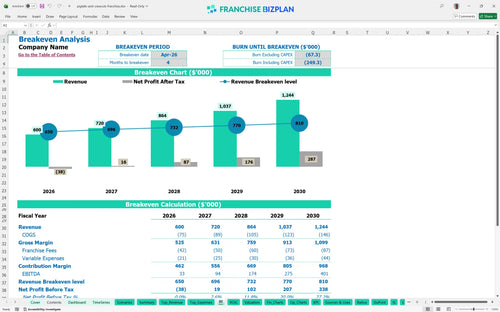
To calculate startup costs for a kids salon franchise, you must know your 'zero-profit' line. This unit hits break-even in April 2026, just four months after launching. Preparing a business budget for a salon franchise requires covering $12,400 in monthly fixed costs, including rent and insurance, before the first haircut is even finished.
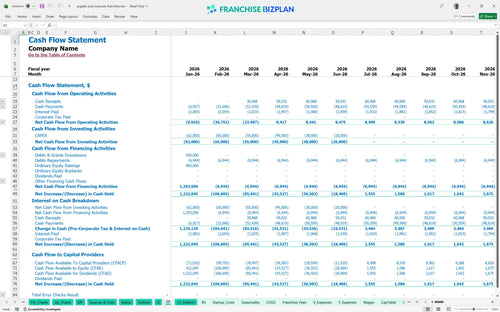
Best practices for forecasting franchise unit cash flow suggest watching your lowest point during the build-out. The model indicates a minimum cash position of $931,000 in June 2026, which suggests a very healthy capital cushion was planned. Still, if your leasehold improvements take 60 days longer than expected, that runway can shrink fast.
This franchise financial projection spreadsheet for new owners lets you toggle between performance levels. A 'High' scenario focuses on maximizing the $518,400 haircut revenue potential by year five, while the 'Low' case warns of tighter margins if labor costs spike. Adjusting these variables shows how quickly a 1-point margin leak impacts your year-1 $33,000 EBITDA.
Finance: update unit break-even and payback model by Friday.
This financial model template for retail franchise locations is built in Excel, allowing you to tweak every variable from stylist wages to retail margins. You can adjust the pre-filled formulas to match your specific territory or local labor market. It's defintely the fastest way to stress-test your assumptions before signing a lease.

Map out your long-term growth with a franchise business plan template that scales from one unit to a small chain. The model tracks revenue climbing from $600,000 in year one to over $1.2 million by year five. Seeing the full trajectory helps you plan for future equipment upgrades and staff expansion.

Understanding franchise royalty and marketing fees in financial models is critical for protecting your bottom line. This tool automatically calculates the 5% royalty and 2% marketing fund contributions against your gross sales. It ensures you see exactly how much cash stays in the unit after the brand takes its cut.

Evaluating franchise investment opportunities with financial models requires a clear view of your entry price. We've mapped out the $285,000 in initial capital expenditures, including leasehold improvements and those custom vehicle chairs. The model shows you the exact sales volume needed to cover your $9,000 monthly rent and other fixed overhead.

Use this retail franchise financial statements tool to compare your salon franchise startup costs against industry norms. We've included benchmarks for grooming supplies and retail inventory to keep your cost of goods sold in check. It helps you spot if your $32,000 stylist salaries are out of alignment with the niche service market.


Simply purchase and download the financial model template, then access it instantly using Microsoft Excel or Google Sheets. No installation or technical expertise required-just open and start working.

Enter your business-specific numbers, including revenue projections, costs, and investment details. The pre-built formulas will automatically calculate financial insights, saving you time and effort.

Leverage the investor-ready format to confidently showcase your financial projections to banks, franchise representatives, or investors. Impress stakeholders with clear, data-driven insights and professional reports.

Leverage the investor-ready format to confidently present your projections to banks, franchise representatives, or investors.