


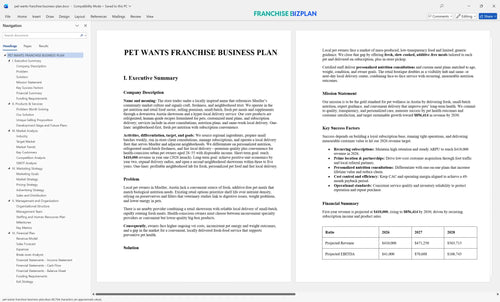
Executive Summary
Your concept at a glance



You get a complete, editable franchise business plan in Microsoft Word and an Excel financial model to customize your projections.
Your concept at a glance
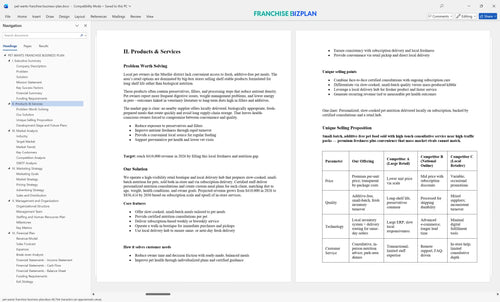
What you sell and why
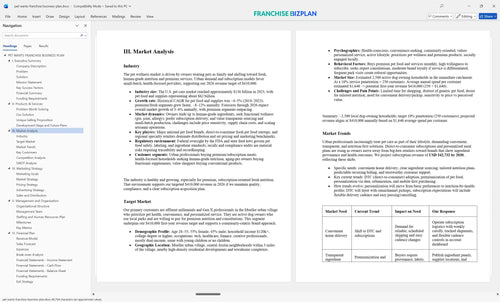
Market size and rivals
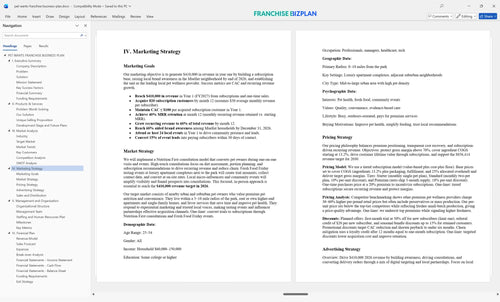
Channels, promotions, conversions
Team roles and org chart
P&L cash flow break-even

Edit fast on any device

All core chapters included
We developed this franchise unit business plan template in Microsoft Word based on our own research into opening and operating a new location. All six chapters are pre-populated with data specific to this pet wellness franchise model, from startup costs to a 5-year financial forecast showing a payback period of 5 years. The entire document is fully editable, allowing you to adapt the plan to your specific territory and financial situation.
The opportunity is to launch a high-touch pet nutrition boutique and local delivery service targeting affluent, health-conscious pet owners in a dense, high-income area like Mueller in Austin. The model combines the convenience of hyper-local delivery with the trust built through personalized, in-store wellness consultations, creating a defensible niche against mass-market competitors.
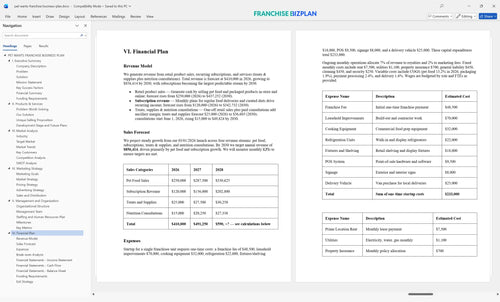
The unit's revenue comes from four primary streams: direct sales of proprietary pet food, recurring revenue from delivery subscriptions, sales of treats and supplies, and fees from personalized nutrition consultations. Pet food sales are projected to be the largest contributor, starting at $250,000 in the first year, while the subscription model is designed for rapid growth, scaling from $120,000 to over $342,000 by year five.
The target customers are affluent millennials and Gen X pet owners in urban villages who view their pets as family and prioritize wellness over cost. This segment is concentrated in areas with high foot traffic, luxury apartments, and community spaces like parks. The business plan focuses on capturing this demographic by offering a premium, convenient service that big-box pet stores and online-only retailers cannot easily replicate.
The strategy is built on a hyper-local, community-focused approach rather than broad advertising. Key tactics include forming referral partnerships with local veterinary clinics, hosting 'tasting' events at nearby luxury apartment complexes, and using the retail boutique's high-visibility location to capture foot traffic. The 2% marketing fee contributes to national brand awareness, but local execution is what will drive initial sales and build the subscription base.
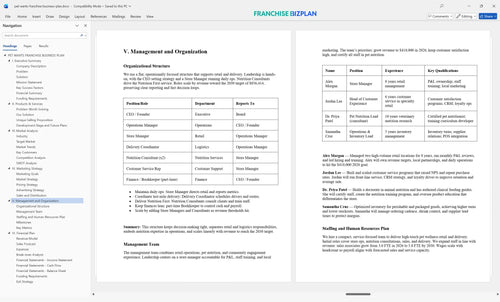
The unit will be run by a full-time Store Manager ($65,000 annual salary) responsible for daily operations, sales, and upholding brand standards. The initial team will also include one Nutrition Consultant, three Sales Associates, and one Delivery Driver. As revenue grows toward $1,275,000 in year five, the staffing plan scales to include more consultants and sales staff to maintain service quality without over-staffing during the critical ramp-up phase.
The total startup investment is significant, driven by a $48,500 franchise fee, $70,000 in leasehold improvements, and other capital expenditures. The financial model projects the unit will reach its breakeven point just 4 months after its March 2026 launch. With a 7% royalty and 2% marketing fee, managing costs like rent ($7,500/month) is essencial. The plan forecasts positive EBITDA of $42,000 in the first year, growing to $333,000 by year five, with a full payback in 5 years.
This franchise unit business plan template is fully pre-written, saving you dozens of hours of work on a pet food franchise business plan. It's also completely editable in Microsoft Word, allowing you to tailor every detail to your specific location, local market analysis, and operational strategy. This combination ensures your plan meets franchisor standards while reflecting the unique realities of your territory.

The included Word template contains detailed franchise financial projections, breaking down startup costs, operating expenses, and revenue assumptions for a new unit. With first-year revenue projected at $608,000 and growing to $1,275,000 by year five, these figures provide a clear basis for evaluating profitability, securing funding, and understanding the financial path to success for your pet wellness franchise model.

Using this professional business plan template for a retail franchise is a highly cost-effective solution that reduces your reliance on expensive consultants. It saves you both time and money, allowing you to allocate more of your capital toward essential franchise startup costs. Instead of paying high fees for a plan, you can invest that cash directly into the $70,000 for leasehold improvements, inventory, or local marketing.

This franchise investment business plan is designed to make a strong, professional impression on lenders, investors, and the franchisor's review committee. The clear structure, logical financial projections, and organized presentation of your retail pet store operations enhance your credibility. It provides a solid foundation for funding discussions, showing you have a well-researched plan to manage the initial investment and drive unit performance.

This template delivers a comprehensive overview of your proposed franchise unit, covering your mission, vision, target market, and local competitive positioning. It provides a clear narrative for your pet supply store business plan, detailing your operational plan, value proposition, and management approach. This structured framework helps you present a cohesive and compelling case for your new venture within the established brand system.


Purchase the template and download it immediately. Open and edit it seamlessly using Microsoft Word or Google Docs, making it easy to start working on your business plan right away.

Modify each section to align with your business concept, industry, and financial goals. Personalize the content to reflect your target market, unique value proposition, and key financial details.

Leverage the provided example financial projections or seamlessly incorporate your specific figures, utilizing an optional financial model available for purchase.

Conduct a thorough review of your business plan, refining the content to ensure it's investor-ready and serves as an effective operational guide.