


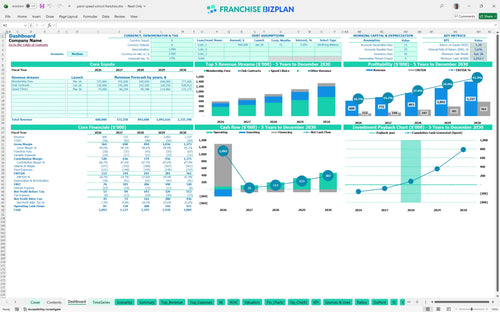
All-in-one Dashboard
Core inputs and core outputs



This franchise unit financial model template provides a complete Excel-based toolkit for forecasting revenue, managing operating expenses, and calculating the total investment needed for a sports training facility.
Core inputs and core outputs
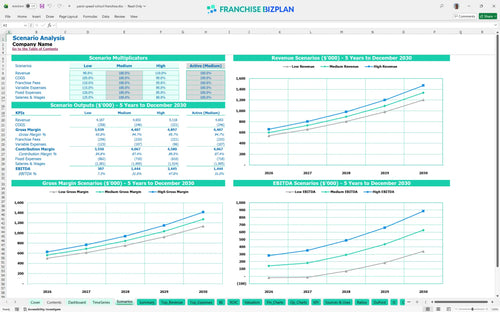
Three scenario analysis
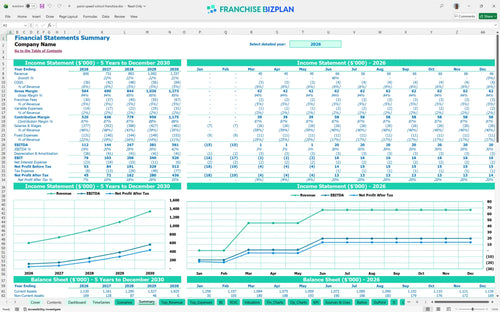
Presentation ready
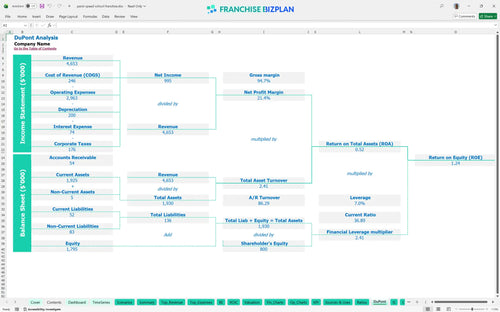
DuPont analysis
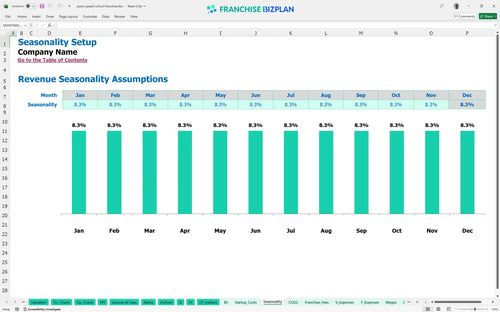
Researched revenue assumptions
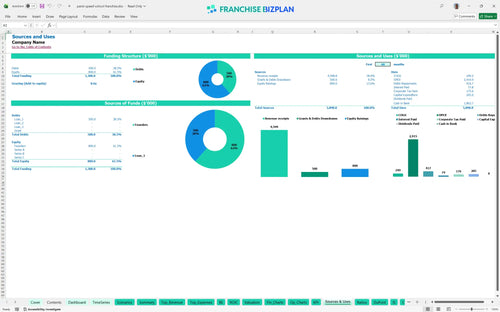
Lender-friendly financial outputs
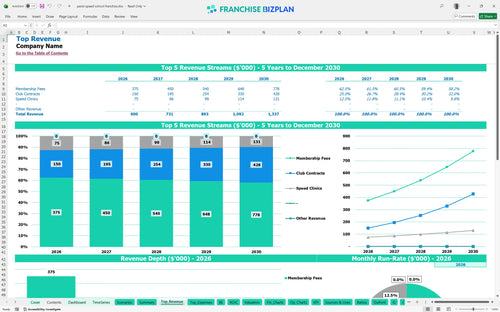
Revenue stream detailed view
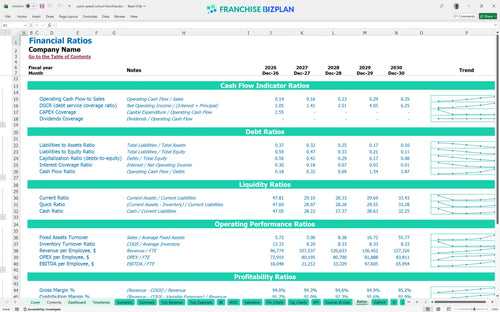
Performance metrics benchmark
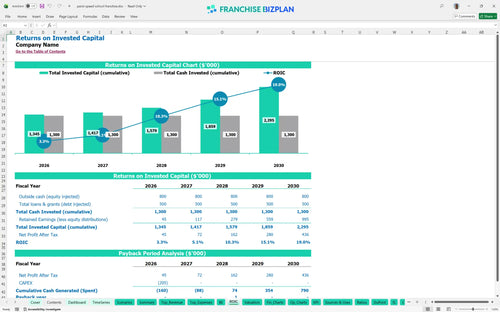
We developed this franchise unit financial model through extensive research into the youth sports performance sector to give you a realistic roadmap for success. The pre-populated data includes everything from the $30,000 initial fee to the $45,000 turf installation, ensuring your fitness franchise business plan is grounded in real-world numbers. With year-one revenue starting at $600,000 and a clear path to a 3-year payback, this tool helps you stress-test your assumptions before committing capital.
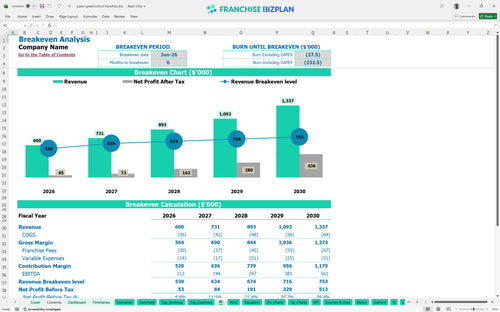
Based on our research, the unit hits its stride fairly quickly, reaching monthly break-even by June 2026, just six months after launch. With year-one EBITDA starting at $112,000 and climbing toward $561,000 by year five, the profitability trajectory is strong as long as you maintain the 5% royalty structure and keep training supplies around 4% of sales. Honestly, the speed of this ramp-up depends heavily on how fast you can stack those recurring membership fees.
You will need approximately $205,000 in hard startup costs to get the doors open, plus a significant cash buffer for the initial months of operation. The model shows a minimum cash requirement of $1,033,000 by June 2026, which accounts for the build-out, the $30,000 franchise fee, and the working capital needed to cover the $6,500 monthly rent before the membership base matures. If the build-out takes 60 days longer than expected, your initial liquidity becomes your most critical asset.
The model projects a 3-year payback period, which is quite respectable for a brick-and-mortar fitness concept with high upfront equipment costs. You are looking at an Internal Rate of Return (IRR) of 5.61% and a Return on Equity (ROE) of 1.24 over the initial five-year term. While the IRR might look conservative, it reflects a realistic ramp-up and the steady weight of a 5% royalty fee on every dollar of revenue. Here's the quick math: by year five, you're generating over $500k in EBITDA on a $1.3M top line.
The franchise unit profitability analysis shows you hit the break-even point in June 2026, roughly 6 months after the initial lease starts. To cover your fixed monthly burn of about $11,350-which includes $6,500 for rent plus utilities and insurance-you'll need to focus heavily on the $250,000 annual membership target. Labor is your biggest variable lever, so managing the 2.5 FTE trainers in year one is vital to keeping the lights on during the quiet months.
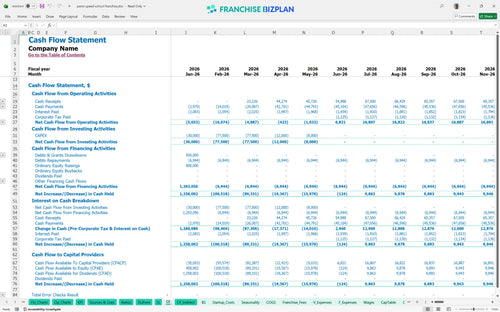
Your lowest cash point occurs in June 2026, coinciding with your break-even month, where the model shows a cash floor of $1,033,000. This suggests you need a deep well of working capital to survive the ramp-up phase and the heavy $155,000 equipment and build-out phase. We defintely recommend keeping a 20% contingency fund because unexpected delays in signage or tech installation can eat through your runway faster than you think. Still, once you pass that six-month mark, the cash flow begins to stabilize nicely.
Our model allows you to toggle between Low, Medium, and High cases to see how a 10% dip in club contracts or a spike in trainer wages changes your outcome. In a high-performance scenario where revenue hits the $1.3M mark early, your year-5 EBITDA margin expands significantly due to the fixed nature of the $6,500 rent. Conversely, if membership growth slows by 15%, your payback period could easily stretch to 4 or 5 years, making local marketing execution your most important daily task.
Finance: update unit break-even and payback model by Friday.
This franchise unit financial model is fully customizable in Excel, allowing you to swap our researched data for your specific territory reality. Every formula is unlocked, so you can easily adjust membership pricing, trainer wages, or rent to see how different operating scenarios impact your bottom line before you sign a lease.

Long-term planning is the difference between a job and a business, and this model delivers a full 5-year outlook on revenue, costs, and cash flow. You get a clear view of how scaling from $600,000 in year one to over $1.3 million in year five impacts your store-level margin and long-term exit value.

We built this to capture the specific financial weight of being a franchisee, from the $30,000 upfront fee to the ongoing 5% royalty drag. Seeing these costs side-by-side with your local overhead helps you understand the real economics of the brand standards before you commit to the system.

Starting a sports performance franchise investment requires a clear handle on the $205,000 in initial CAPEX, including turf and equipment. This model calculates exactly when your monthly membership fees and clinic revenue will finally cover your $6,500 rent and payroll, showing you the light at the end of the tunnel.

Don't fly blind when estimating your fitness franchise business plan; use our built-in benchmarks to see if your 5% royalty or labor ratios are in line with the rest of the industry. It's a reality check that helps you spot if your facility manager's $68,000 salary or your local marketing spend is too high for your expected volume.


Simply purchase and download the financial model template, then access it instantly using Microsoft Excel or Google Sheets. No installation or technical expertise required-just open and start working.

Enter your business-specific numbers, including revenue projections, costs, and investment details. The pre-built formulas will automatically calculate financial insights, saving you time and effort.

Leverage the investor-ready format to confidently showcase your financial projections to banks, franchise representatives, or investors. Impress stakeholders with clear, data-driven insights and professional reports.

Leverage the investor-ready format to confidently present your projections to banks, franchise representatives, or investors.