


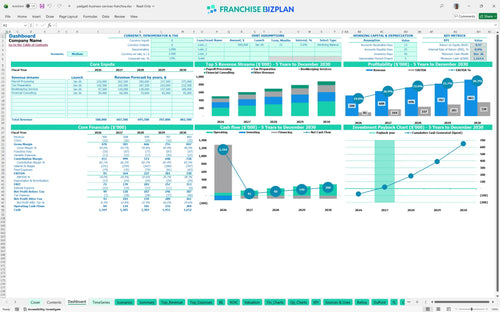
All-in-one Dashboard
Core inputs and core outputs



This financial model for new franchise storefront provides a granular look at unit-level performance from the initial fee through five years of operations.
Core inputs and core outputs
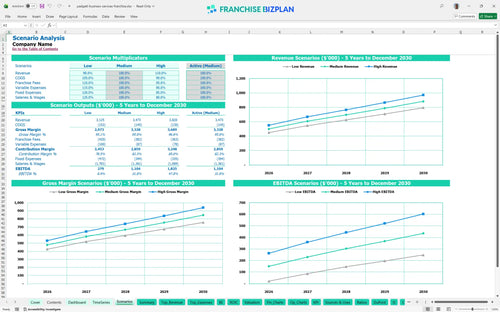
Three scenario analysis
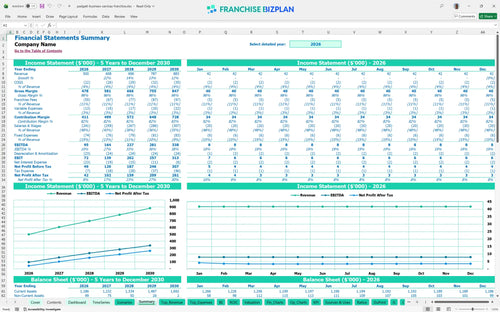
Presentation ready
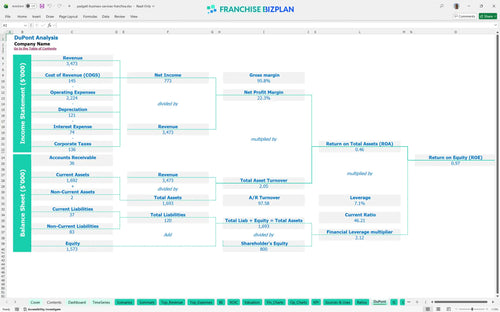
DuPont analysis
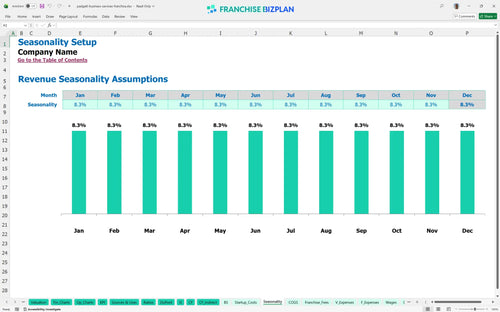
Researched revenue assumptions
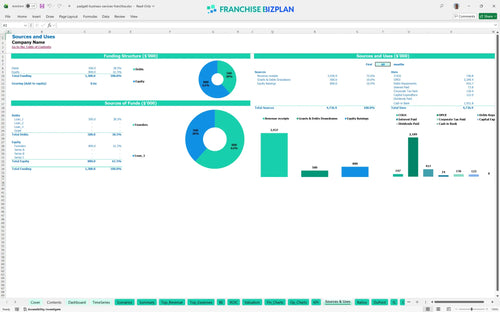
Lender-friendly financial outputs
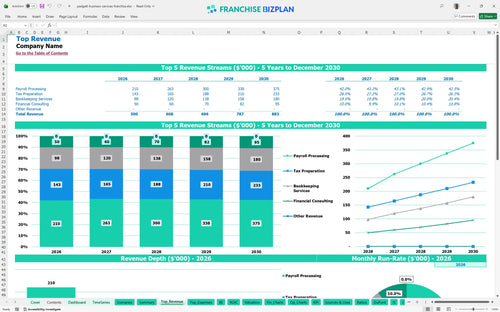
Revenue stream detailed view
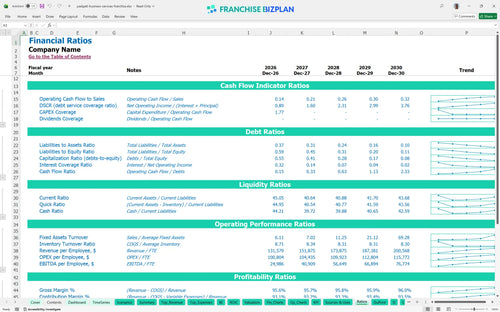
Performance metrics benchmark
We built this franchise unit financial model using our own research into professional service standards and brand-specific requirements. Key assumptions-including recurring payroll revenue, 9% royalties, and senior accountant wages-are pre-populated and fully editable to match your Charlotte South End location. Every 1-point margin leak matters fast in a single-unit model.
Profitability for this unit is projected to start in year one, with an initial EBITDA of $95,000. By year five, as your client base for tax and bookkeeping matures, net profit is expected to climb toward $338,000 annually. This franchise unit profitability analysis shows a steady trajectory as you scale your service mix. Evaluating profitability of accounting franchise locations requires looking past year one to the mature-unit margin.
The total capital required to launch this unit is approximately $122,000, which includes the $56,000 franchise fee and $20,000 for leasehold improvements. This franchise investment calculator also accounts for $15,000 in computer workstations and $12,000 in office fixtures to meet brand standards. Having a clear view of your sources and uses prevents mid-ramp funding gaps.
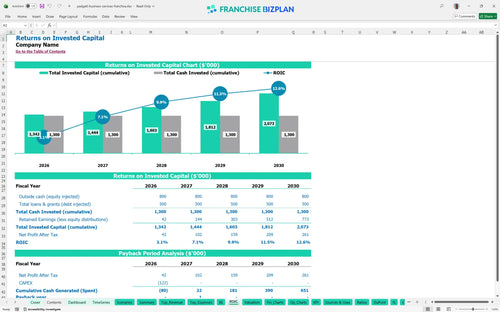
Investors can expect an Internal Rate of Return (IRR) of 7.97% and a payback period of approximately 2 years. Calculating return on investment for service-based franchises is unique because the asset is the recurring client list, not just the equipment. With a Return on Equity (ROE) of 0.97, the model defintely shows a path to recovering your initial $122,000 outlay quickly through high-margin tax and payroll work.
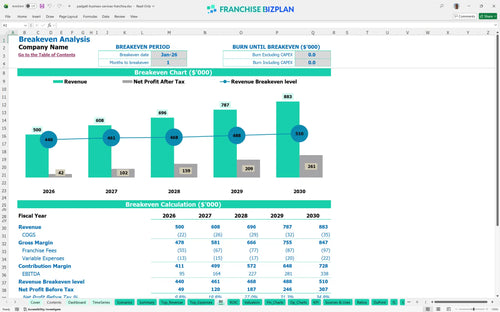
The unit reaches break-even in January 2026, just one month after opening, assuming you hit your initial revenue targets. Analyzing recurring revenue streams for accounting franchises shows that the $140,000 annual payroll processing goal is the primary driver for covering your $4,200 monthly rent. Speed to break-even depends on how fast you can convert your local network into monthly bookkeeping clients.
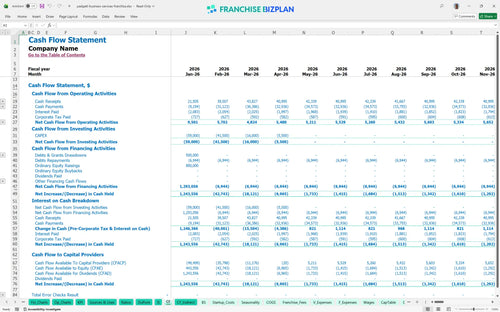
Your lowest cash point is projected to be $1,164,000 in December 2026, reflecting the need for a significant buffer during the first year of operations. This franchise unit cash flow statement template helps you track the timing gaps between paying your staff $218,000 in annual wages and collecting client fees. Still, maintaining a healthy runway is the best defense against slow-paying clients or seasonal tax dips.
The model compares low, medium, and high cases to show how a 10% shift in client retention or average ticket changes your peak cash need. Using best practices for franchise financial forecasting, you can see that the high scenario significantly accelerates your IRR beyond the 7.97% baseline. Real-world success usually lives in the details of local marketing execution and staff productivity.
This franchise financial model template is fully customizable in Excel, allowing you to swap pre-filled data for your specific local market realities. It features editable assumptions and formulas that handle everything from professional service pricing to complex staffing schedules. Using this Excel template for franchise unit financial projections ensures you aren't starting from scratch when modeling your territory.

Long-term planning is vital for professional service firms where client retention drives value over time. The model delivers detailed financial projections for franchises, covering five years of revenue, costs, and cash flow to map your growth from a single desk to a full-service office. Accurate revenue forecasting helps you anticipate when to scale your team as your client base matures.

Operating a branded office means accounting for specific financial obligations like royalty fees and brand fund contributions. This model captures these recurring costs-specifically the 9% royalty and 2% marketing fund-so you can see the impact on your store-level margin. Understanding these business services franchise startup costs is essential for maintaining a healthy bottom line while leveraging a national brand.

Knowing how to calculate startup costs for a business services franchise is the first step toward a successful launch. The model includes a detailed break-even analysis that calculates the exact sales volume needed to cover your $6,180 in monthly fixed costs. It maps out your total initial investment, including leaseholds and equipment, to ensure you aren't caught off guard by early-stage capital needs.

This accounting franchise business plan incorporates built-in benchmarks for labor, occupancy, and operational expenses common in the professional services sector. These metrics help you sanity-check your assumptions against industry standards for gross margins and revenue drivers. Estimating operating expenses for professional service franchises becomes much more precise when you have a baseline for comparison.


Simply purchase and download the financial model template, then access it instantly using Microsoft Excel or Google Sheets. No installation or technical expertise required-just open and start working.

Enter your business-specific numbers, including revenue projections, costs, and investment details. The pre-built formulas will automatically calculate financial insights, saving you time and effort.

Leverage the investor-ready format to confidently showcase your financial projections to banks, franchise representatives, or investors. Impress stakeholders with clear, data-driven insights and professional reports.

Leverage the investor-ready format to confidently present your projections to banks, franchise representatives, or investors.