


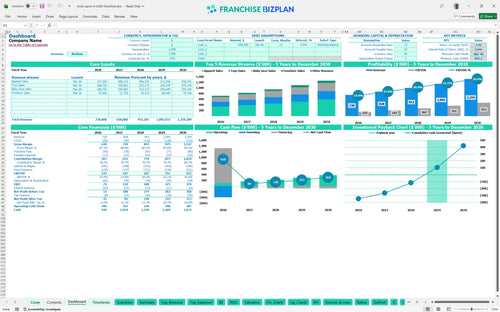
All-in-one Dashboard
Core inputs and core outputs



This Excel template for retail franchise financial forecasting includes pre-populated data for apparel, toys, and baby gear sales to streamline your investment analysis.
Core inputs and core outputs
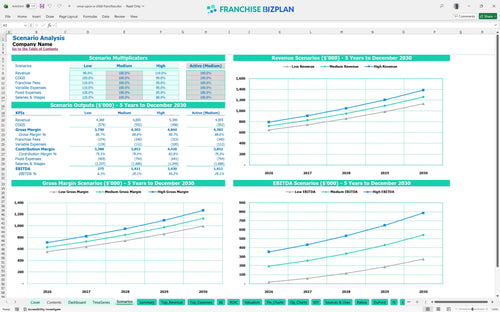
Three scenario analysis
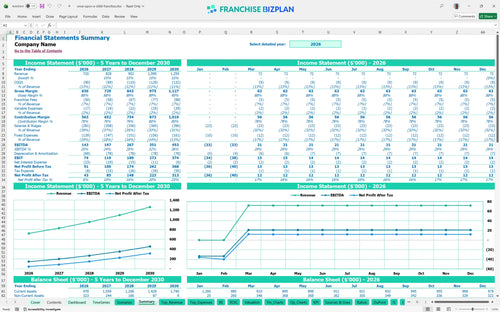
Presentation ready
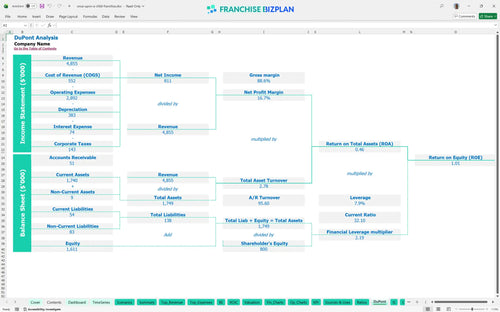
DuPont analysis
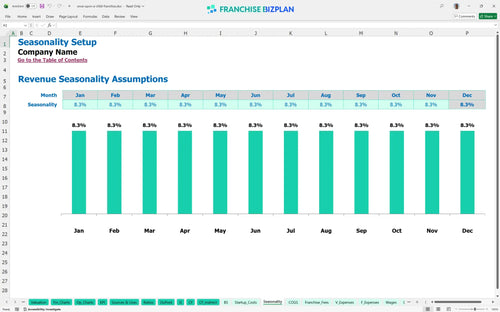
Researched revenue assumptions
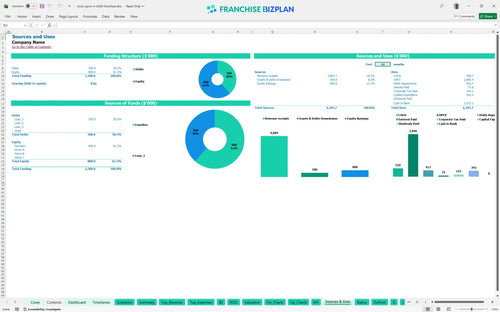
Lender-friendly financial outputs
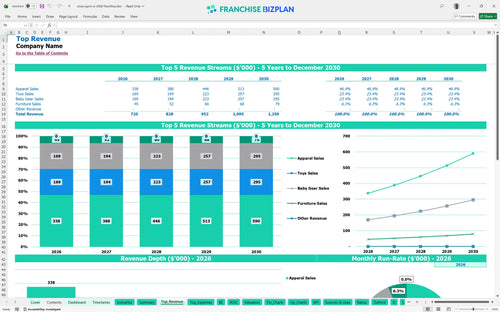
Revenue stream detailed view
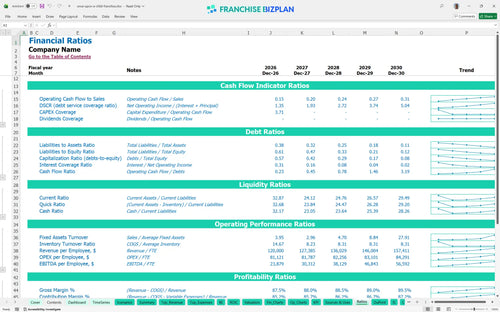
Performance metrics benchmark
We built this franchise unit financial model using our own research to help you navigate the complexities of a resale retail environment. The model comes pre-populated with data showing a year-one EBITDA of $143,000 and a clear path to $453,000 by year five, all while accounting for the specific franchise royalty fee structure and marketing fund requirements. You can easily edit these assumptions to reflect your specific site selection and local labor market.
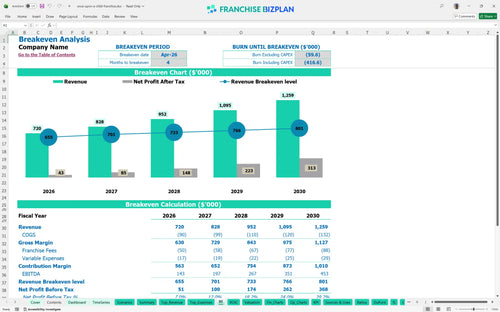
This unit is projected to reach its break-even point in April 2026, just four months after launching. Net profit grows as you scale, with year-one EBITDA starting at $143,000 and expanding as inventory purchases (COGS) drop from 11.5% to 9.5% of sales. To be fair, staying profitable requires tight managment of the $15,800 monthly fixed costs before you even pay a single sales associate.
You will need approximately $392,000 in total initial investment for hard costs like leaseholds and fixtures, but the model suggests a minimum cash requirement of $846,000 to handle the ramp-up. This covers the $25,000 franchise fee and the $185,000 build-out needed for a premium boutique environment. Here's the quick math: your biggest cash outlays happen in the first 90 days before the first customer walks in.
The internal rate of return (IRR) for this unit is estimated at 3.56%, with a return on equity (ROE) of 1.01. You can expect a payback period of 4 years, which is standard for a retail franchise investment analysis spreadsheet for small business. While the IRR seems modest, the cash flow scales defintely well, reaching $453,000 in annual EBITDA by the fifth year of operation.
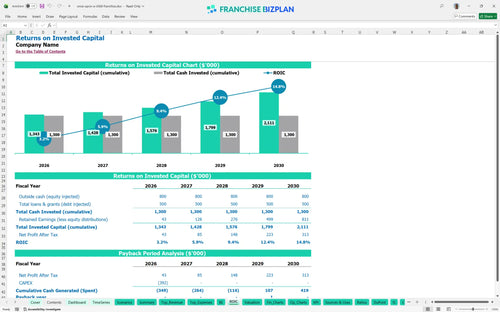
The monthly break-even point occurs in month 4, driven primarily by the high volume of apparel and toy sales which account for $337,500 in combined year-one revenue. Your ability to hit this target depends on managing variable costs in a resale franchise, specifically the 1.8% payment processing fees and the $11,150 monthly fixed overhead. If your rent stays at $8,200, volume is your best friend.
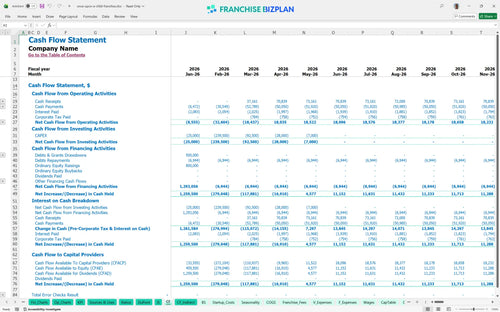
The lowest cash point occurs in April 2026, coinciding with your break-even month, where you'll need at least $846,000 on hand to feel safe. Planning operational expenses for a new retail franchise means accounting for the $15,000 monthly salary for the management team during the early months. Still, having a cash buffer is vital if the build-out takes longer than the planned 60 days.
In a High scenario, hitting $1.25M in revenue earlier than year five would significantly boost your IRR and shorten the 4-year payback. The model shows that even a 10% swing in revenue dramatically impacts the year-one $143,000 EBITDA because fixed costs like the $8,200 rent don't move. Estimating revenue for a secondhand children's clothing franchise requires looking at these Low vs High cases to understand your downside risk.
This franchise financial model template is built entirely in Excel, giving you total control over the numbers. Every formula is pre-filled but remains editable, so you can adjust the children's resale franchise business plan to fit your specific territory or local market conditions. It is a flexible small business investment calculator that lets you swap out rent, labor rates, or local tax assumptions without breaking the logic.

Planning for the long term is essential when evaluating retail franchise startup costs and future returns. This franchise financial projection spreadsheet provides a detailed 5-year outlook, mapping out how revenue grows from $720,000 in year one to over $1.25 million by year five. It includes a full balance sheet and cash flow view to ensure you understand the long-term franchise profitability analysis before signing the lease.

The model is hard-wired with the standard franchise royalty fee structure to ensure your margins are realistic. It tracks the 5% royalty and 2% marketing fund contributions against your monthly sales, so you see exactly how much goes to the franchisor. This level of detail helps you manage the operating expenses for retail store locations while maintaining brand standards and local marketing efforts.

Calculating break-even point for retail franchise units is the most critical step for any new owner. This tool aggregates your $25,000 franchise fee, $185,000 in leasehold improvements, and $95,000 in fixtures to show the total mountain you need to climb. It provides a clear ROI calculation for franchises by comparing these upfront costs against your projected monthly store-level EBITDA.

We have integrated researched benchmarks to help you sanity-check your inventory turnover ratio retail targets. The model compares your projected labor costs and rent against industry norms for children's resale stores, ensuring your financial feasibility study for children's retail store is grounded in reality. This helps you spot if your $8,200 monthly rent or staffing plan is out of sync with similar high-performing units.


Simply purchase and download the financial model template, then access it instantly using Microsoft Excel or Google Sheets. No installation or technical expertise required-just open and start working.

Enter your business-specific numbers, including revenue projections, costs, and investment details. The pre-built formulas will automatically calculate financial insights, saving you time and effort.

Leverage the investor-ready format to confidently showcase your financial projections to banks, franchise representatives, or investors. Impress stakeholders with clear, data-driven insights and professional reports.

Leverage the investor-ready format to confidently present your projections to banks, franchise representatives, or investors.