


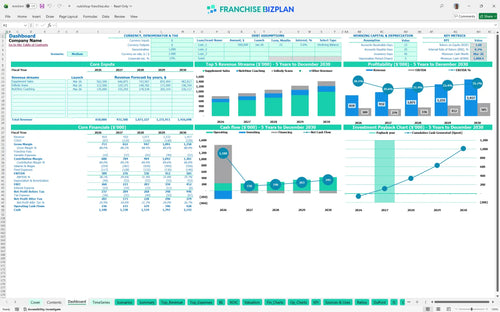
All-in-one Dashboard
Core inputs and core outputs



This franchise unit financial model template provides a complete Excel-based toolkit for projecting five-year performance, managing startup costs, and analyzing unit-level profitability for a retail supplement location.
Core inputs and core outputs
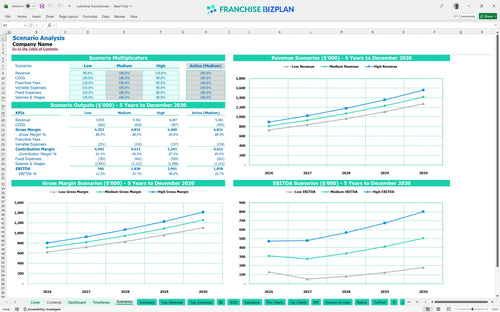
Three scenario analysis
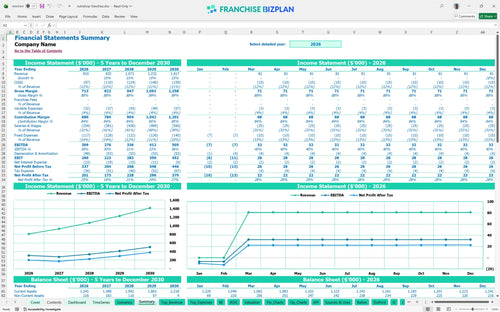
Presentation ready
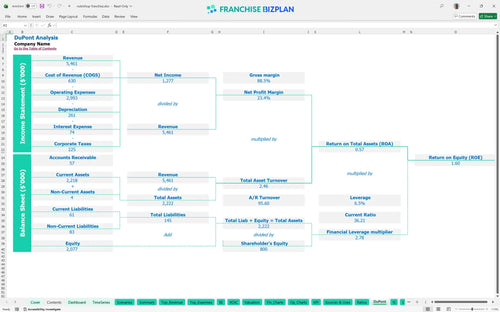
DuPont analysis
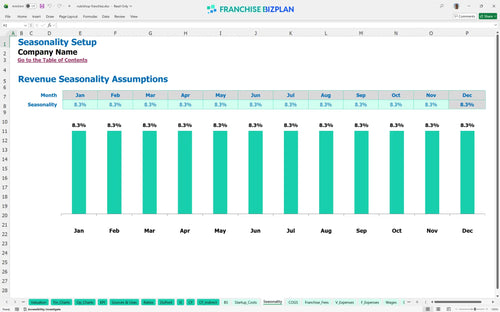
Researched revenue assumptions
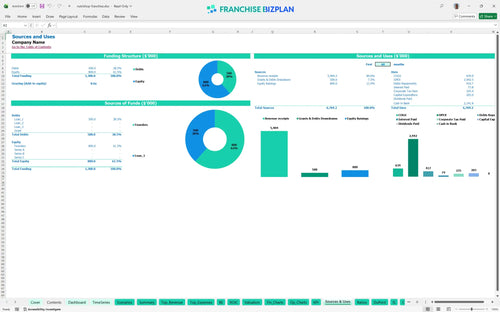
Lender-friendly financial outputs
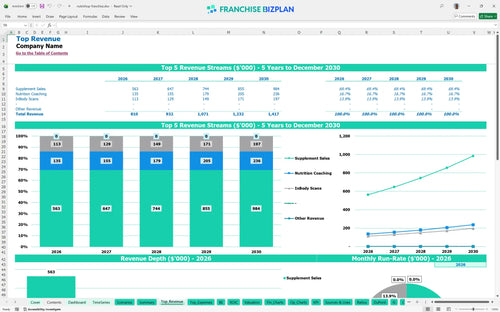
Revenue stream detailed view
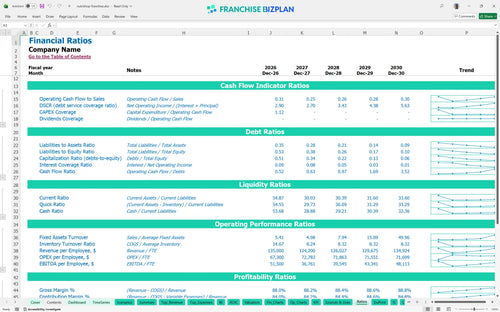
Performance metrics benchmark
We built this franchise unit financial model using research on retail supplement operations and Austin-specific market data. Key assumptions like the $810,000 Year 1 revenue target and the $265,000 initial investment are pre-populated and fully editable to reflect your specific location and operating scenario. This tool provides the precision needed to manage a unit that scales to $1.4M in annual sales by Year 5.
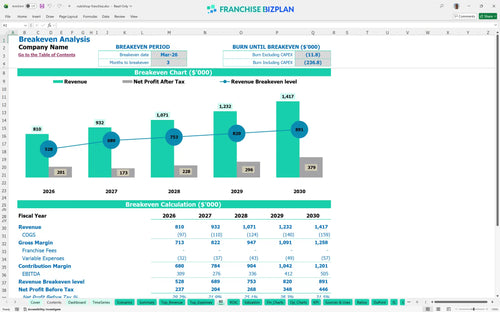
This franchise unit reaches profitability almost immediately, with a projected breakeven date in March 2026, just three months after the initial investment phase. By Year 1, the store generates $309,000 in EBITDA after accounting for inventory costs, $5,500 monthly rent, and a full staffing roster including a manager and nutritionist.
You need approximately $265,000 to launch this franchise unit in the US, covering the initial fee, build-out, and opening inventory. This budget ensures you have the necessary equipment, like the $15,000 InBody scanner, to deliver the data-driven consultations that drive the value proposition in a competitive retail environment.
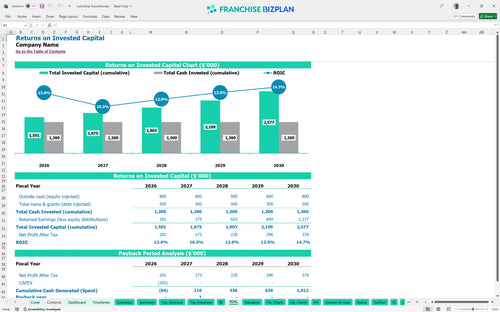
A franchisee can expect a 2-year payback period and an Internal Rate of Return (IRR) of 8.17% based on the current five-year growth trajectory. The franchise investment return analysis shows a Return on Equity (ROE) of 1.6, supported by a strong revenue ramp that reaches $1.41M by the fifth year of operation.
The unit reaches its monthly breakeven point in March 2026, requiring enough volume to cover roughly $10,000 in fixed monthly costs including rent and utilities. The primary driver for reaching this point is supplement sales volume, which is projected to start at $375,000 annually and grow steadily through local referrals.
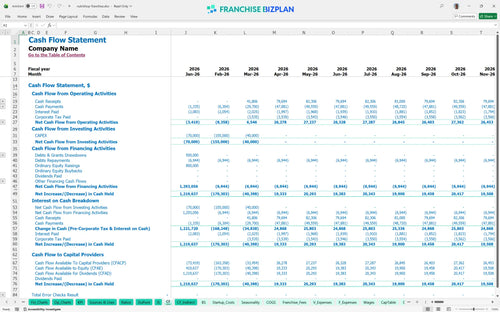
The lowest cash point occurs in March 2026 with a minimum cash balance of $1,009,000, suggesting a very healthy liquidity position if the initial funding is secured. The operating expense breakdown for retail franchise shows that while rent is fixed at $5,500, labor scales with growth, so maintaining a cash buffer is vital during the Year 2 hiring phase.
Using a fitness retail franchise business plan template allows you to defintely see how a 10% drop in revenue impacts your 2-year payback goal. In a high-growth scenario, increasing the average ticket through nutrition coaching can significantly boost the Year 1 EBITDA margin, while a low-volume scenario might extend the payback period by several months.
This franchise unit financial model is a fully customizable Excel tool that allows you to adjust every assumption from local rent to specific supplement inventory costs. It uses a sample financial model for franchise operations with pre-filled formulas, making it a reliable financial model template for retail franchise planning that adapts to your specific territory and market conditions.

Long-term planning is essential for a retail franchise business plan, and this model delivers detailed 5-year revenue forecasting and profit views. You can generate a complete retail store franchise profit and loss statement and use the franchise unit financial projections excel to track how supplement store financial projection targets evolve as your customer base matures.

This tool acts as a franchise profitability calculator by capturing all franchise operating expenses, including the initial $20,000 fee and ongoing obligations. It helps you how to estimate franchise profitability by modeling the impact of zero-percent royalties and marketing fees, ensuring you understand the real economics of the unit before signing a long-term agreement.

Estimating your total initial investment is the first step in any retail supplement business startup budget, covering everything from leasehold improvements to initial inventory. The built-in breakeven analysis identifies the exact sales volume needed to cover your $5,500 monthly rent and labor costs, providing a clear roadmap to store-level stability.

The model uses unit economics and ROI analysis benchmarks to help you sanity-check your projections against industry standards for supplement retail. By comparing your expected gross margins and labor costs to typical ranges, you can ensure your franchise startup costs and operating assumptions are grounded in real-world performance data.


Simply purchase and download the financial model template, then access it instantly using Microsoft Excel or Google Sheets. No installation or technical expertise required-just open and start working.

Enter your business-specific numbers, including revenue projections, costs, and investment details. The pre-built formulas will automatically calculate financial insights, saving you time and effort.

Leverage the investor-ready format to confidently showcase your financial projections to banks, franchise representatives, or investors. Impress stakeholders with clear, data-driven insights and professional reports.

Leverage the investor-ready format to confidently present your projections to banks, franchise representatives, or investors.