


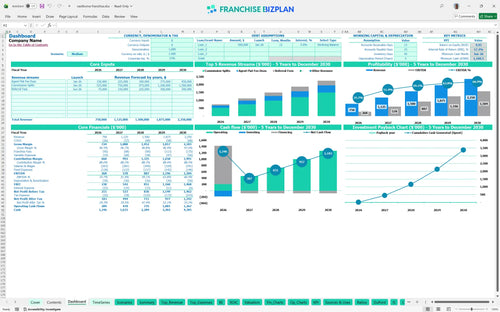
All-in-one Dashboard
Core inputs and core outputs



This real estate office business model financial template provides a complete framework for projecting commissions, agent dues, and office overhead over a five-year period.
Core inputs and core outputs
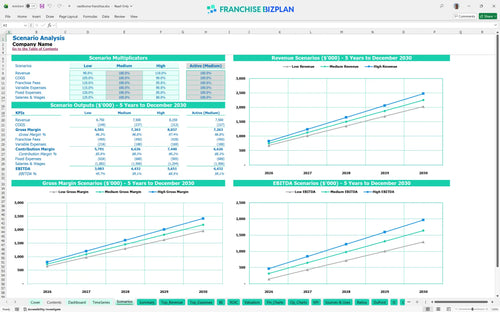
Three scenario analysis
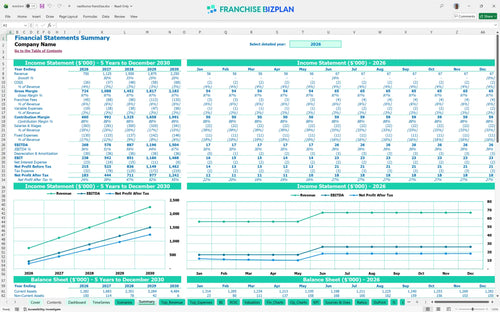
Presentation ready
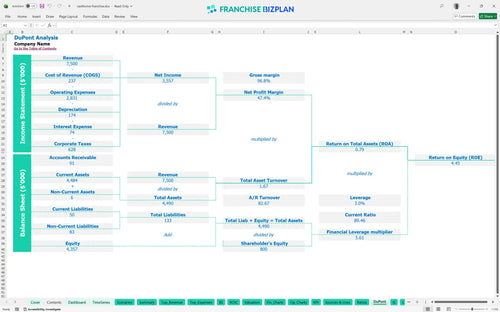
DuPont analysis
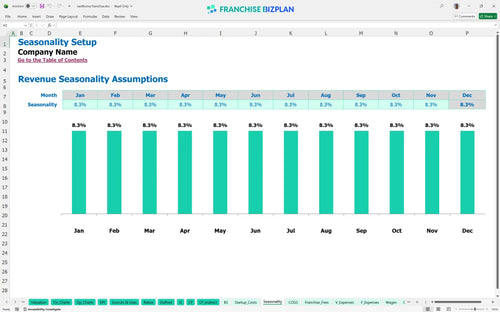
Researched revenue assumptions
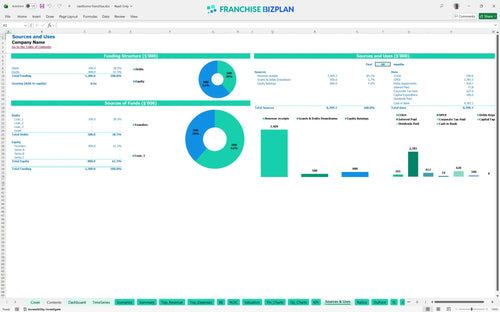
Lender-friendly financial outputs
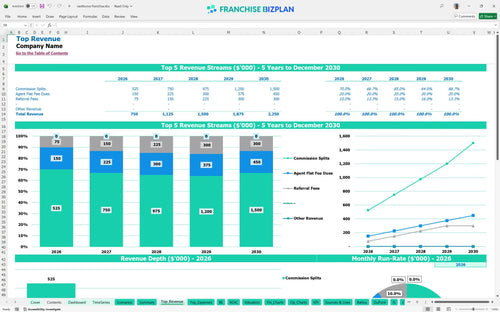
Revenue stream detailed view
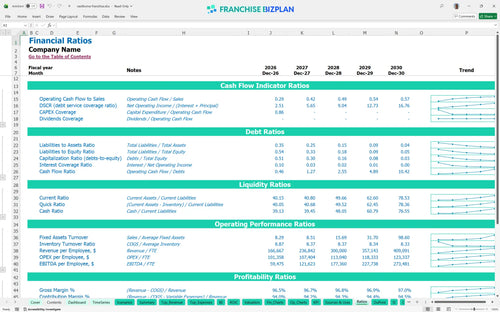
Performance metrics benchmark
We built this real estate franchise financial model using our own research into boutique brokerage economics. Key assumptions, including the $350,000 in Year 1 commission splits and the $10,000 franchise fee, are pre-populated with researched data and remain fully editable. This tool helps you map out a 17.24% IRR and see how $750,000 in Year 1 revenue translates into store-level cash flow.
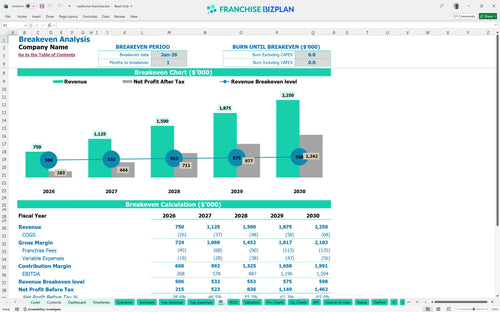
The unit hits profitability almost immediately, with the break-even date occurring in January 2026. With Year 1 EBITDA at $268,000 scaling to $1.5 million by Year 5, this franchise P&L statement reflects a high-margin service business. Here's the quick math: your $100,000 in annual agent dues provides a stable base that defintely helps cover the $11,900 in monthly fixed costs.
You will need approximately $180,000 to launch, which covers everything from the $10,000 franchise fee to $80,000 in leasehold improvements. This startup budget template for independent real estate brokerage also includes $20,000 for tech setup and $15,000 for AV equipment. Still, you should keep an eye on the $1,161,000 minimum cash balance to ensure you have a sufficient buffer during the first six months.
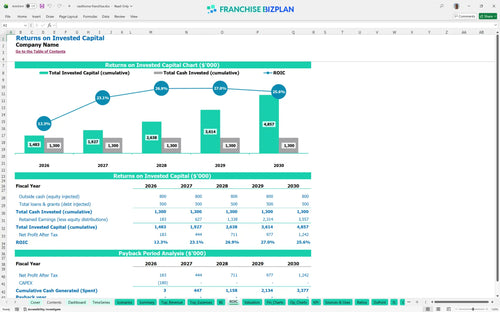
Investors can expect an Internal Rate of Return (IRR) of 17.24% and a Return on Equity (ROE) of 4.45. While the model shows the payback period extending beyond the five-year mark, the steady climb to $2.25 million in annual revenue builds significant enterprise value. Evaluating commission structures for real estate agents is the key to maintaining this franchise fee ROI over the long haul.
You reach the monthly break-even point in just one month, specifically January 2026. The primary driver is the $350,000 in Year 1 commission splits, which quickly offsets the $7,500 monthly rent and $20,000 in monthly payroll. Determining break-even point for real estate franchise success depends on how fast you can recruit agents to generate those initial dues.
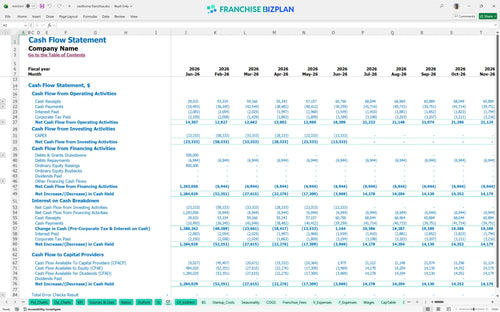
The lowest cash point is $1,161,000 in June 2026, which means you have a massive runway and no immediate cash crunch. This real estate franchise operating budget assumes you are well-capitalized from the start, but you should still manage your $50,000 marketing coordinator salary carefully. Anyway, the $50,000 in Year 1 referral fees provides an extra cushion if agent recruitment lags.
The High scenario sees revenue hitting $2.25 million by Year 5, which dramatically improves your store-level margin. These franchise financial projections for new real estate owners show that even in a Low case, the flat-fee dues of $100,000 provide a safety net. Plus, toggling these scenarios helps you see how a 2.5% MLS fee impact changes as your transaction volume grows.
Finance: update unit break-even and payback model by Friday
This real estate franchise financial model is fully customizable in Excel, giving you total control over every line item. You can adjust pre-filled formulas and editable assumptions to fit your specific territory, whether you are launching a boutique office in a high-growth tech hub or a larger regional brokerage. This financial model template for boutique real estate office makes it easy to swap out local market data and see the impact on your bottom line instantly.

Plan for long-term growth with a detailed five-year view of your revenue, costs, and cash flow. The model tracks your progress as revenue scales from $750,000 in Year 1 to $2.25 million by Year 5, helping you visualize the path to maturity. This business cash flow forecast is essential for multi-unit operators or single-store owners building a real estate brokerage business plan that stands up to bank or investor scrutiny.

Managing franchise-specific obligations is simple with dedicated inputs for the $10,000 initial fee and ongoing 6% royalty payments. The model clearly shows how these costs, along with the commission split structure, impact your monthly margins. By tracking every dollar going to the brand fund, you can accurately assess the real economics of the unit and ensure your local overhead doesn't eat your profit.

Estimate your total initial investment and identify the exact sales volume needed to cover your fixed costs. The model breaks down the $180,000 in startup capital, including leasehold improvements and tech setup, so you know exactly how to calculate startup costs for a real estate franchise. Understanding your margin and contribution view helps you determine the break-even point for real estate franchise operations before you sign a lease.

This model includes built-in industry benchmarks to help you sanity-check your real estate office overhead and labor costs. With rent set at $7,500 per month and a $70,000 office manager salary, you can compare your projections against typical performance ranges. Estimating operating expenses for a real estate franchise becomes much more accurate when you have a baseline for gross margins and revenue drivers already in place.


Simply purchase and download the financial model template, then access it instantly using Microsoft Excel or Google Sheets. No installation or technical expertise required-just open and start working.

Enter your business-specific numbers, including revenue projections, costs, and investment details. The pre-built formulas will automatically calculate financial insights, saving you time and effort.

Leverage the investor-ready format to confidently showcase your financial projections to banks, franchise representatives, or investors. Impress stakeholders with clear, data-driven insights and professional reports.

Leverage the investor-ready format to confidently present your projections to banks, franchise representatives, or investors.