


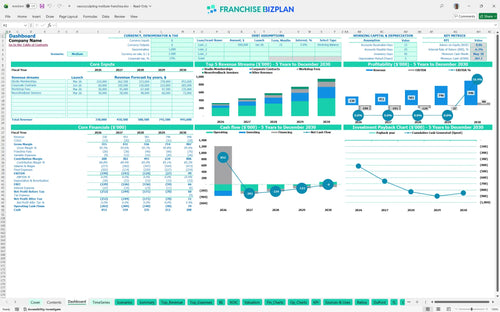
All-in-one Dashboard
Core inputs and core outputs



This franchise unit financial projection spreadsheet provides a data-driven roadmap for launching and scaling a mental fitness studio with integrated corporate wellness revenue streams.
Core inputs and core outputs
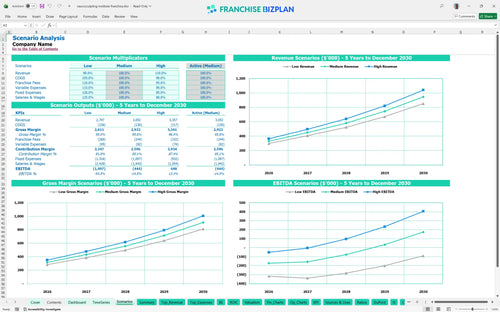
Three scenario analysis
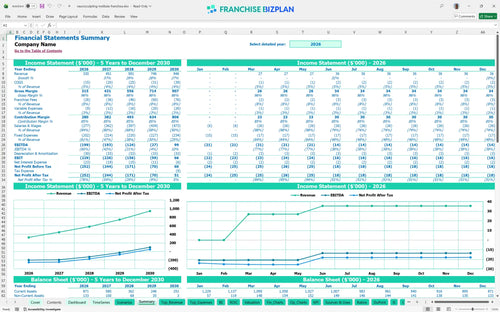
Presentation ready
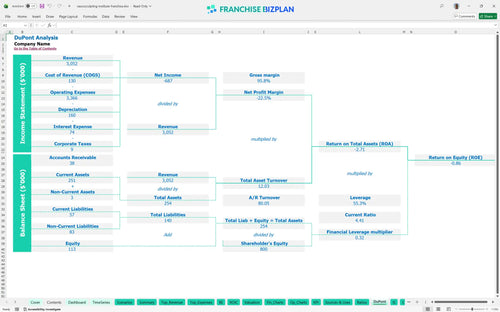
DuPont analysis
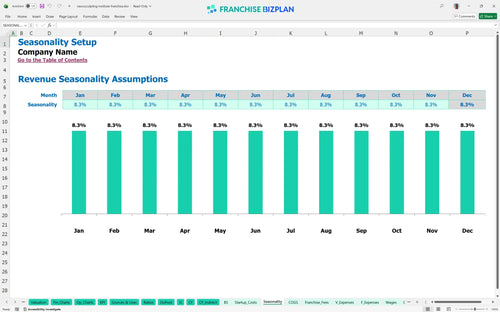
Researched revenue assumptions
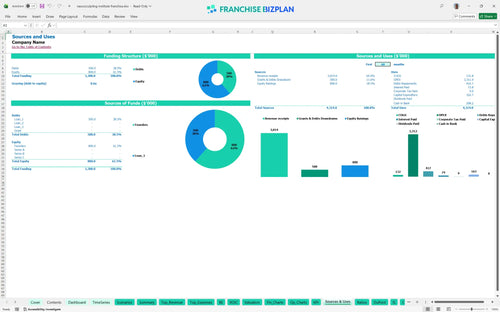
Lender-friendly financial outputs
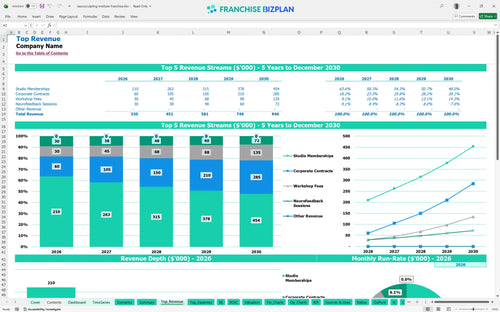
Revenue stream detailed view
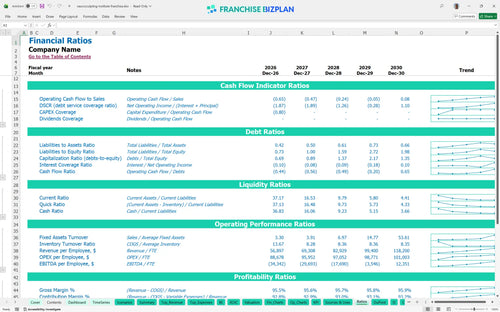
Performance metrics benchmark
We built this model using detailed research on high-end wellness operations and specialized brain-training services. Key assumptions like the $12,000 monthly rent in premium districts and the 6% royalty fee are pre-populated but fully editable to fit your specific site selection. With year 5 revenue projected at $946,000, this tool helps you navigate the 49-month path to break-even while managing a complex staffing model.
Realistically, this unit defintely takes time to mature, reaching EBITDA positivity in year 5 with a projected $99,000. You will likely face negative EBITDA for the first four years as you scale memberships and corporate contracts. Profitability depends on managing the high fixed costs of specialized facilitators and premium rent.
You need roughly $162,650 in upfront CAPEX plus a significant working capital buffer, as the lowest cash point hits $208,000 in May 2030. The total startup investment breakdown for health and wellness franchises here includes leasehold improvements and specialized sensory equipment. Most of your funds go toward the physical build-out and the tech needed for sessions.
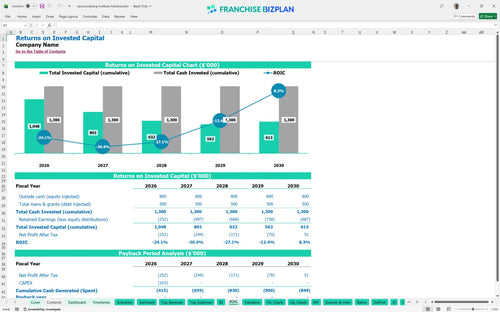
Assessing profitability for mental health service franchises shows a longer horizon here, with payback occurring after year 5. The internal rate of return (IRR) is currently modeled at -6.33% based on the initial 5-year ramp. This suggests the model is built for long-term equity growth rather than a quick cash flip.
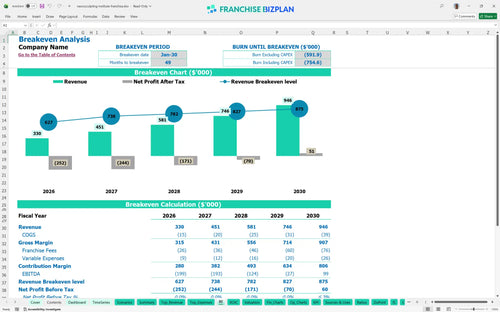
The unit hits its break-even date in January 2030, roughly 49 months after launch. To cover the $12,000 rent and $20,000+ monthly facilitator payroll, you need a high average ticket from neurofeedback sessions and steady workshop fees. Revenue forecasting for niche franchise units shows that volume is the primary lever to offset these high fixed costs.
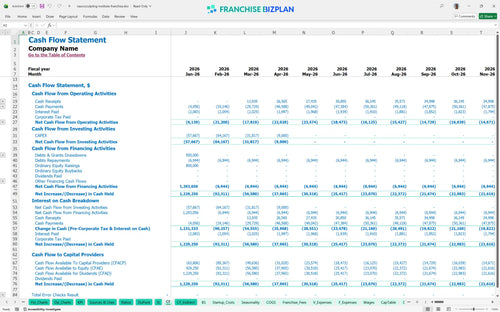
Your lowest cash point is $208,000, which occurs deep into the fifth year of operations. This indicates that the business requires a deep pocket to fund ongoing losses during the 49-month ramp-up. If corporate contract closing cycles take longer than expected, working capital pressure will rise significantly.
Moving from a medium to a high-growth scenario can pull the break-even date forward by 12+ months. The high-end wellness franchise financial feasibility study template shows that a 10% lift in membership pricing drastically improves year-1 margins. Conversely, a slow start in a premium district could extend the payback period well beyond the 5-year mark.
Finance: update unit break-even and payback model by Friday.
This franchise unit financial model template is a flexible Excel tool designed for high-end wellness studios. You can adjust pre-filled formulas and editable assumptions to match your specific territory, whether you are in a high-rent district or a suburban market. It simplifies complex unit economics so you can focus on local demand and throughput.

Planning a mental fitness studio business model requires looking past the first year of losses. This model provides a detailed 5-year outlook on revenue, costs, and cash flow, showing how a studio scaling from $330,000 to $946,000 in annual sales impacts the bottom line. It helps you see the transition from early-stage ramp-up to mature-unit performance.

Managing the 6% royalty and 2% marketing fund is critical for maintaining store-level margin. The model automatically calculates these ongoing obligations based on your revenue forecasting for niche franchise units. By tracking these fees alongside local overhead, you get a realistic view of the cash actually staying in your pocket after the franchisor takes their cut.

Use this franchise startup cost calculator to map out the initial $162,650 investment, covering everything from the $7,500 franchise fee to leasehold improvements and neurofeedback equipment. Understanding your fixed and variable cost analysis is the only way to pinpoint the exact sales volume needed to cover your $12,000 monthly rent and specialized labor. Every dollar in the build-out phase affects your eventual ROI.

This franchise unit economics spreadsheet includes benchmarks for labor and occupancy to help you sanity-check your plan. If your staffing for certified facilitators exceeds typical wellness franchise business plan ratios, the model flags it. It ensures your gross margin ranges stay competitive while you are managing operating expenses for high-end wellness studios.


Simply purchase and download the financial model template, then access it instantly using Microsoft Excel or Google Sheets. No installation or technical expertise required-just open and start working.

Enter your business-specific numbers, including revenue projections, costs, and investment details. The pre-built formulas will automatically calculate financial insights, saving you time and effort.

Leverage the investor-ready format to confidently showcase your financial projections to banks, franchise representatives, or investors. Impress stakeholders with clear, data-driven insights and professional reports.

Leverage the investor-ready format to confidently present your projections to banks, franchise representatives, or investors.