


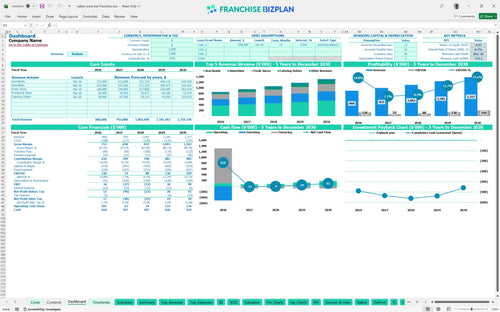
All-in-one Dashboard
Core inputs and core outputs



This comprehensive toolkit provides a pro forma for a new franchise location, including a franchise startup cost calculator and detailed food and beverage financial forecast.
Core inputs and core outputs
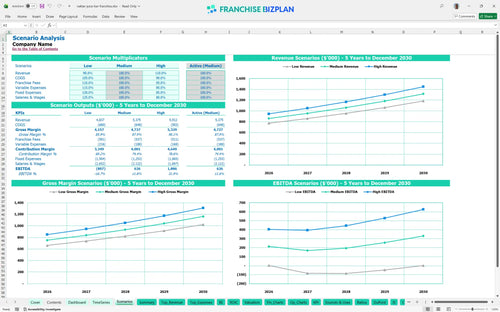
Three scenario analysis
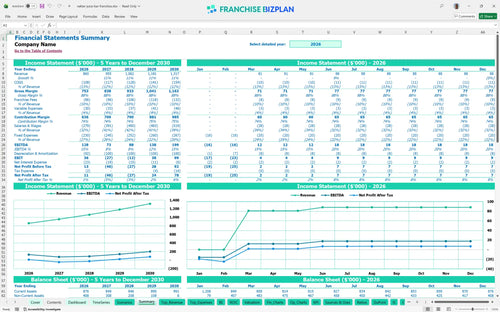
Presentation ready
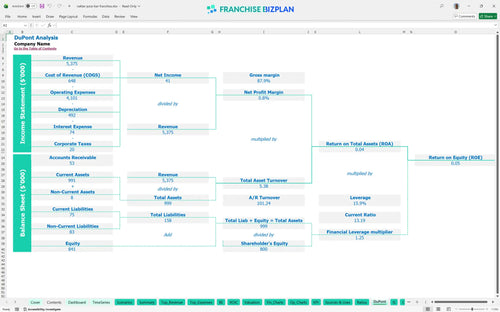
DuPont analysis
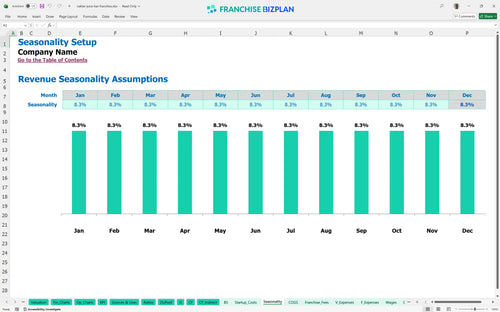
Researched revenue assumptions
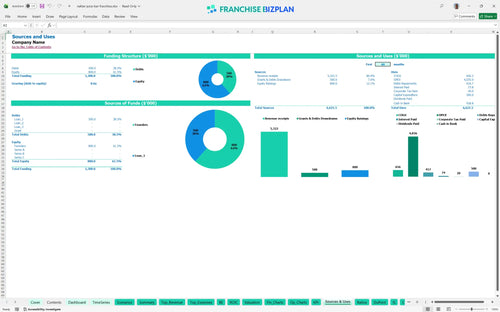
Lender-friendly financial outputs
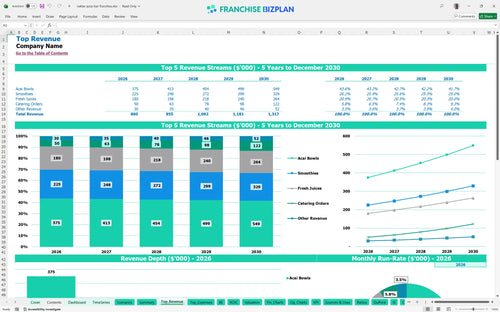
Revenue stream detailed view
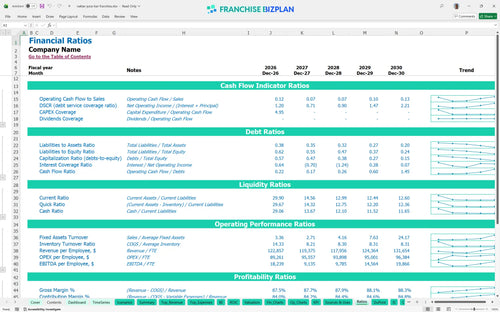
Performance metrics benchmark
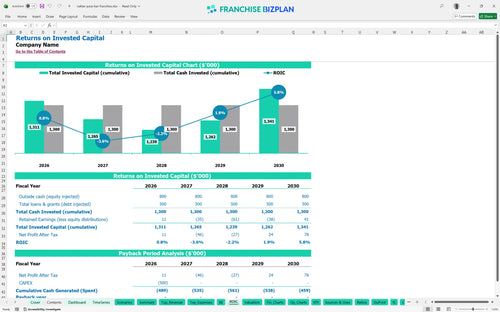
We built this franchise unit financial model using our own research to help you navigate a juice bar business plan with confidence. Key assumptions, including the $860,000 year-one revenue and 6% royalty fees, are pre-populated and fully editable to match your specific territory. This tool provides a detailed franchise profitability analysis, showing an IRR of 21% and a clear path to a $1.3 million revenue target by year five.
The unit is projected to be profitable in its first year with an EBITDA of $128,000, though net profit fluctuates as you scale the assistant manager and shift lead positions. By year five, the store-level EBITDA reaches $199,000 as you refine ingredient sourcing and benefit from the 9.2% food cost efficiency. Here's the quick math: higher volume naturally dilutes your $14,000 fixed rent over time.
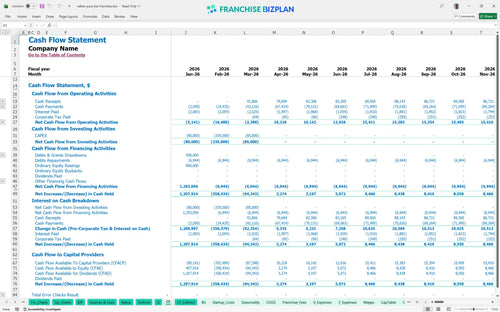
You need approximately $500,000 to launch this franchise unit in the US, covering the $35,000 initial fee and $220,000 in leasehold improvements. This model also accounts for a minimum cash buffer, showing a lowest cash point of $755,000 in March 2026 to ensure you can handle early payroll and the $14,000 monthly rent. Knowing how to calculate startup costs for a juice bar franchise is the first step to securing funding.
An investor can expect an Internal Rate of Return (IRR) of 21% and a Return on Equity (ROE) of 5% based on these projections. While the full payback of the $500,000 investment occurs after year five, the consistent cash flow and 21% IRR make this a competitive franchise investment ROI analysis template for multi-unit operators. To be fair, your actual ROI depends heavily on maintaining local density and repeat customer traffic.
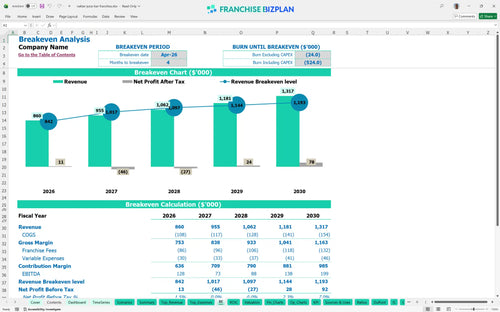
The monthly break-even point is reached in April 2026, just four months after the initial launch. This rapid transition to covering costs is driven by the high-margin nature of smoothies and acai bowls, provided you keep your crew member staffing at the initial 4.0 FTE (full-time equivalent) level. Estimating monthly operating expenses for a smoothie bar is simple when you realize labor and rent are your two biggest hurdles.
The lowest cash point occurs in March 2026, meaning you must be defintely disciplined with spending during the first 90 days of operation. You will need enough runway to cover the $14,000 rent and $1,800 in total insurance premiums before the catering revenue stream fully ramps up in June. Honestly, a six-month cash buffer is the smartest way to protect your personal liquidity during the store's infancy.
In a High scenario, increasing your average ticket through functional shot bundles can push year-one revenue well beyond $860,000. However, a Low scenario where delivery platform commissions exceed the projected 1.5% will squeeze your margins and delay the break-even date. Using financial forecasting tools for restaurant entrepreneurs allows you to see how a 10% drop in acai bowl sales impacts your ability to pay the $65,000 manager salary.
This franchise unit financial model is a fully editable Excel tool designed to help you stress-test your assumptions before signing a lease. You can adjust every formula, from revenue growth to specific labor hours, ensuring the math reflects your local market reality rather than just a corporate average. It serves as a comprehensive franchise financial model template for those who need to pivot quickly between different site selection scenarios.

Mapping out a five-year horizon is critical for understanding how a juice bar scales from a grand opening to a mature operation. This model tracks revenue climbing from $860,000 in year one to over $1.3 million by year five, allowing you to see how margin expansion actually happens as you optimize food waste and labor efficiency. It is the perfect food and beverage financial forecast for long-term strategic planning.

Managing the ongoing 6% royalty and 4% marketing fund is vital for maintaining store-level EBITDA. This tool automatically calculates these fees against your monthly sales, so you always know exactly how much cash is leaving the business before you pay your own bills. Understanding these profitability metrics for health food franchises ensures you don't get caught off guard by brand-mandated contributions.

Starting a new location requires significant upfront capital, including $220,000 for leasehold improvements and $110,000 for specialized equipment like juicers and blenders. This analysis helps you identify the exact month-estimated here at month four-when your daily sales finally cover both your fixed $14,000 rent and variable ingredient costs. Use this as your primary franchise startup cost calculator during the discovery phase.

Use built-in benchmarks to see if your 10% food ingredient cost and 2.5% packaging spend are in line with top-performing healthy fast-casual units. Comparing your projected labor spend against these standards helps you spot margin leaks before they become permanent drains on your cash flow. This is one of the best excel templates for franchise unit budgeting because it forces you to face real-world operating expenses.


Simply purchase and download the financial model template, then access it instantly using Microsoft Excel or Google Sheets. No installation or technical expertise required-just open and start working.

Enter your business-specific numbers, including revenue projections, costs, and investment details. The pre-built formulas will automatically calculate financial insights, saving you time and effort.

Leverage the investor-ready format to confidently showcase your financial projections to banks, franchise representatives, or investors. Impress stakeholders with clear, data-driven insights and professional reports.

Leverage the investor-ready format to confidently present your projections to banks, franchise representatives, or investors.